Problem Solving Strategies: 72 Self-Checking Word Problems
Most students can follow a worked example. The hard part of a word problem is the moment before that: deciding how to start. That's what problem solving strategies are for, and it's why teaching them by name pays off. When a student can say "I'll make a table" or "Let me work backward," a scary word problem turns into a plan.
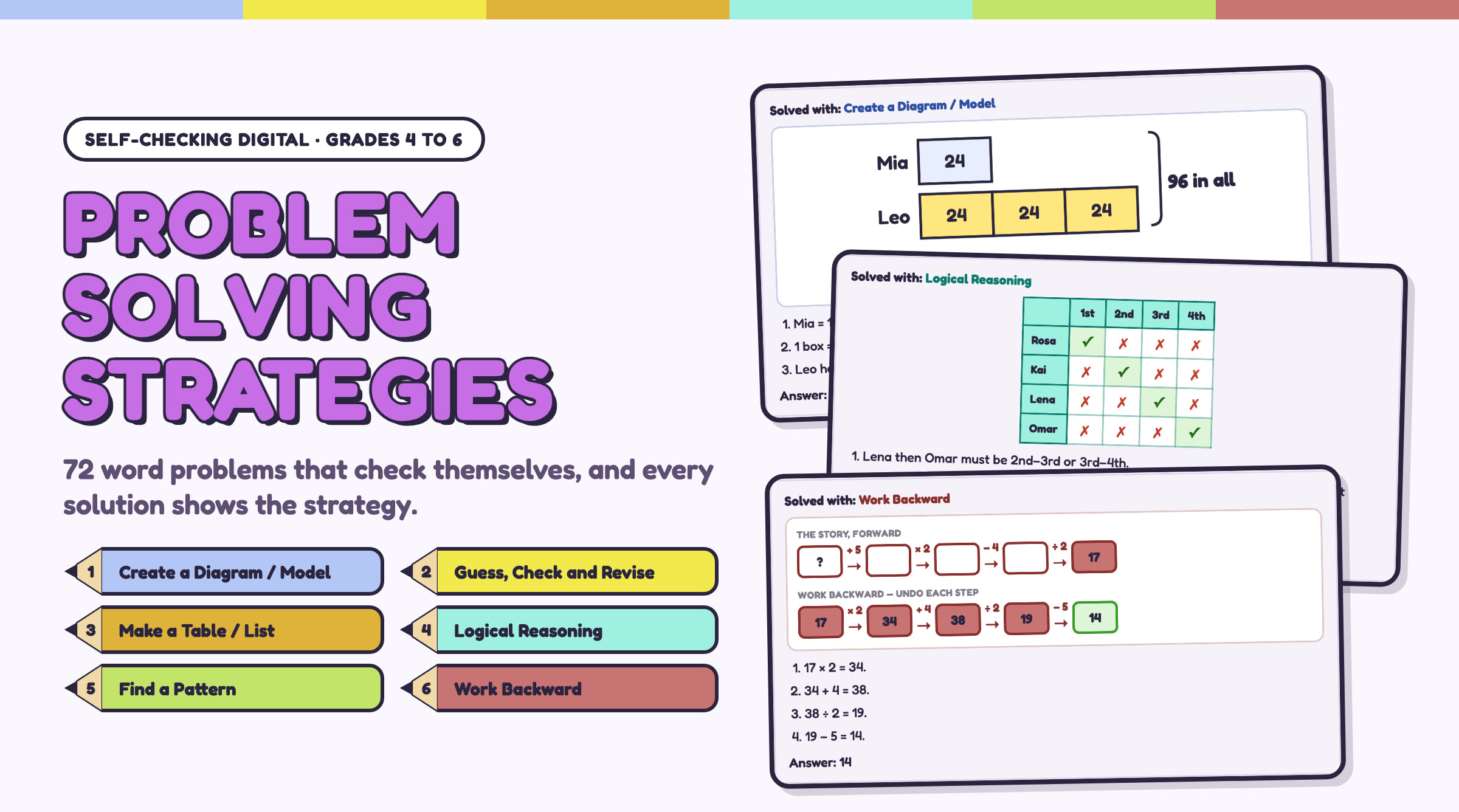
Problem Solving Strategies is a self-checking digital activity for grades 4 to 6 with 72 multi-step word problems, 12 for each of the six classic strategies. Students type their answer and get instant feedback. The best part is the worked solution, which doesn't just give the answer. It shows the strategy: table problems are solved in a table, logic problems in a logic grid, and diagram problems with a drawn diagram.
Watch it in action
It plays in any web browser. There's nothing to print, cut or laminate, and students don't need logins.
The 6 problem solving strategies
These are the six strategies on our classroom poster, and each one gets its own set of 12 problems in the game.
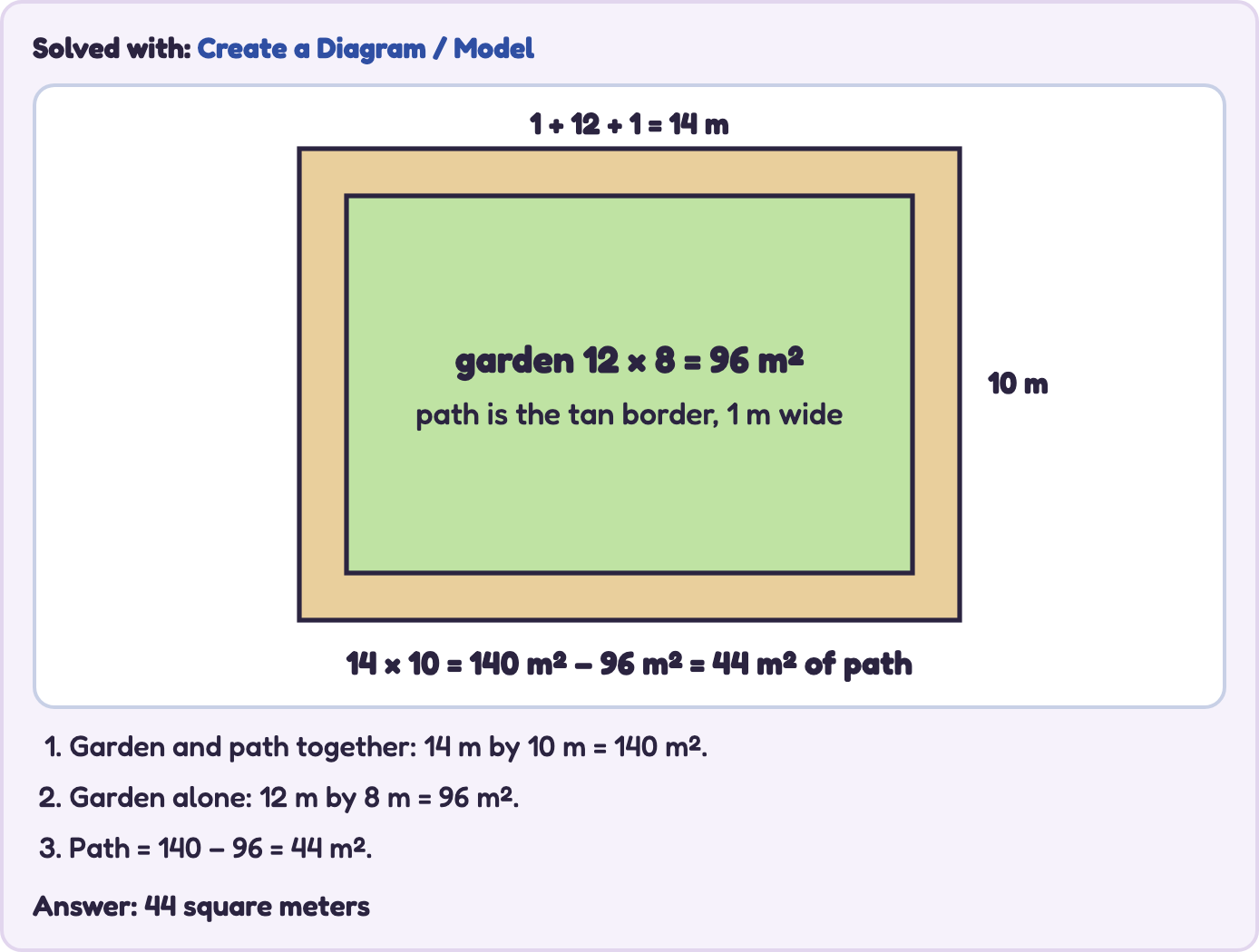
1. Create a Diagram / Model
Draw a picture, a bar model or a number line so you can see the problem. Diagrams are perfect for "3 times as many" problems, fractions of an amount, distances, and anything with posts and gaps.
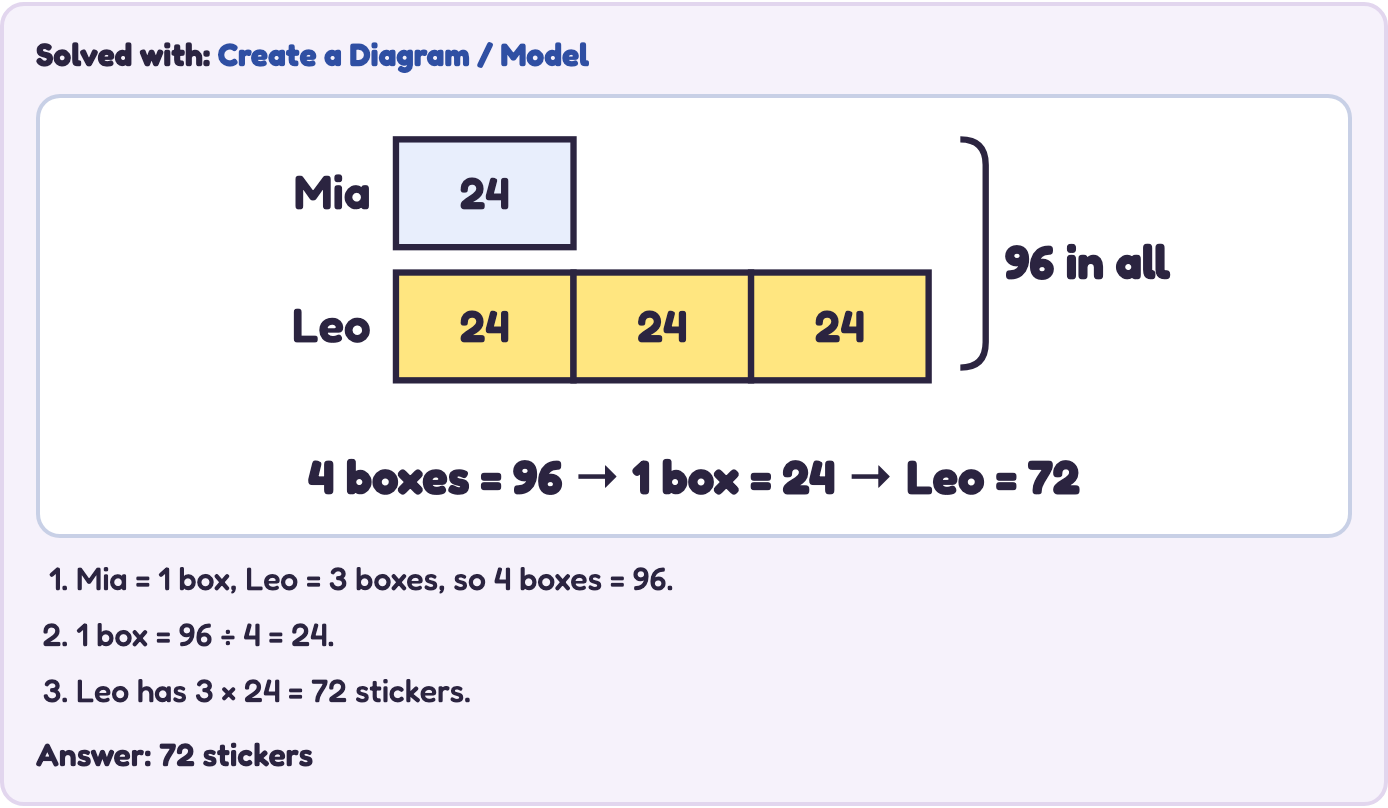
Leo has 3 times as many stickers as Mia. Together they have 96. The bar model shows 4 equal boxes make 96, so each box is 24 and Leo has 72.
2. Guess, Check and Revise
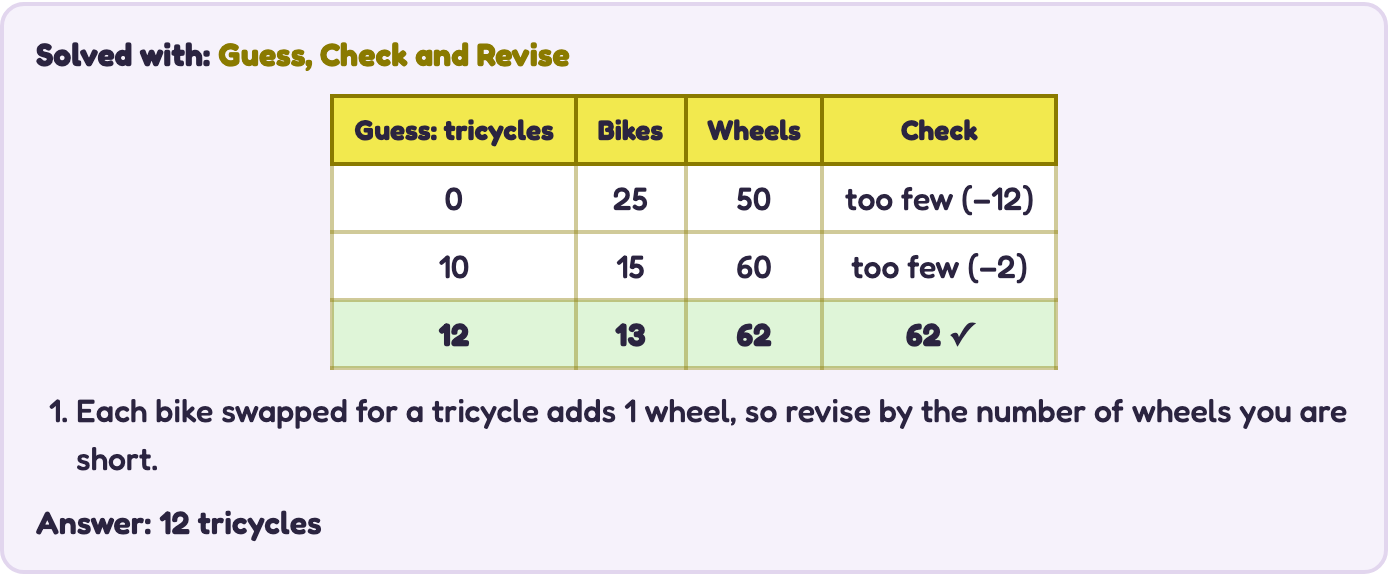
Make a sensible guess, check it against every fact, then adjust. The key word is revise: each wrong guess tells you whether to go higher or lower. Great for "heads and legs" problems, coins and tickets.
3. Make a Table / List
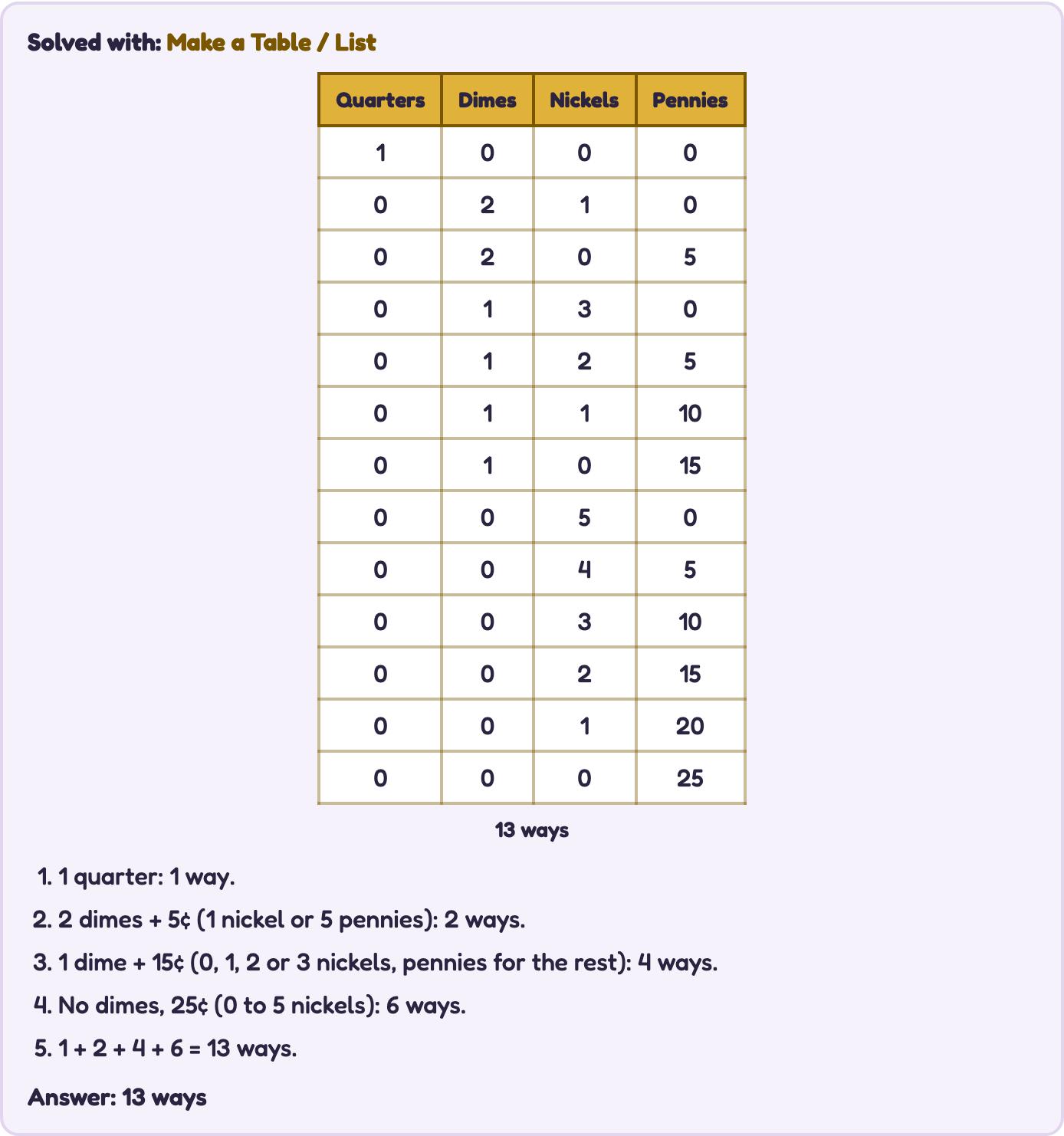
Organize the possibilities in a table or an organized list so you don't miss any. Use it for "how many ways," "when will they be equal," and ratio problems.
4. Logical Reasoning
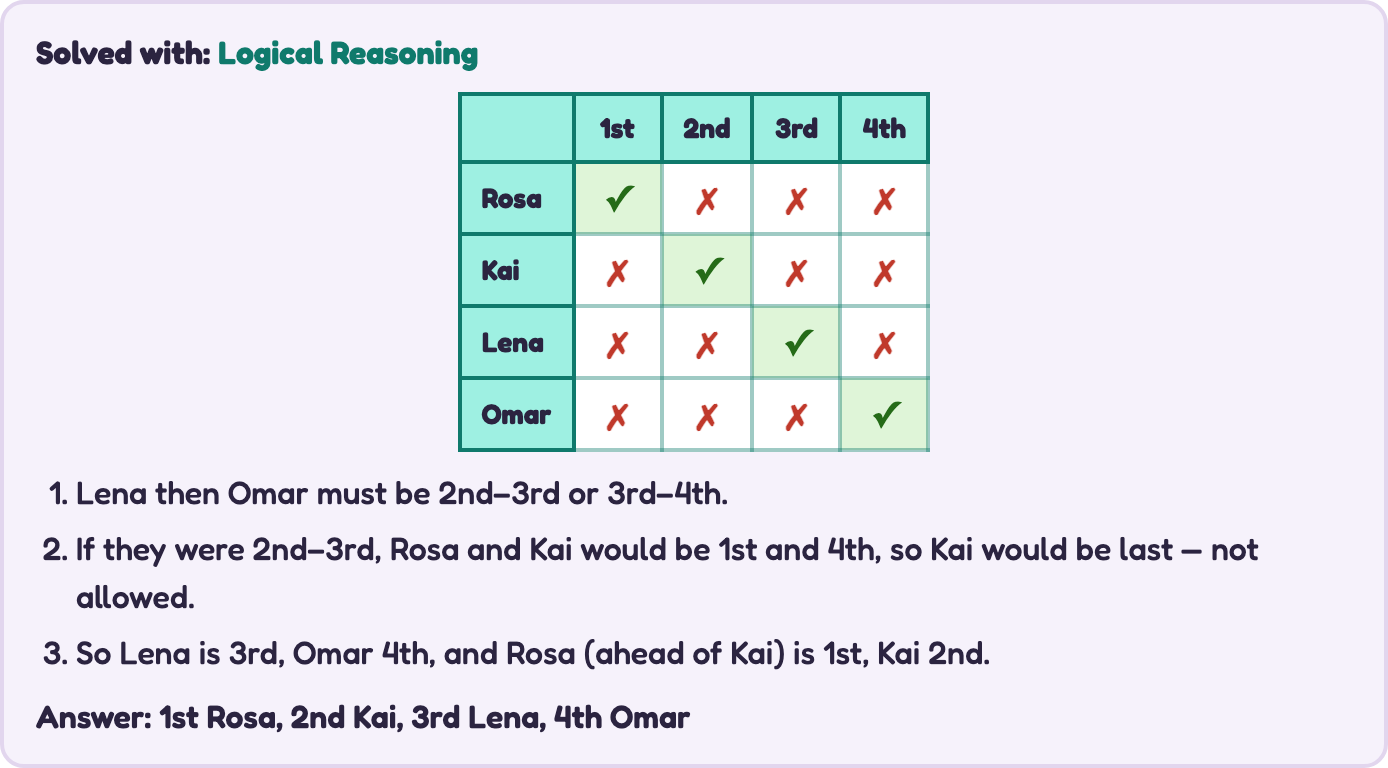
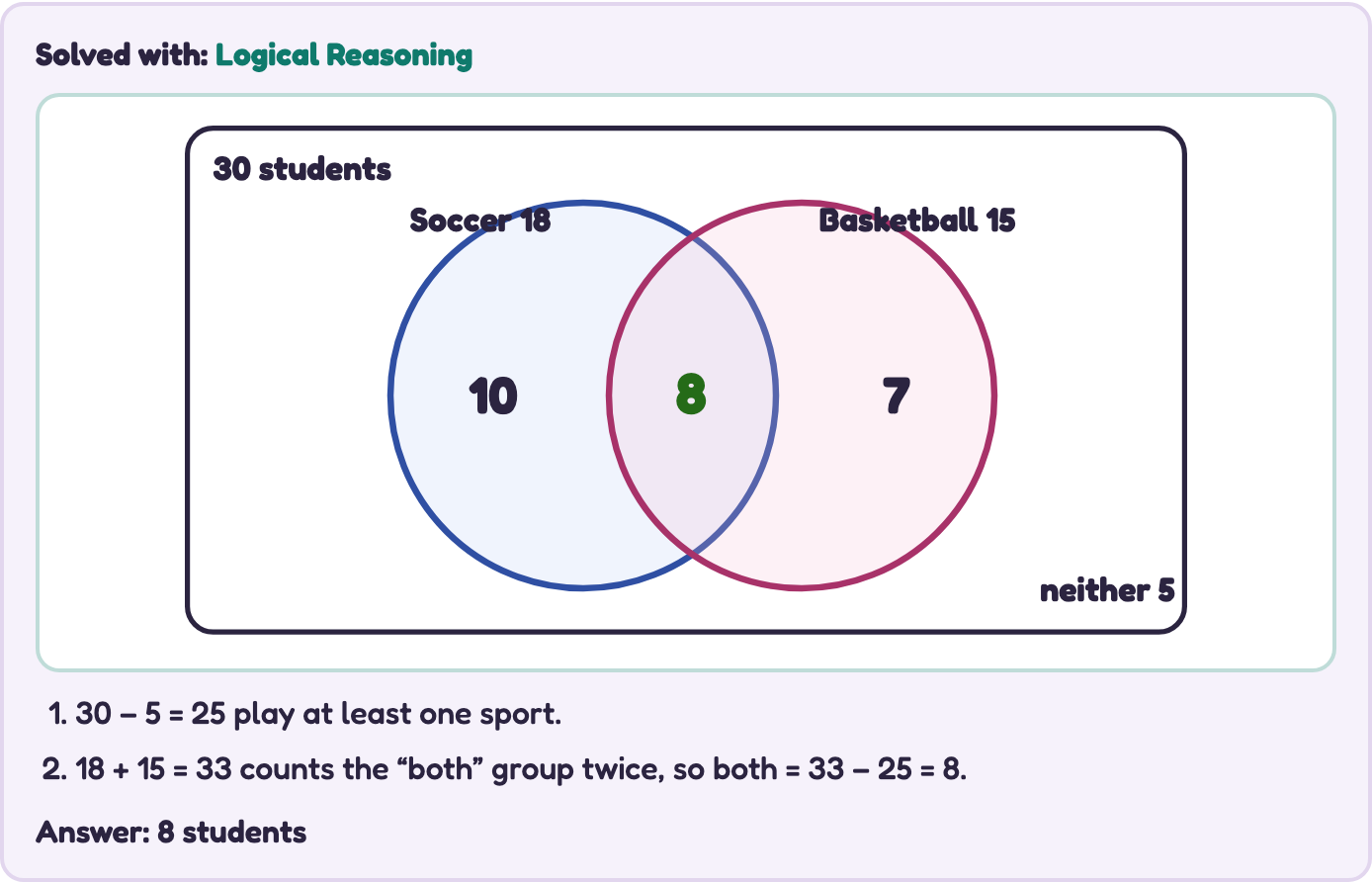
Use each clue to rule things out until only one answer fits. Logic grids, Venn diagrams and "test every candidate" tables all belong here.
5. Find a Pattern
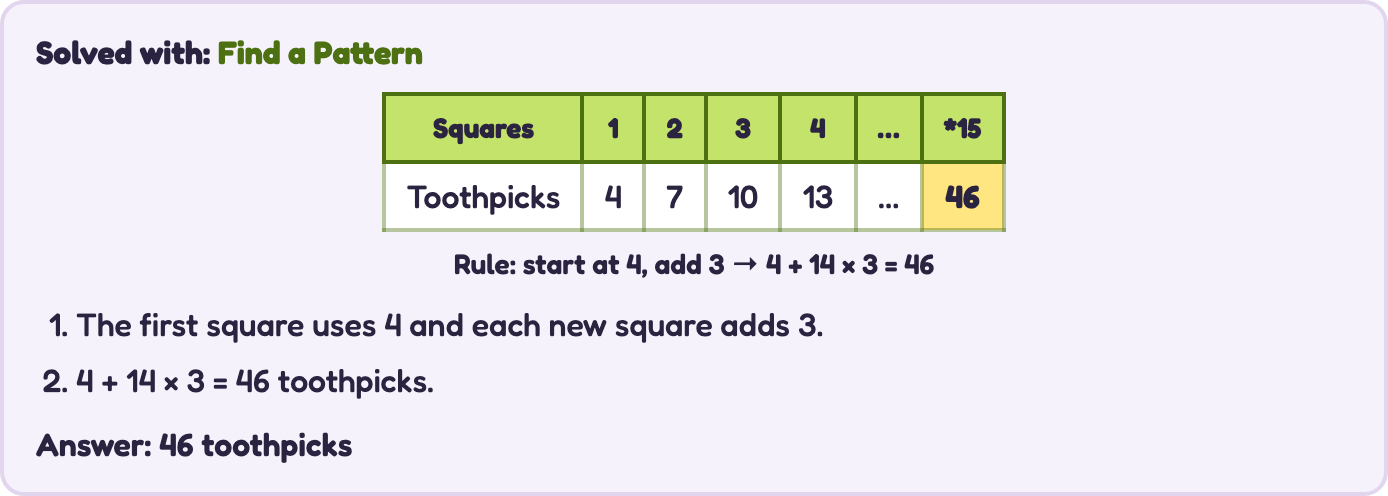
Work out the first few cases, find the rule, then extend it. Sequences, growing shapes, repeating patterns and "what's the 20th term" problems.
6. Work Backward
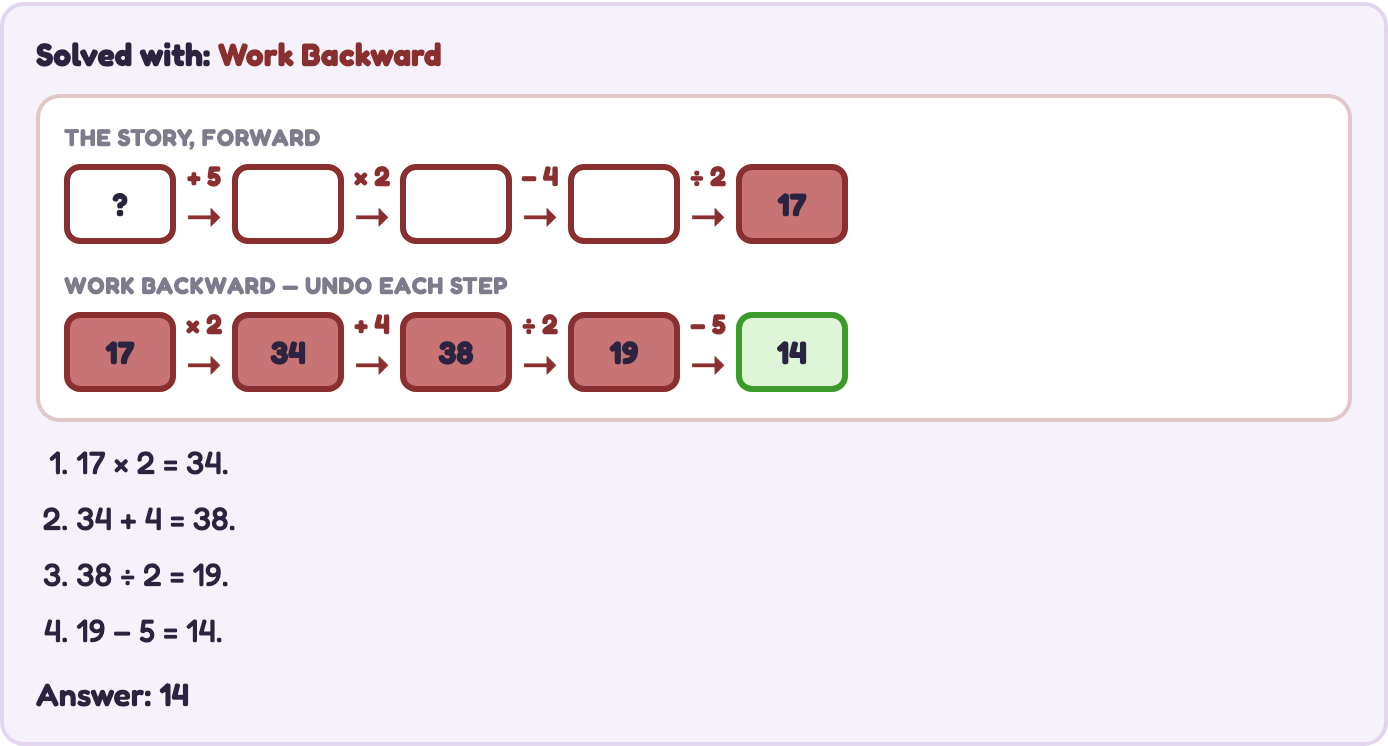
Start from the end and undo each step in reverse order: add what was subtracted, divide what was multiplied. Perfect for "how much did she start with?" and elapsed-time problems.
Try these: 6 free word problems, one per strategy
Here's one problem from each strategy to use as a warm-up or a number talk. Ask students which strategy they'd choose before they start. The answers are hidden so you can project this page.
Create a Diagram. Ruby cuts a long ribbon into 6 equal pieces. Each cut takes her 4 minutes. How long does it take her to cut the whole ribbon?
Show answer
20 minutes. Draw the ribbon: 6 pieces only need 5 cuts, and 5 × 4 = 20.
Guess, Check and Revise. A farmer has chickens and cows. Altogether the animals have 20 heads and 56 legs. How many cows are there?
Show answer
8 cows. Try 10 cows and 10 chickens: 60 legs, too many. Try 5 cows: 50 legs, too few. 8 cows and 12 chickens: 32 + 24 = 56 ✓
Make a Table / List. You roll a red number cube and a blue number cube. In how many different ways can the two numbers add up to 8?
Show answer
5 ways: (2, 6), (3, 5), (4, 4), (5, 3), (6, 2).
Logical Reasoning. Someone ate the last cookie. Amy says, "Ben did it." Ben says, "I didn't do it." Cara says, "I didn't do it." Exactly one of them is telling the truth. Who ate the cookie?
Show answer
Cara. Test each person. If Amy or Ben ate it, two statements are true. If Cara ate it, only Ben is telling the truth ✓
Find a Pattern. A necklace has beads in this repeating pattern: red, blue, blue, green, red, blue, blue, green… What color is the 50th bead?
Show answer
Blue. The pattern repeats every 4 beads, so bead 48 is green, 49 is red and 50 is blue.
Work Backward. Juan spent half of his money on a video game. Then he spent $6 on snacks. He has $9 left. How much money did he start with?
Show answer
$30. Undo the snacks: $9 + $6 = $15. Undo the half: $15 × 2 = $30.
How the game works
Pick a strategy
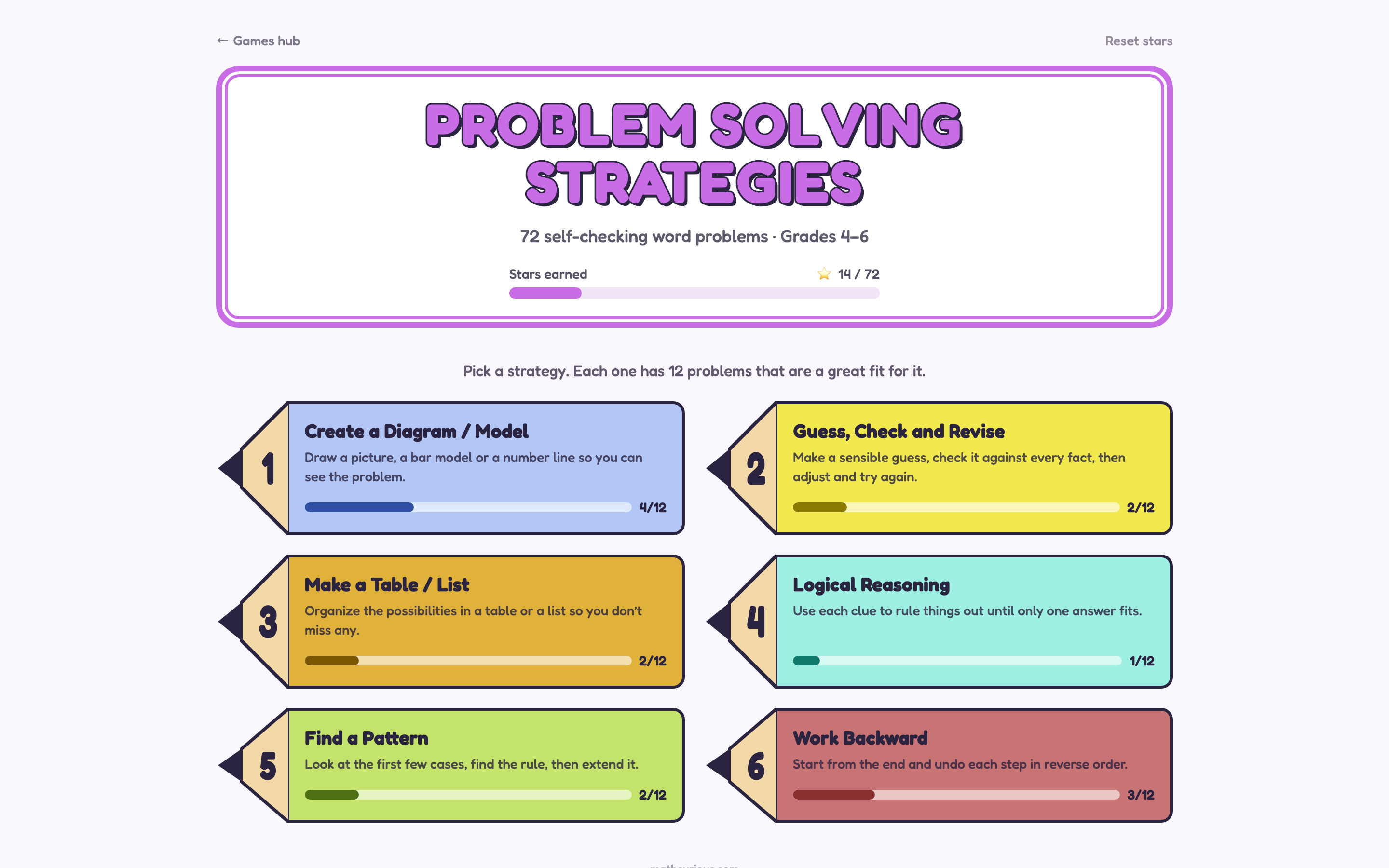
Six pencil cards, one per strategy, each with 12 problems and a star bar. Students can work through one strategy at a time, and each one picks up at the first unsolved problem.
Type the answer, any way it makes sense
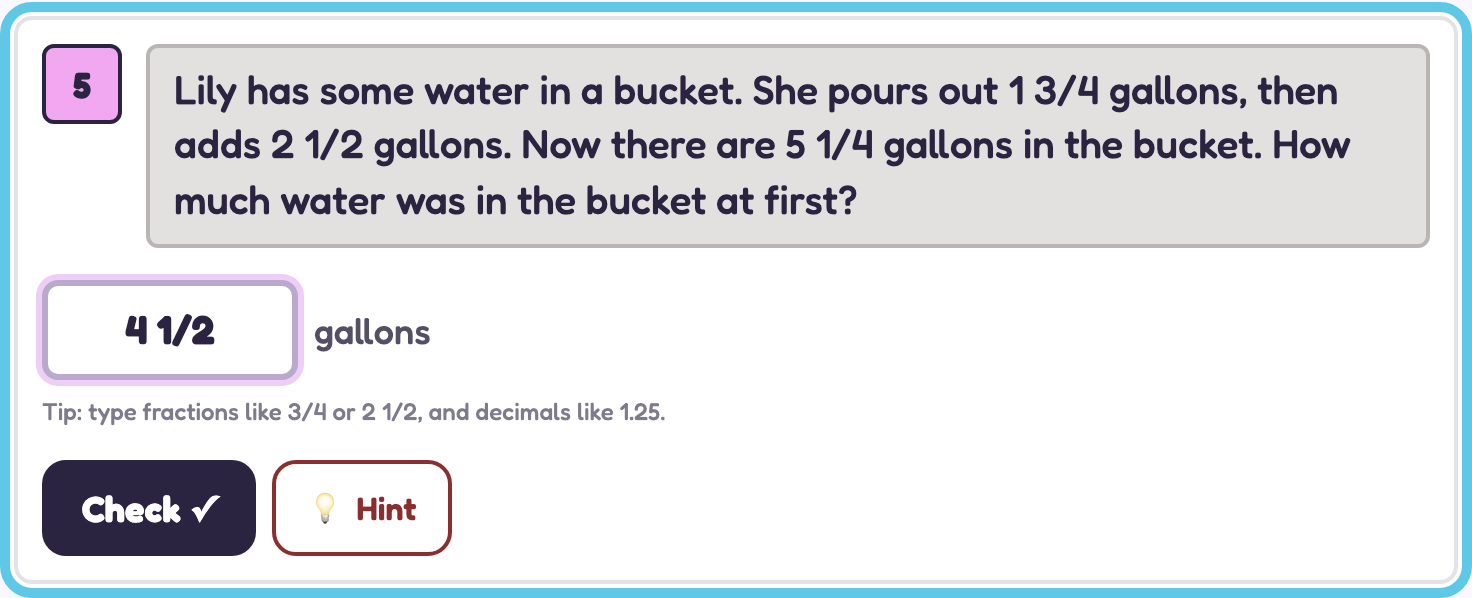
Students type whole numbers, decimals, fractions like 3/4, mixed numbers like 4 1/2, money like $1.10 and times like 2:05. Unit words are fine too ("72 stickers"). Logic problems use dropdowns for orders and matches.
Wrong? A hint for that strategy
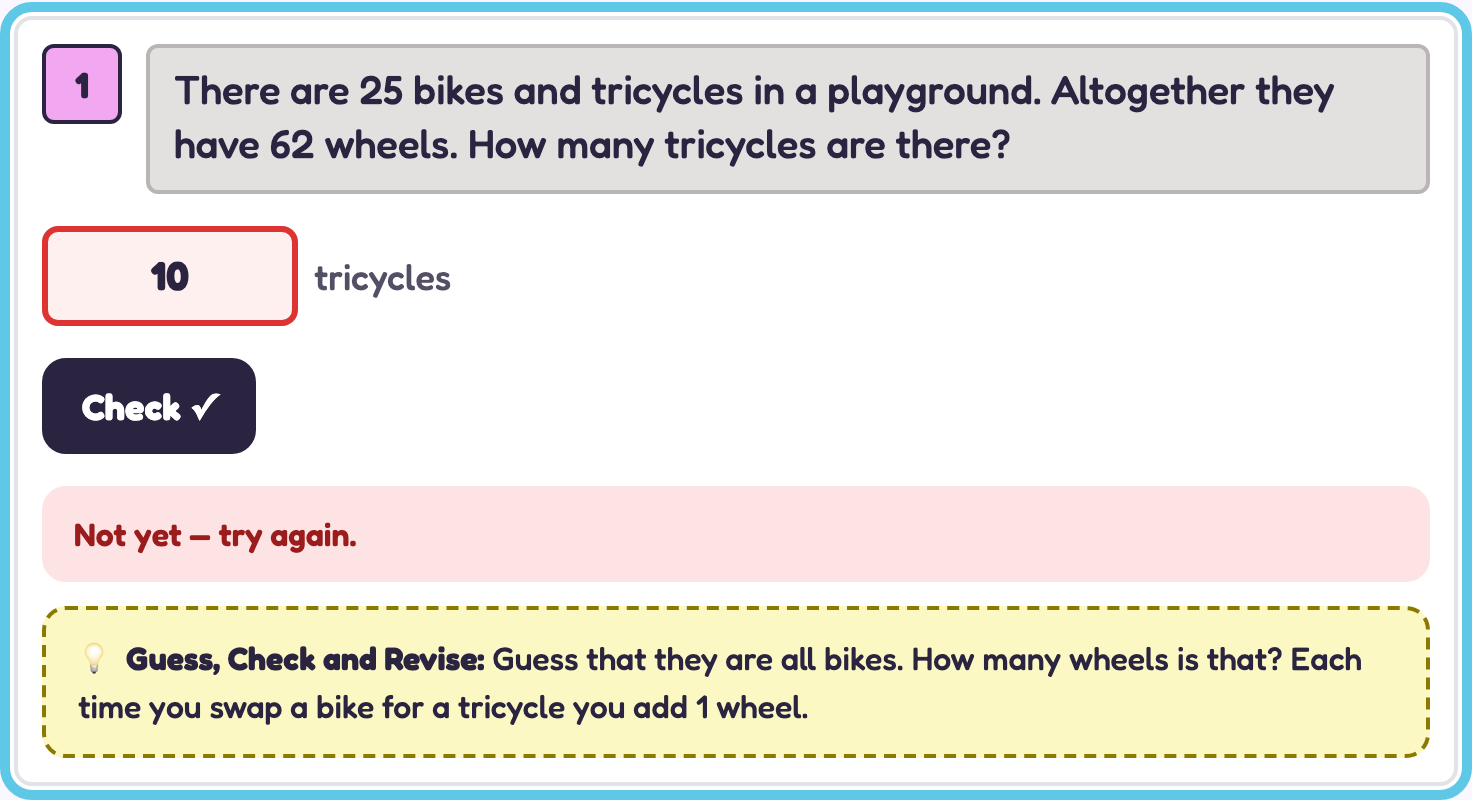
The box turns red and a hint written for that problem points students toward the strategy, without giving the answer away.
Right? A star, and the strategy solution
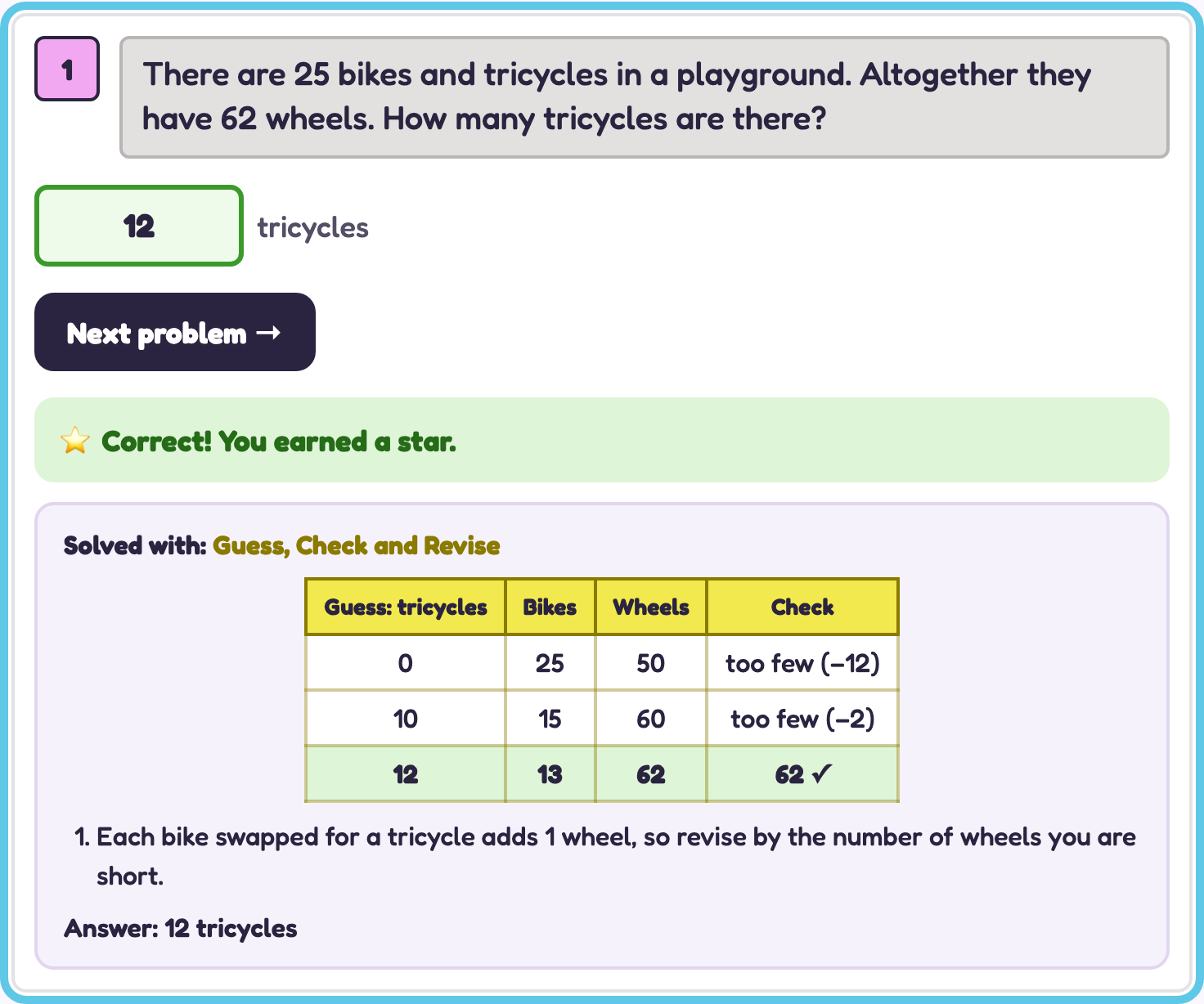
A correct answer earns a star and opens the worked solution, drawn with the strategy. Still stuck after two tries? Show solution opens it early, and students type the answer to finish. Stars only count when the problem is solved before peeking.
What's inside
- 72 original word problems, 12 for each of the six strategies
- A hint for every problem
- A worked solution that shows the strategy: diagrams, guess tables, tables and lists, logic grids, Venn diagrams, pattern tables and undo chains
- Multi-step problems with whole numbers, fractions, mixed numbers, decimals, money, time, area and perimeter
- Stars and progress saved on the device
- A teacher guide PDF with your private game link
Where it fits in your week
- Teaching the strategies one at a time. Model a strategy on the board, then let students do its 12 problems.
- Math centers and stations. One device per student or pair.
- Test prep for multi-step word problems.
- Early finishers and enrichment. Can they collect all 72 stars?
- Whole-class number talks. Put one problem on the board and ask, "Which strategy would you use, and why?"
Teaching tips
- Name the strategy first. Before anyone calculates, have students say which strategy they'll try.
- Paper alongside the screen. Ask students to sketch the diagram, table or guess chart, then compare it with the solution in the game.
- More than one way. Many problems can be solved with two strategies. The chickens and cows problem works with a table or guess and check. Talk about which is faster.
- Use "Revise" on purpose. In guess and check, ask "Was that guess too high or too low? By how much?" That's where the reasoning lives.
Standards
- MP1: Make sense of problems and persevere in solving them
- MP4: Model with mathematics
- 4.OA.A.3: Solve multistep word problems using the four operations
- 4.OA.C.5 / 5.OA.B.3: Generate and analyze patterns that follow a rule
- 4.NF.B.3d / 5.NF.A.2: Word problems adding and subtracting fractions and mixed numbers
- 4.MD.A.2 / 4.MD.A.3: Measurement, money, time, area and perimeter word problems
- 6.RP.A.3: Ratio and rate reasoning
Quick answers
Do students need accounts? No. It's a link, so there's nothing to sign in to.
What devices does it work on? Any device with a web browser, including Chromebooks, iPads and the classroom board.
What grades is it for? Grades 4 to 6. Fourth graders can start with Diagram, Table and Work Backward. The fraction and logic problems stretch fifth and sixth graders.
Do I need to check answers? No. Every problem checks itself, and the solutions are built in.
Get Problem Solving Strategies
Give students a plan for every word problem, and a solution that shows them the plan working.
Get Problem Solving Strategies on Teachers Pay Teachers
More from Math Curious
- Free the Monsters: multiplication, division and prime factorization for grades 4 to 6
- The Museum Comes to Life: a division escape room for grades 4 to 6
- 100 Monster Hunt: Level Up: times tables, factors, primes and the order of operations