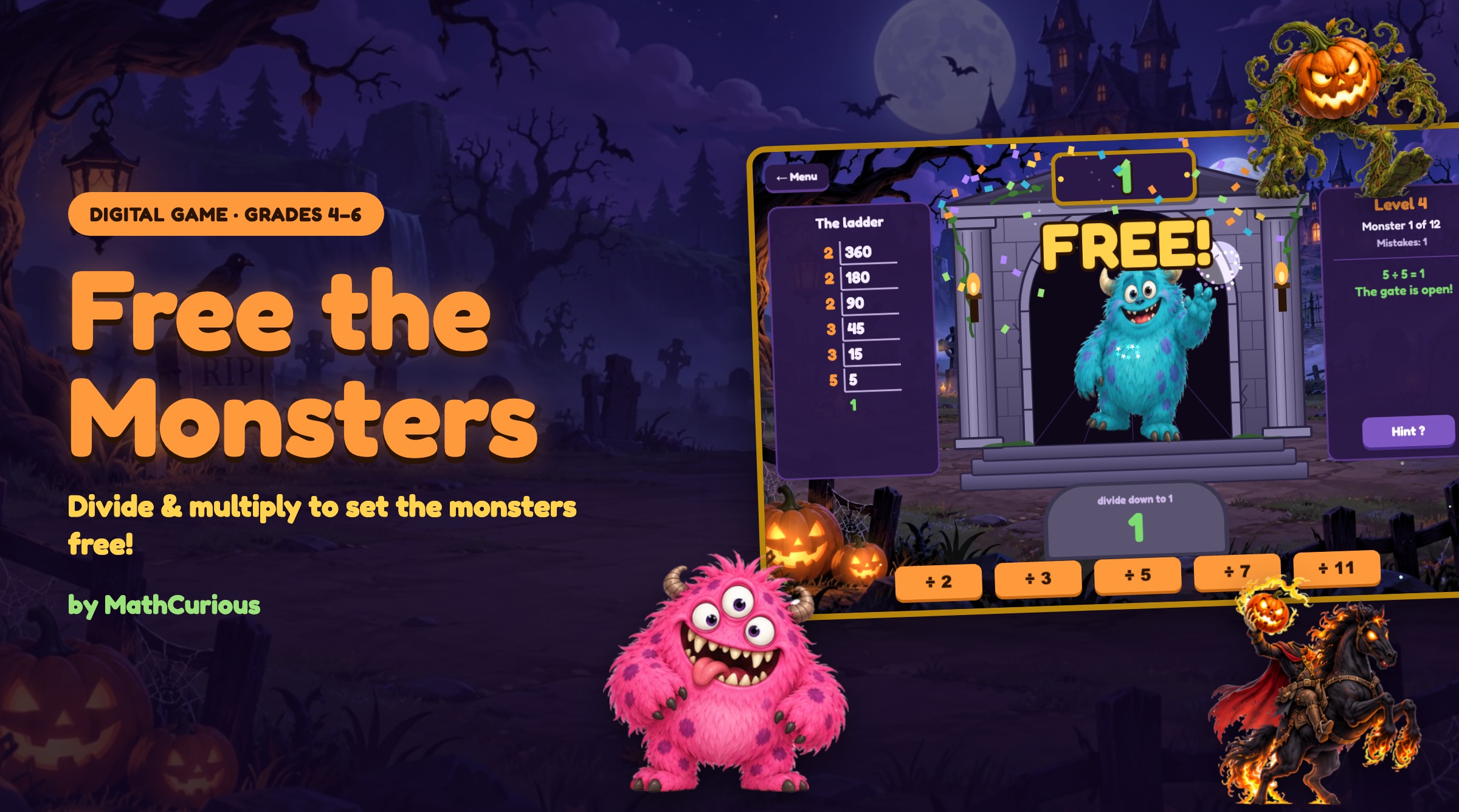
Multiplication, Division, Factorization Game - Free the Monsters
Free the Monsters gives students a fun reason to practice: every monster is locked in a crypt, and the only way to set it free is to keep dividing its number until it reaches 1.
It's a digital Halloween game for grades 3–7 that practises multiplication and division facts, divisibility, and multiples and factors, with 9 levels, more than 160 monsters and a celebration every time one breaks out.
Try it for free here
Watch it in action
The game plays in any web browser. There's nothing to print, cut or laminate, and students don't need logins.
How it works
A monster, a gate and a number
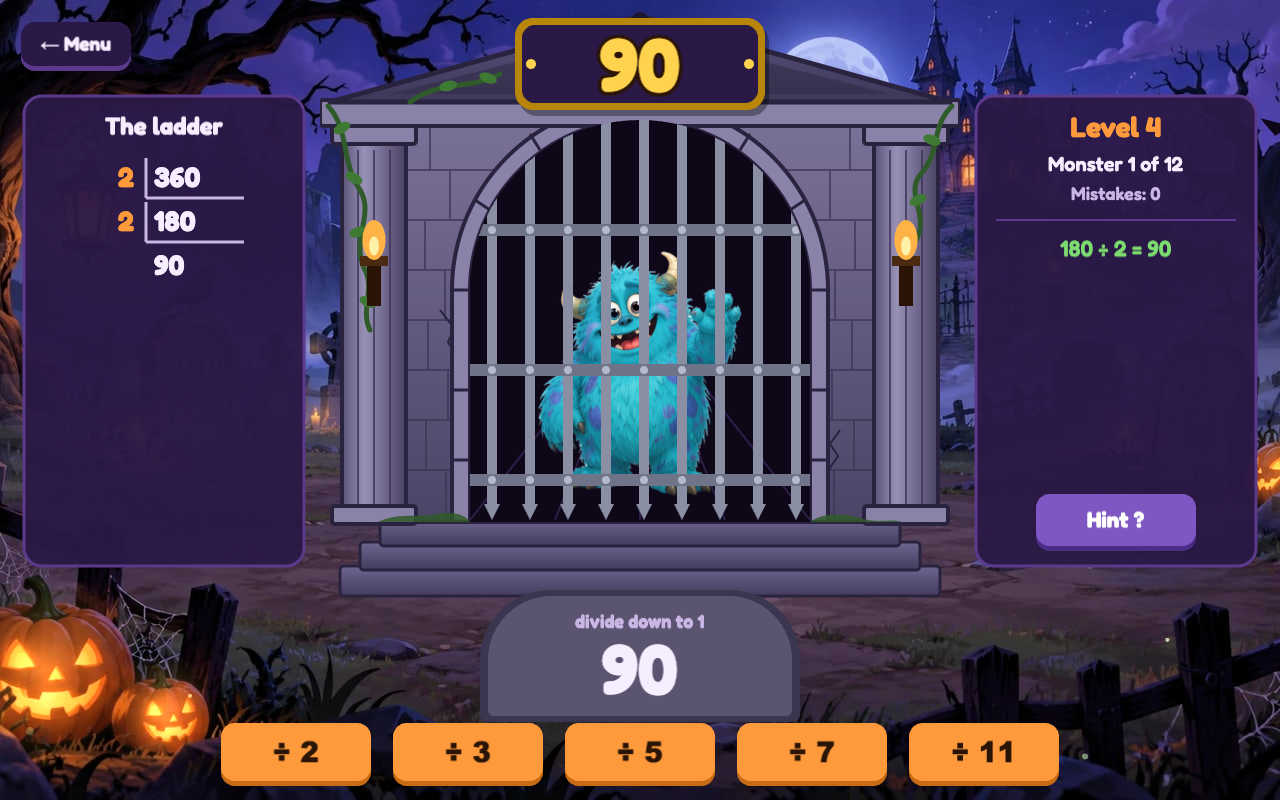
Each monster is locked behind an iron gate with a number on the sign above it. Students tap a key to divide: ÷2 to ÷12 on some levels, or ÷2, ÷3, ÷5, ÷7 and ÷11 on others. Every number that divides evenly lifts the gate, but it slams back down until the number reaches 1.
Every turn is a question about facts: does 9 go into 360? What's 180 ÷ 2? The working builds up on the left as a ladder (2 | 360, 2 | 180, 2 | 90…), so students can see each step.
Wrong choices explain themselves
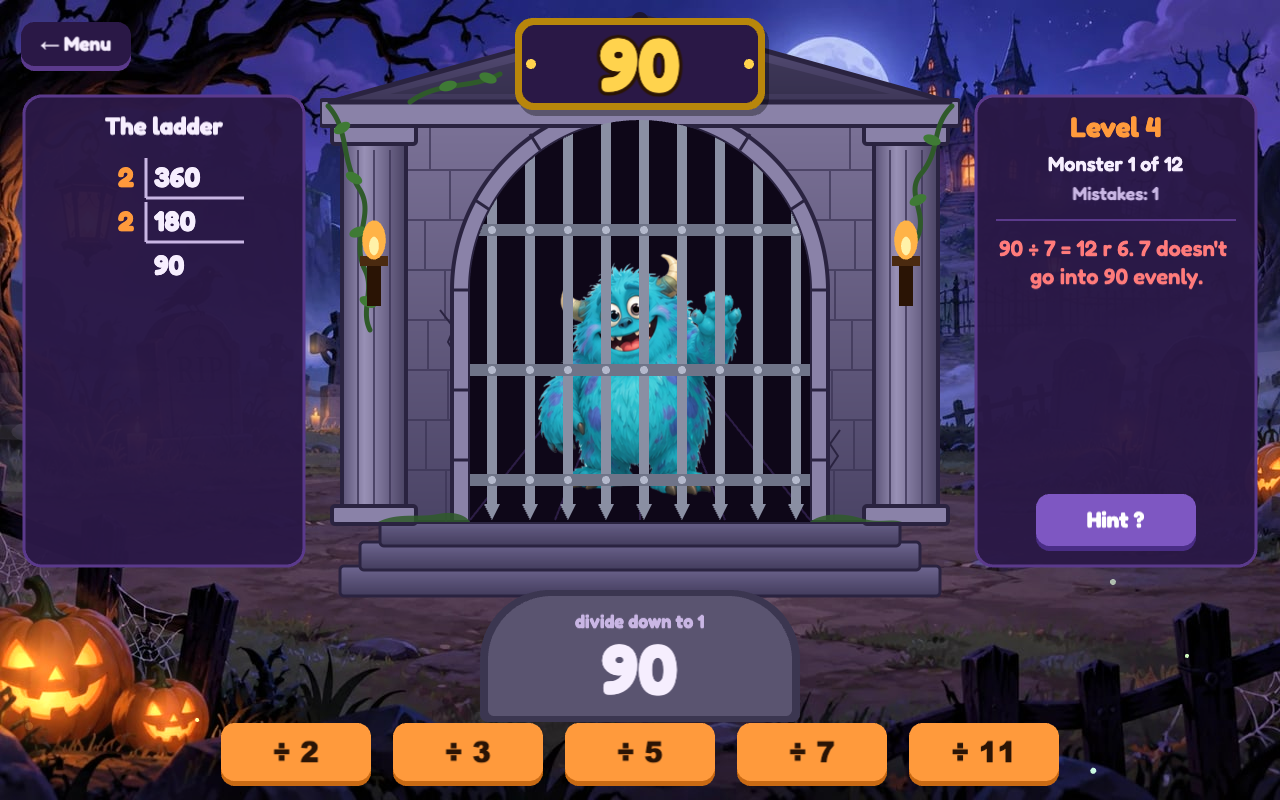
Pick a number that doesn't divide evenly and the game shows why: 90 ÷ 7 = 12 r 6. 7 doesn't go into 90 evenly. The gate stays shut and students try again. A Hint button gives a divisibility clue, such as "360 is even, so 2 goes in" or "4 + 5 = 9, a multiple of 3, so 3 goes in".
Reach 1 and the monster breaks free
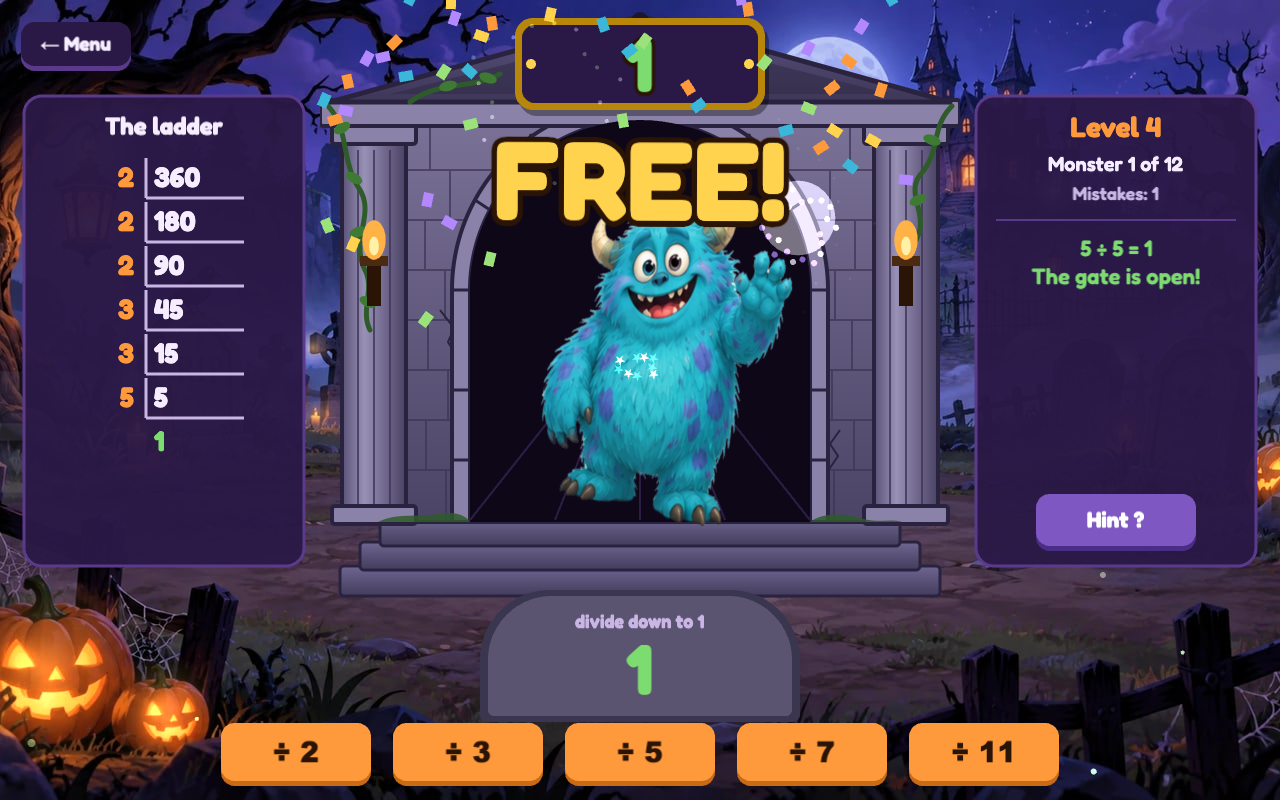
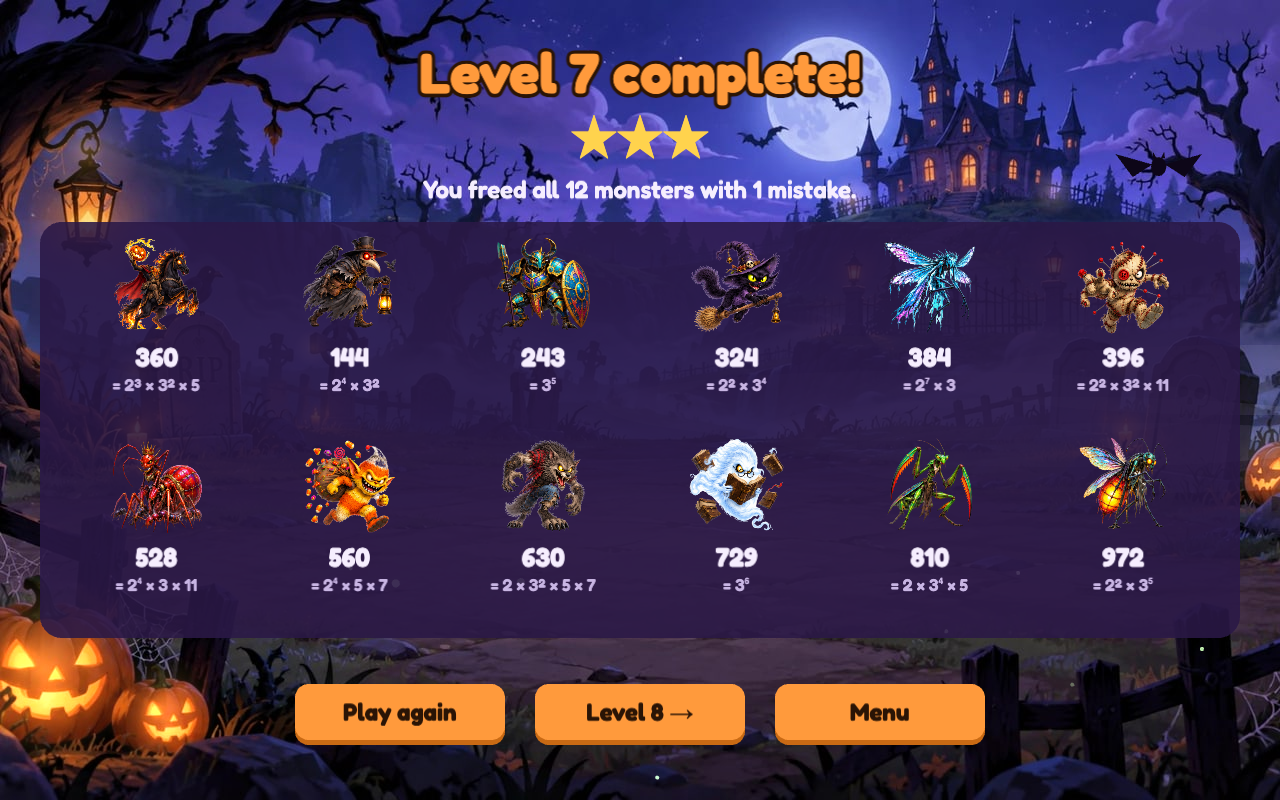
When the number gets to 1, the monster bursts out with fireworks and confetti, and does a little celebration: a bounce, a leap, a dance or a victory lap, never the same twice in a row. A card then shows how the number was built, like 360 = 2 × 2 × 2 × 3 × 3 × 5.
Fright Night: the same idea, backwards
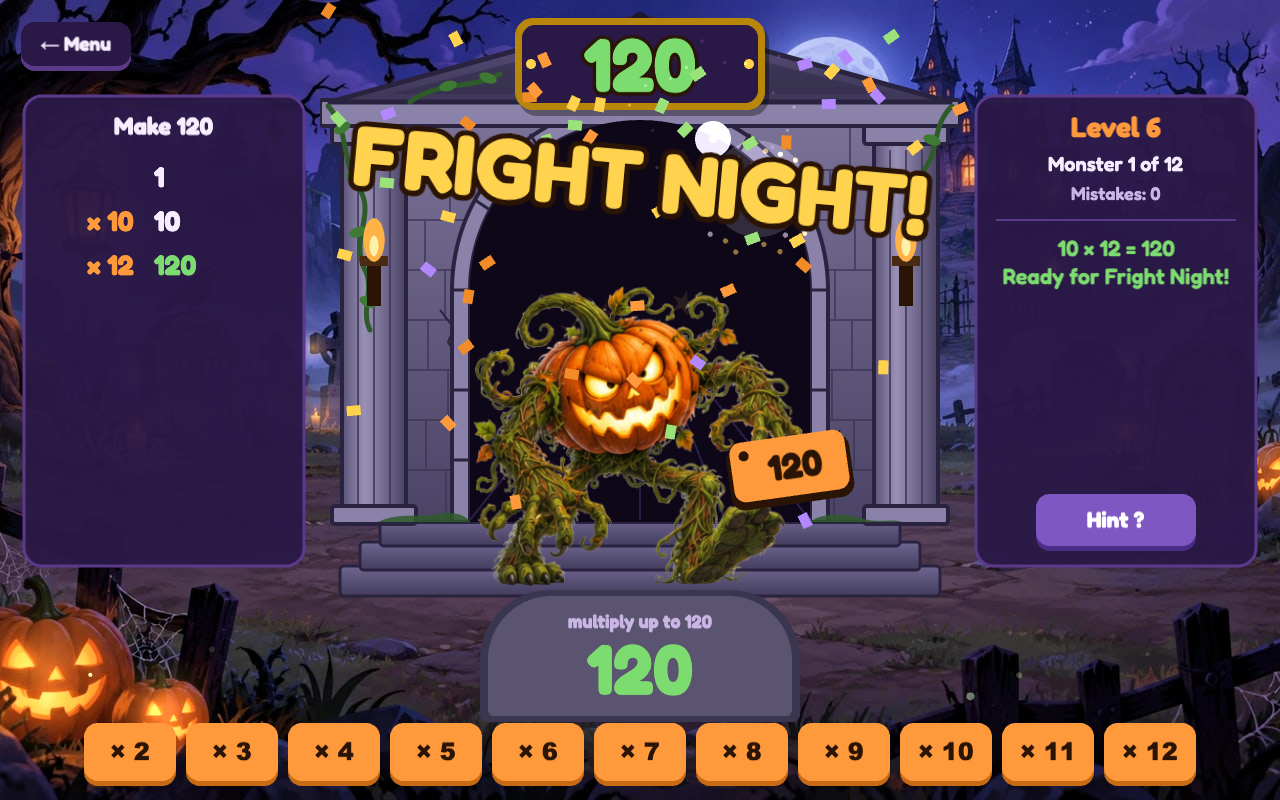
In the multiplication levels, students start at 1 and multiply up to the monster's number to get it ready for Fright Night: 1 × 10 × 12 = 120. Each step is a multiplication fact, and picking a number that isn't a factor of the target is explained the same way: 1 × 7 = 7, but 7 doesn't go into 120 evenly, so you could never reach it. Students start thinking in multiples and factors before they tap.
9 levels, two ways to play
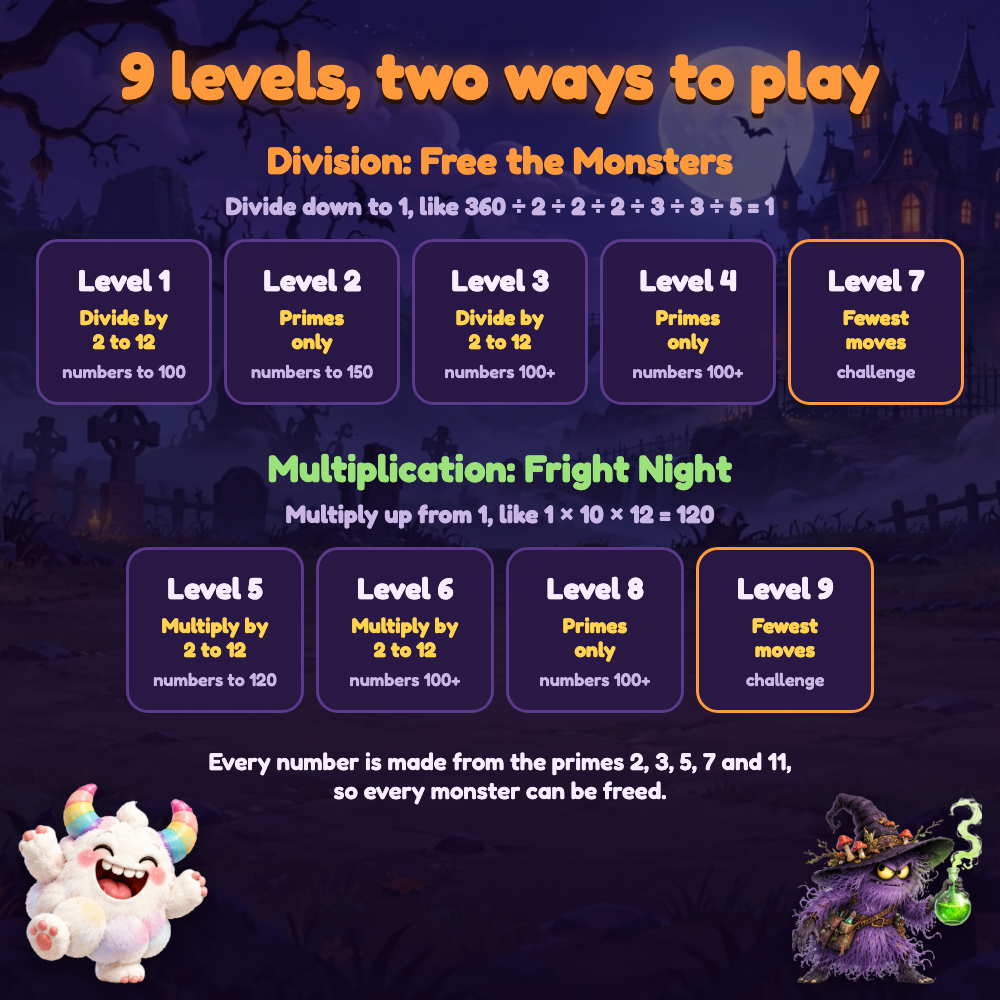
Division: Free the Monsters
- Level 1: divide by any number from 2 to 12, numbers 20 to 100
- Level 2: primes only, numbers 20 to 150
- Level 3: divide by 2 to 12, numbers 100 to 999, getting bigger as you play
- Level 4: primes only, numbers 100 to 999, getting bigger as you play
- Level 7: the challenge, dividing by 2 to 12 in the fewest possible moves
Multiplication: Fright Night
- Level 5: multiply by 2 to 12, numbers 30 to 120
- Level 6: multiply by 2 to 12, numbers 100 to 999
- Level 8: primes only, numbers 100 to 999
- Level 9: the challenge, multiplying by 2 to 12 in the fewest possible moves
The fewest-moves challenge
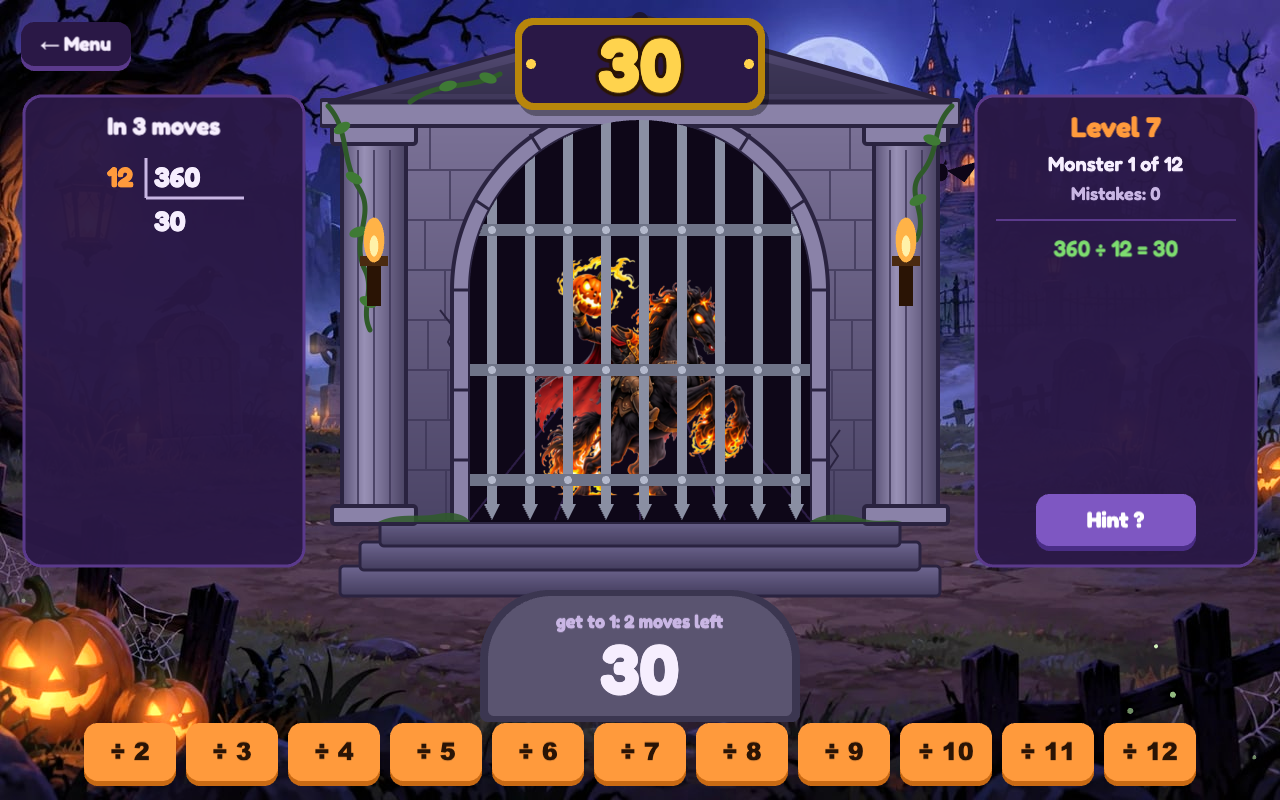
Levels 7 and 9 add a twist: free the monster in the fewest possible moves. 360 can be done in just 3 (÷12, ÷10, ÷3) instead of 6 small steps. If a move can no longer finish in time, the number goes back to the start. This is where students really start looking for the biggest factors, like 12, 10 and 9.
Every number in the game is built only from 2, 3, 5, 7 and 11, so every monster can always be freed.
More than 160 monsters
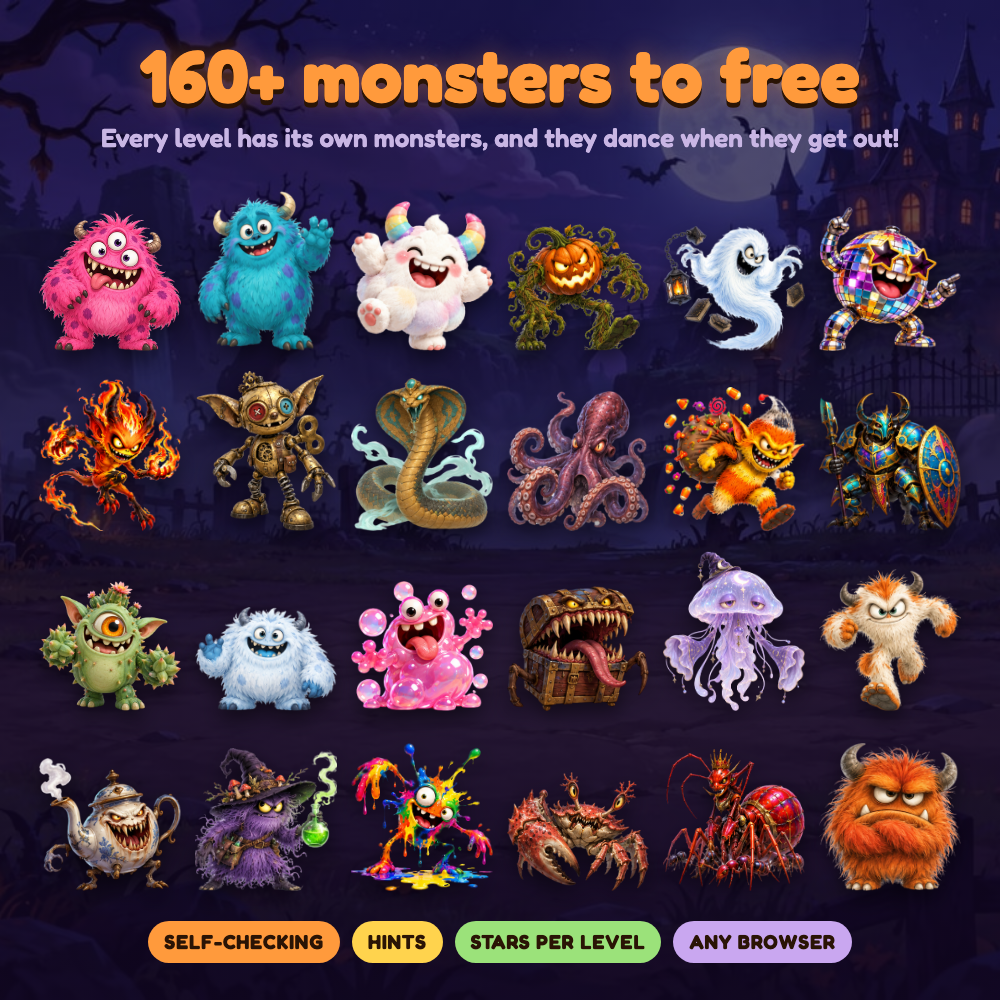
Every level has its own set of monsters: fuzzy monsters, haunted teapots and treasure chests, Egyptian mummies, sea creatures, elementals, creepy carnival toys and Halloween classics. Each level deals 12 at random, so it's a different line-up every time. Finish a level and all 12 line up on the results screen with your stars.
What students practise
- Division facts and dividing 2- and 3-digit numbers by 2 to 12
- Multiplication facts to 12 × 12, and multiplying up to 3-digit numbers
- Divisibility rules for 2, 3, 5, 10 and more, with hints when students need them
- Multiples and factors: which numbers go into 360, and which don't
- Primes in the primes-only levels
- Strategy: using the biggest factors to finish in the fewest steps
Where it fits in your week
- Halloween math in October, and factor practice the rest of the year.
- Math centres and stations. One device per student or pair.
- Whole class on the board. Students vote on the next divisor before you tap.
- Early finishers. Can they earn three stars on every level?
- Fact fluency and review for multiplication, division, multiples and factors.
Teaching tips
- Start with Levels 1 and 5 as a warm-up, then move to the primes-only levels.
- Say the fact out loud. Before tapping, students say the division fact: "360 divided by 2 is 180".
- Talk divisibility. When the Hint appears, ask how you could tell without dividing: is it even? Do the digits add to a multiple of 3? Does it end in 0 or 5?
- Compare paths. In Levels 1 and 3, any number from 2 to 12 is allowed. Who freed the monster in the fewest steps, and why?
- Connect the two directions. Freeing 120 by dividing and getting 120 ready by multiplying use the same factors. Multiplication and division are two sides of the same fact.
Standards
- 3.OA.C.7: Fluently multiply and divide within 100
- 4.OA.B.4: Find factor pairs, recognise multiples, and determine whether a number is prime or composite
- 4.NBT.B.6: Find whole-number quotients with up to four-digit dividends and one-digit divisors
- 5.NBT.B.6: Find whole-number quotients with up to four-digit dividends and two-digit divisors
Quick answers
Do students need accounts? No. It's a link, so there's nothing to sign in to.
What devices does it work on? Any device with a web browser, including Chromebooks and the classroom board.
What grades is it for? Grades 4–6. Levels 1 and 5 work well for strong third graders too.
Is it only for Halloween? The theme is spooky, but the maths is year-round multiplication, division and factor practice.
Get Free the Monsters
Give students a monster to rescue and a reason to use every fact, and multiplication and division practice stops being a worksheet.
Get Free the Monsters on Teachers Pay Teachers
More from Math Curious
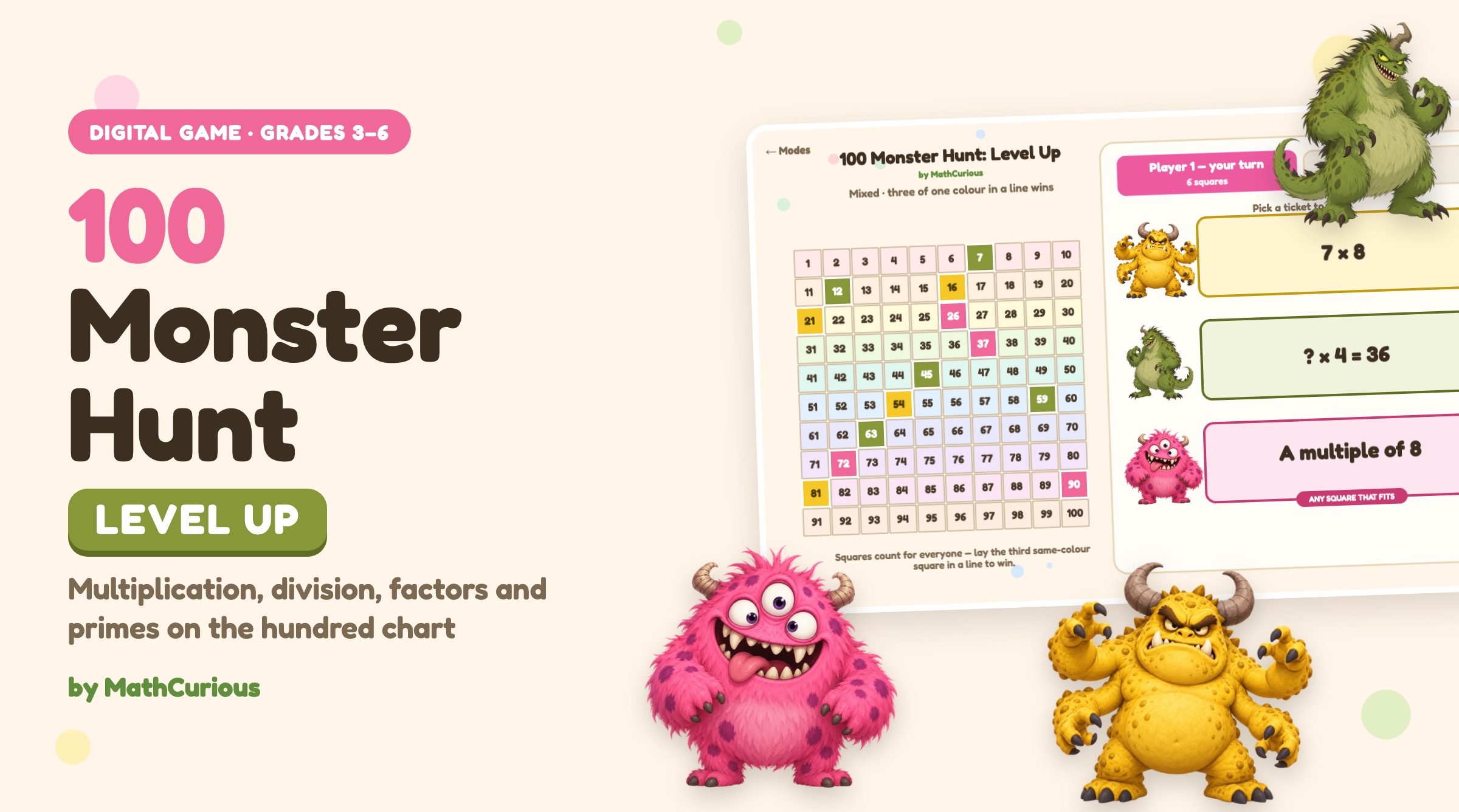
- 100 Monster Hunt: Level Up: multiples, factors and primes on the hundred chart
- 100 Monster Hunt: a hundred chart game for grades 1–3