Multiplication Facts Practice: 84 Self-Checking Slides with Wheels, Mazes and Puzzles
Multiplication Facts Practice is a self-checking digital activity for building multiplication fact fluency the meaningful way: with strategies, patterns and puzzles instead of endless drills. Its 84 slides go from halving and doubling to spinning multiplication wheels, multiples mazes and number-crosses. Students solve right on the slide, press Check, and find their own mistakes.
It's the digital Self-checking version of our Multiplication Facts Activities google slides, print task cards, and worksheets with extra skip counting slides and eight new multiplication wheels.
Watch it in action
It runs in any web browser. There's nothing to print, cut or laminate, and students don't need logins.
Strategies first
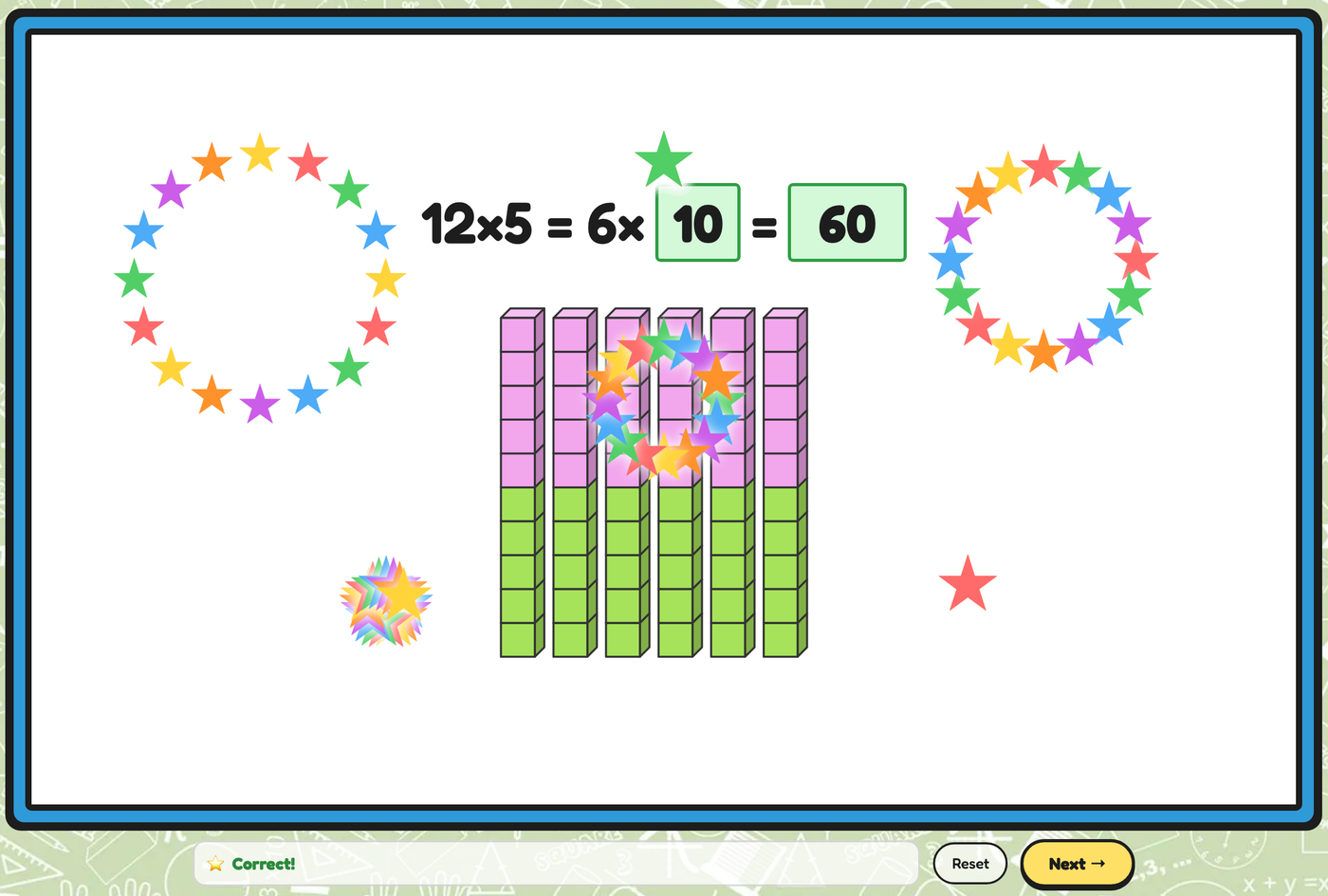
The first slides teach the strategies that make facts easier to remember. Students type the missing numbers and press Check:
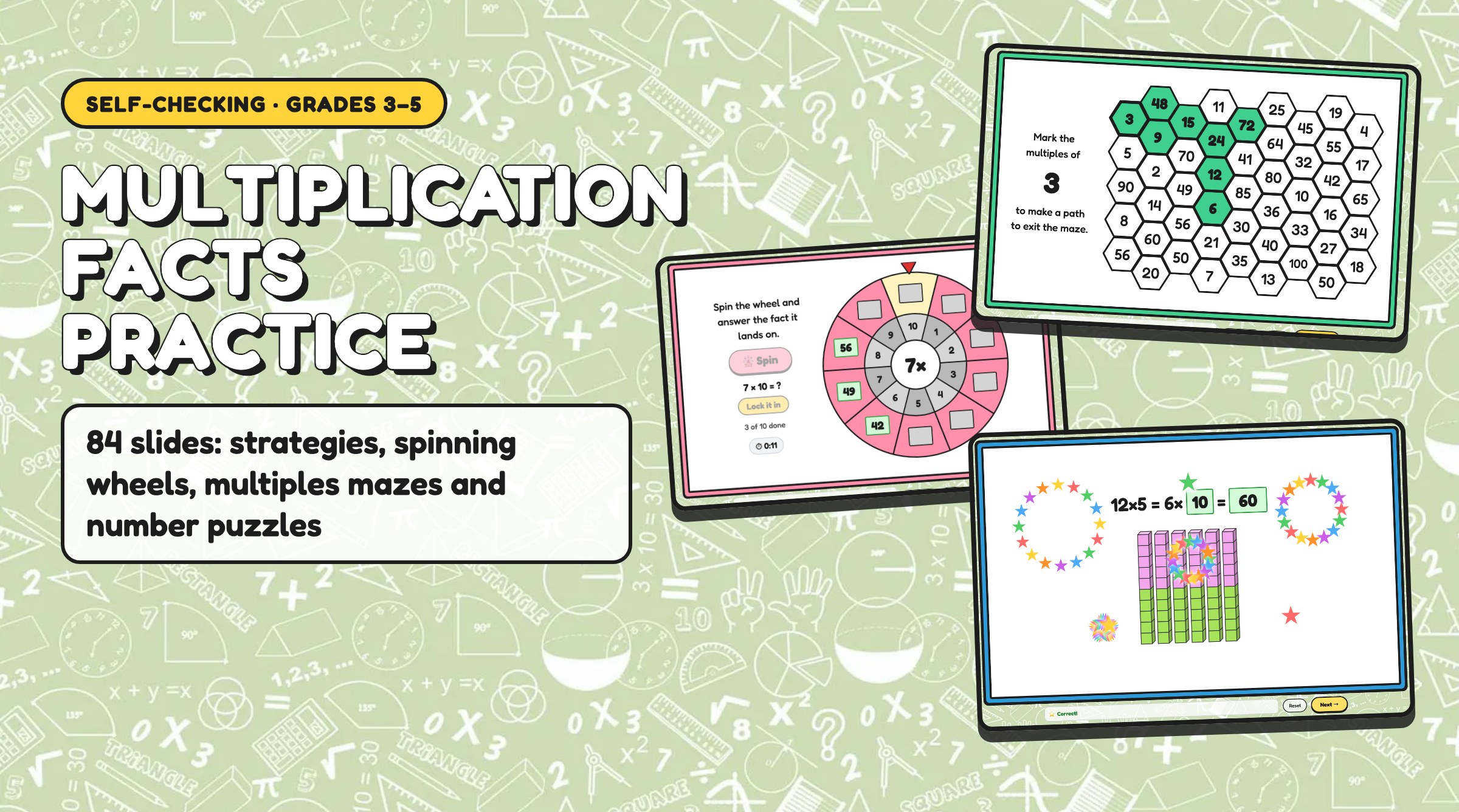
- Halve and double: 12 × 5 is the same as 6 × 10.
- Split a factor: 7 × 12 = (7 × 10) + (7 × 2). Any split that adds up to 12 counts.
- Nines from tens: 4 × 9 = (4 × 10) − 4, with the last cube of each rod crossed out.
- Square numbers as anchors: 8 × 7 = (7 × 7) + 7.
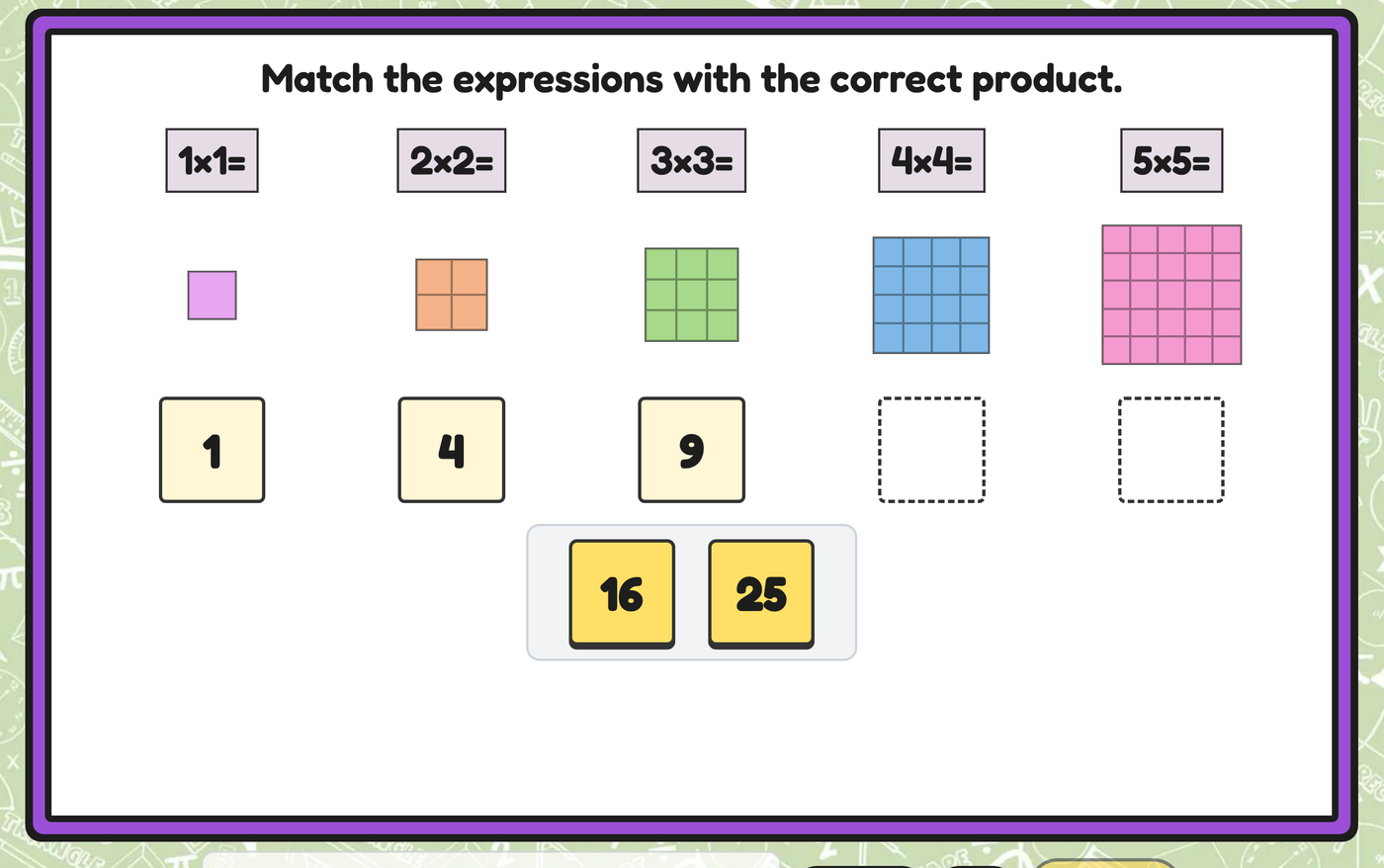
Before the square-number strategies, students match square pictures to their products by dragging number tiles into place.
Skip counting that grows
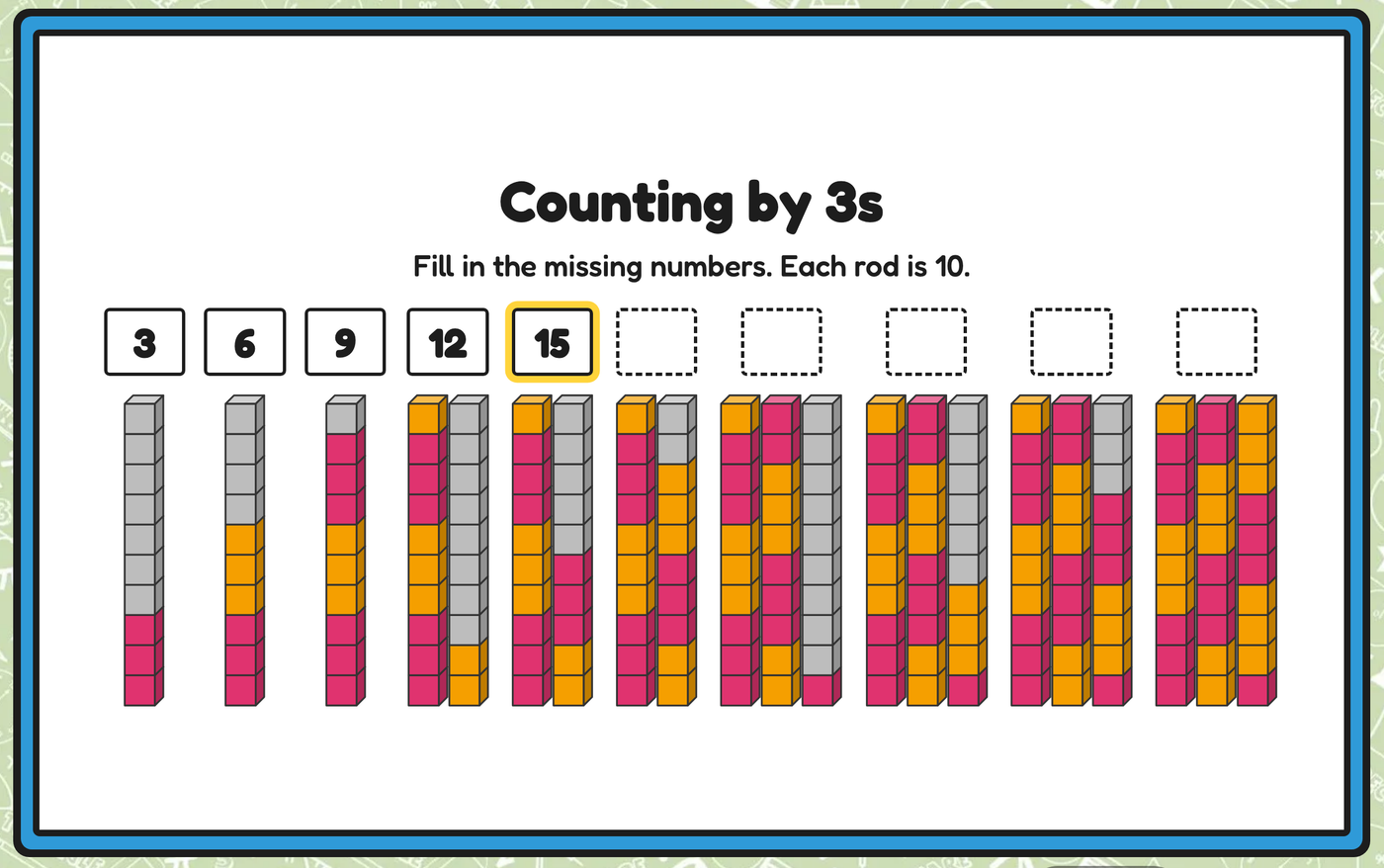
On the counting slides, each column of cubes grows by one group, in alternating colours, so students can see the running total build up: 3, 6, 9, 12… There are slides for counting by 2s all the way to 10s.
Five ways to play the wheels
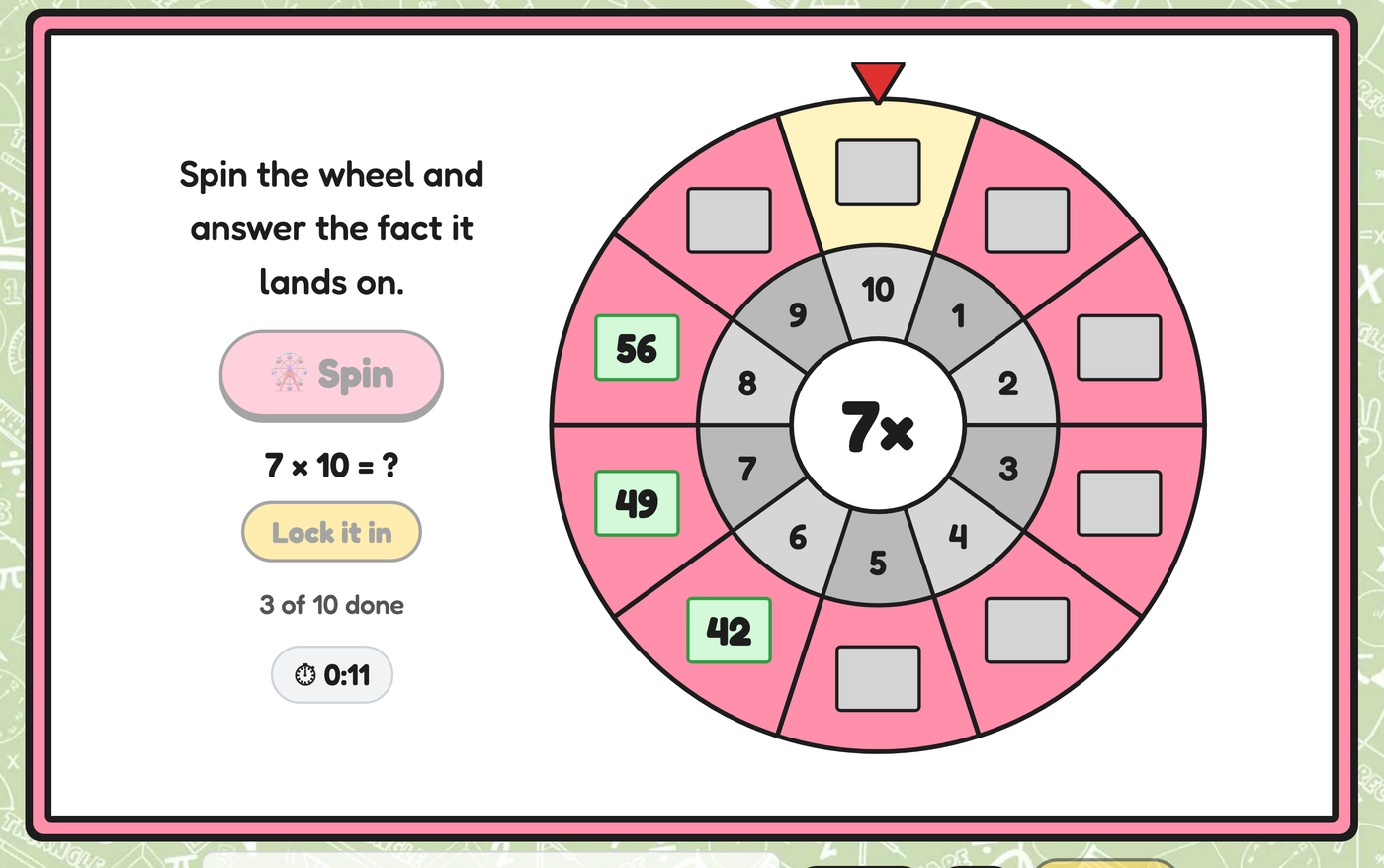
The multiplication wheels start the classic way: fill in the outer ring. Then they change for each number:
- Spin the wheel: the wheel spins and stops under the pointer, and students answer the fact it lands on until the ring is full.
- Scrambled: the inner ring is mixed up, so students can't just skip count around.
- Find the factor: the answers are on the outside, and students fill in the inner ring. 8 times what makes 56?
- Missing middle: which wheel is this? Students work out the number in the centre.
- Beat the clock: the extra wheels have a timer that remembers each student's best time.
Find your own mistakes
On the multiples frames and mazes, students tap tiles to mark them and tap again to unmark. When they press Check, the activity says how many tiles are wrong or still missing, but not which ones. "1 tile you marked isn't a multiple of 3. Can you find it?" That second look is where the learning happens.
In the mazes, students step on multiples to make a path from the coloured hexagon through the maze. Some mazes use common multiples, like the multiples of both 2 and 3.
Patterns on the times table
The times table hunt asks students to find the common multiples of two numbers, or every square number. Tapping a number marks it wherever it appears, which leads to a good question: why do some numbers show up more than once?
Odd one out and mystery numbers
Odd one out asks which number doesn't belong, then explains why: "All the others are square numbers." Mystery numbers give clues like "It's a multiple of 3, a multiple of 4 and a multiple of 10", and a wrong pick says which clue it breaks.
Number puzzles
The last section is all puzzles, and the open-ended ones accept any answer that fits the rules:
- Number-crosses: fill in the grid from clues like "multiple of 7" and "the square of 9". Tap a clue to see its boxes.
- Multiplication steps: two-digit numbers across are multiples of one number, and numbers down are multiples of another.
- Flowers: which number belongs in the middle of each flower?
- Balance scales: 6 × 4 = ? × 3.
- Shape tables: find the value of each shape on a mini multiplication table.
- Times Squares: fill a 2 × 2 grid so the products across and down are right.
What's inside
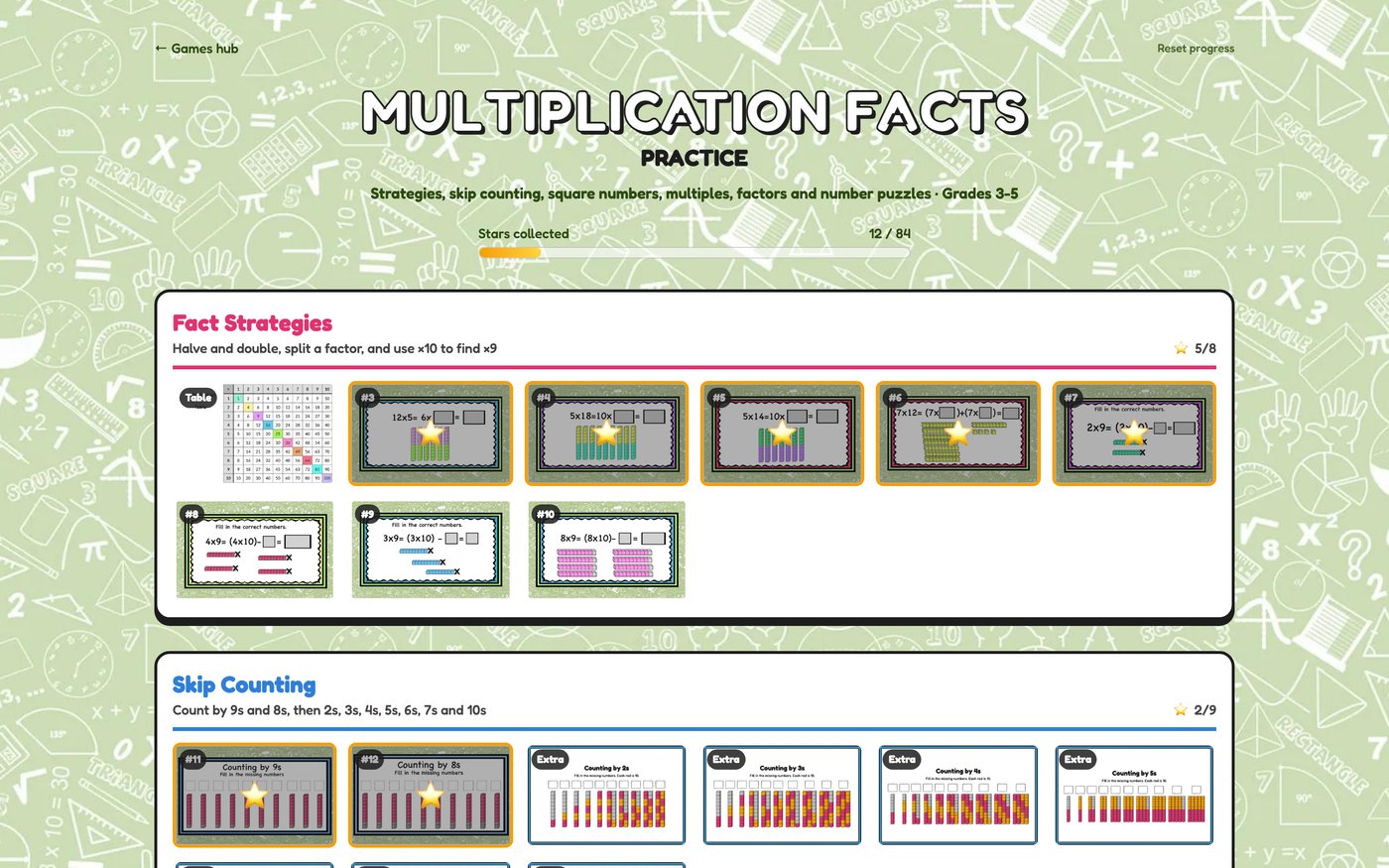
- Fact Strategies: 8 slides
- Skip Counting: 9 slides, from 2s to 10s
- Square Numbers: 7 slides
- Multiplication Wheels: 11 slides, from 2× to 12×
- Times Table Hunt: 8 slides
- Multiples Frames: 8 slides
- Multiples Mazes: 9 slides
- Odd One Out: 9 slides
- Mystery Numbers: 3 slides
- Number Puzzles: 12 slides
Students can pick any slide, in any order. Each solved slide earns a star on the menu, and progress is saved on the device. Every slide has a Show answer button, so the answer only appears when students ask for it.
What students practise
- Multiplication facts to 10 × 10, with wheels up to 12×
- Strategies: halving and doubling, splitting a factor, ×9 from ×10, and square numbers
- Skip counting by 2s to 10s
- Multiples, common multiples and factors
- Reasoning with number puzzles
Teaching tips
- Number talks. Put a strategy slide on the board and ask: "How does knowing 12 × 5 help with 6 × 10?"
- Say the multiples first. Before a maze or a frame, have students say the first few multiples aloud so they know what to look for.
- Talk about the odd one out. Accept any reasoning students can justify, and discuss other answers that could work.
- Race the clock. Use a timed wheel as a warm-up, then compare best times later in the week.
- Whole class or centers. Use it on the board for a number talk, or in centers with students working at their own pace.
Prefer Google Slides?
The original Multiplication Facts Practice deck has the slides for Google Slides, with a printable worksheets version. Use it for whole-class discussion, and the digital version when you want the slides to check themselves.
For more strategy practice, Mental Math Strategies for Multiplication has 107 self-checking problems.
Standards
- 3.OA.B.5: apply the properties of operations to multiply
- 3.OA.C.7: fluently multiply within 100
- 3.OA.D.9: identify patterns in the multiplication table
- 4.OA.B.4: find factors and multiples
Quick answers
Do students need accounts? No. It's a link, so there's nothing to sign in to.
What devices does it work on? Any device with a web browser, including Chromebooks, tablets and the classroom board.
Is there only one right answer? Not on the puzzles. Number-crosses, multiplication steps and Times Squares accept any answer that fits the rules.
Get Multiplication Facts Practice
Strategies, wheels, mazes and puzzles, and the slides do the checking.