Halloween Multiplication Arrays: Self-Checking Candy Arrays for Grades 2-4
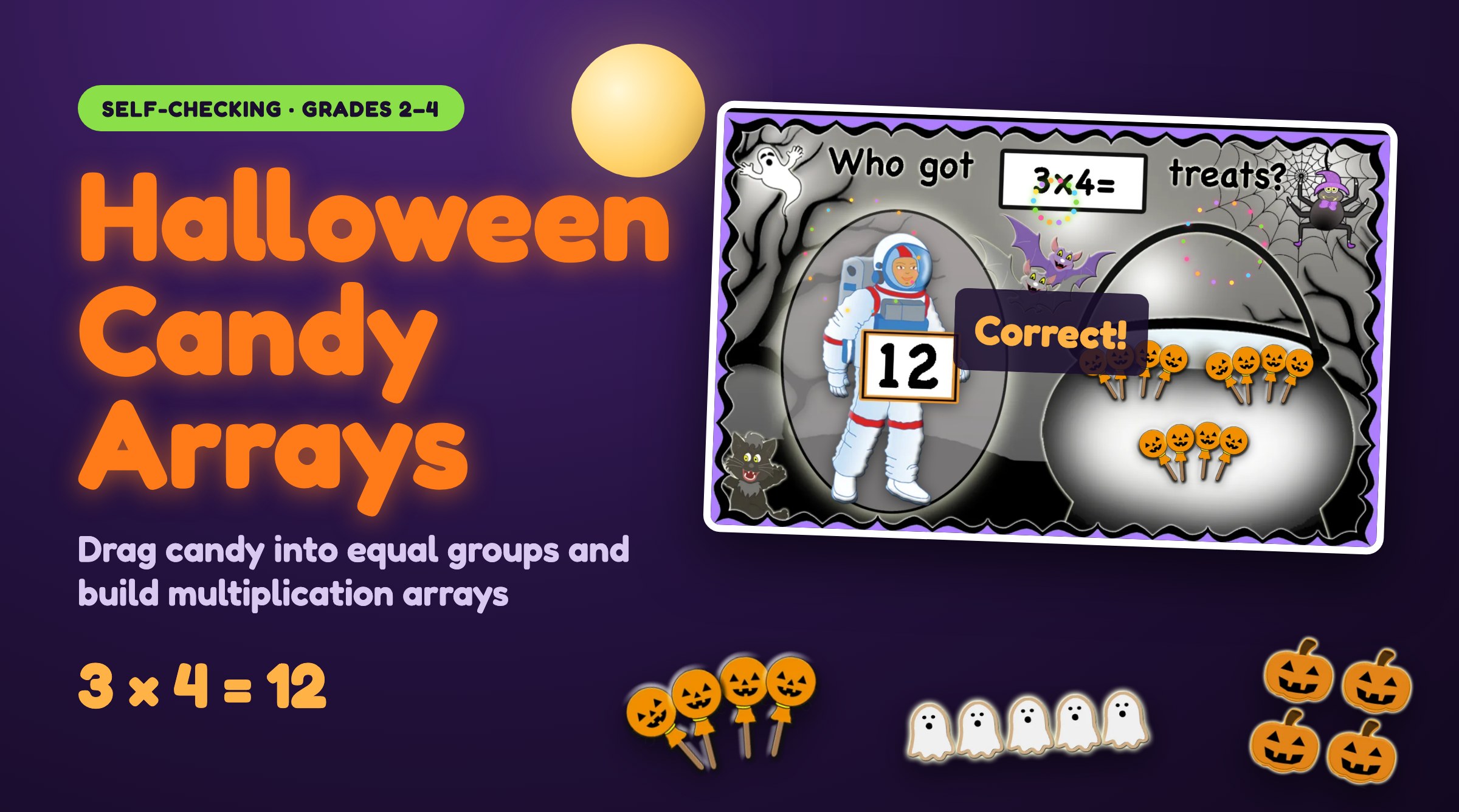
Halloween Candy Arrays is a self-checking digital activity for introducing multiplication with arrays. Students drag groups of Halloween candy into a cauldron, a pumpkin pail or a treat bag, and the groups snap into neat rows, so whatever they build is a real array. Then the activity checks it for them.
It's the digital version of our Halloween Activities: Multiplication Properties, Arrays and Facts slides, with the same candy, characters and cauldrons: 75 slides on equal groups, the commutative, associative and distributive properties, and modelling multiplication facts.
Watch it in action
It runs in any web browser. There's nothing to print, cut or laminate, and students don't need logins.
Who got the treats?
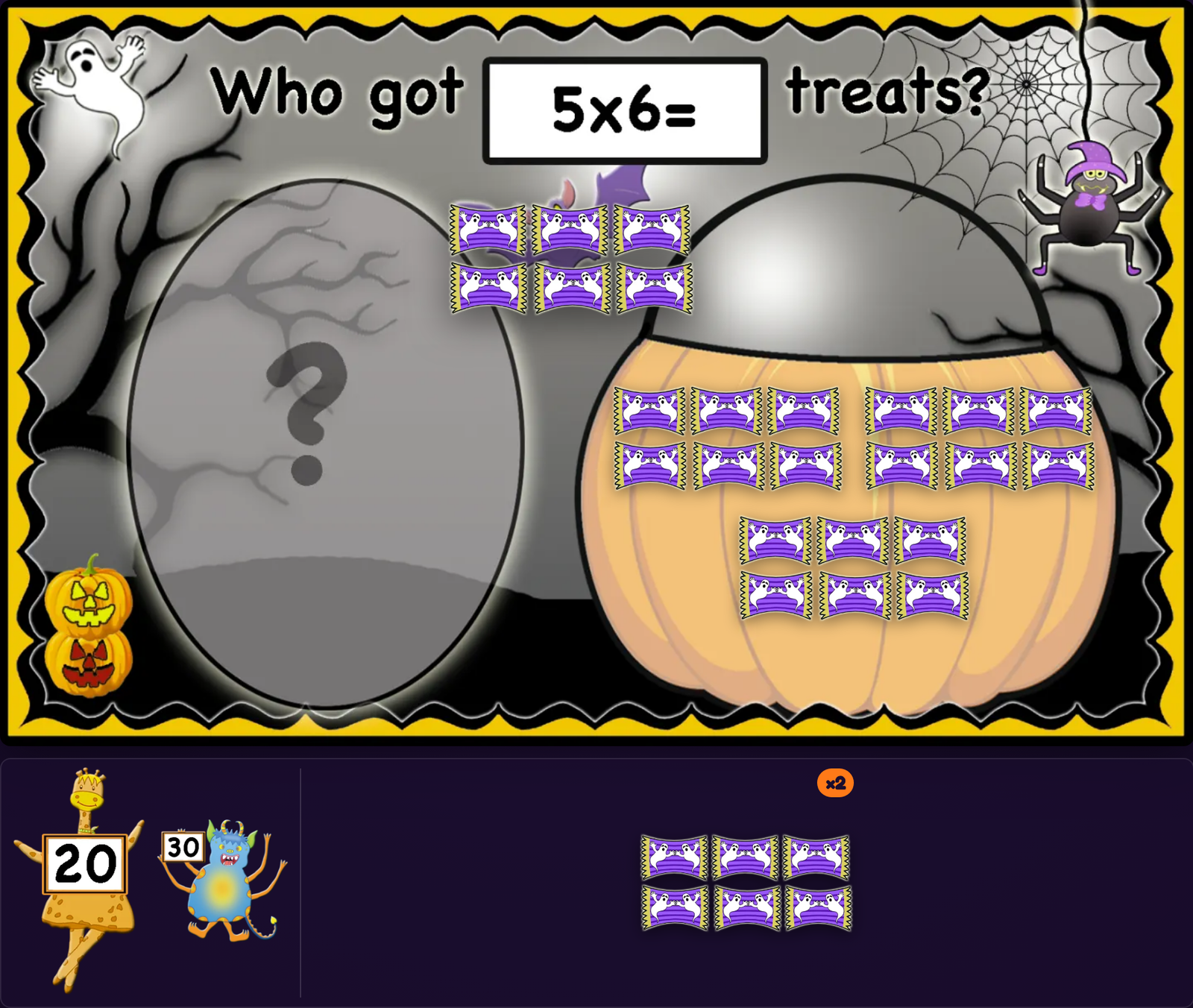
Each slide asks a question like "Who got 3 × 5 treats?" Students drag candy groups from the tray into the container, or tap a group to drop it straight in. Every group snaps into place in rows, so 10 groups of 2 come out as 2 rows of 5.
Once the treats are in, students count them and tap the character holding that number. Two characters are waiting in the tray, and only one of them got the treats.
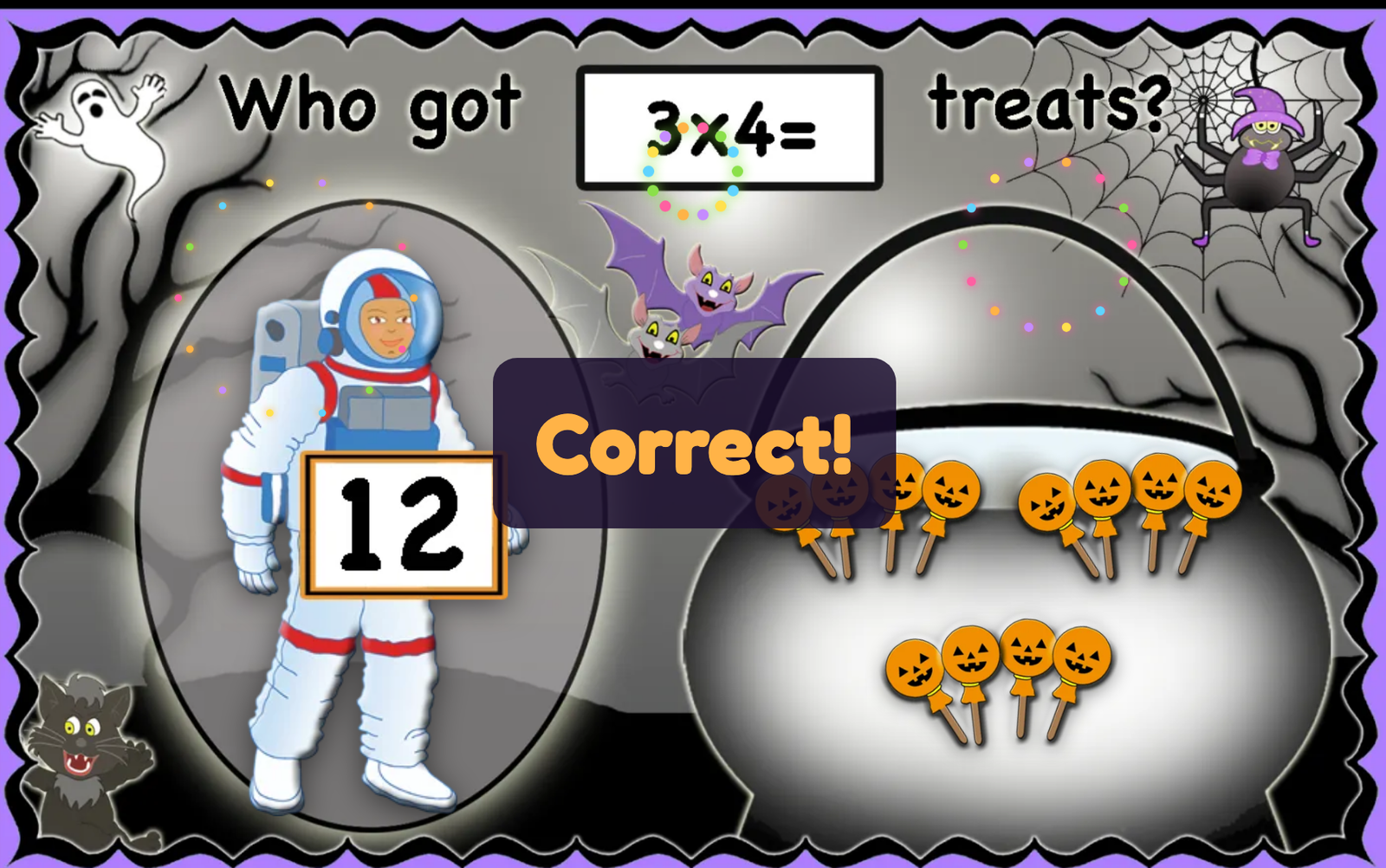
The first slides use repeated addition (2 + 2 + 2, 5 + 5 + 5) and then move on to multiplication, from 2 × 2 to 10 × 2 and 7 × 5. Both orders are accepted, so 2 × 3 can be 2 groups of 3 or 3 groups of 2. That's the commutative property, before students meet the name.
Hints that teach
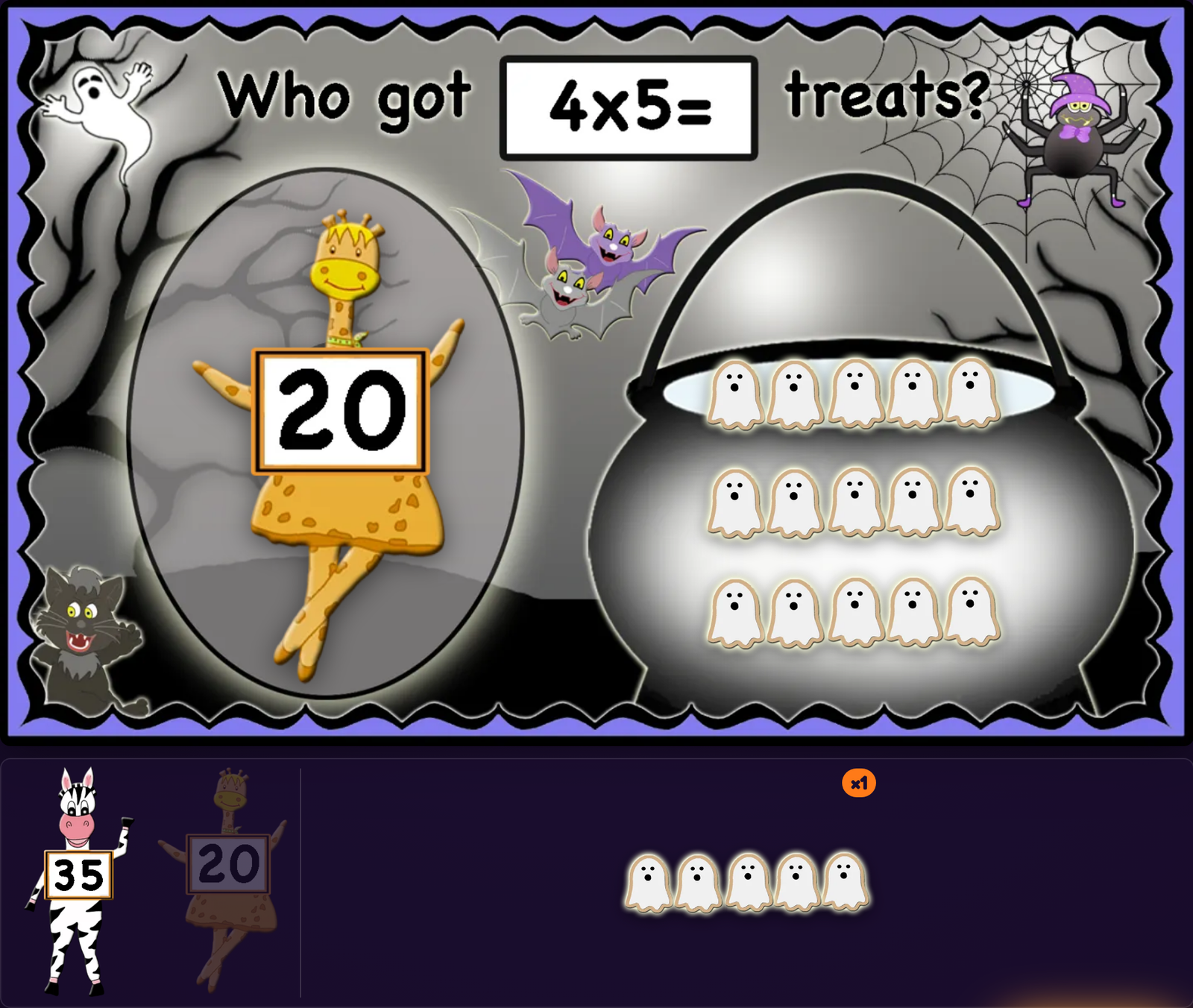
A wrong answer gets a hint written for what the student did: "You showed 3 groups of 5. 4 × 5 means 4 groups of 5." If they mix kinds of candy, they're reminded that "an array needs equal groups". If the treats are right but the character isn't, they're told to count them all again.
After two tries, Show answer puts the answer on the slide. Students can reset and solve it on their own to earn the pumpkin on the menu.
Mark the expressions that match
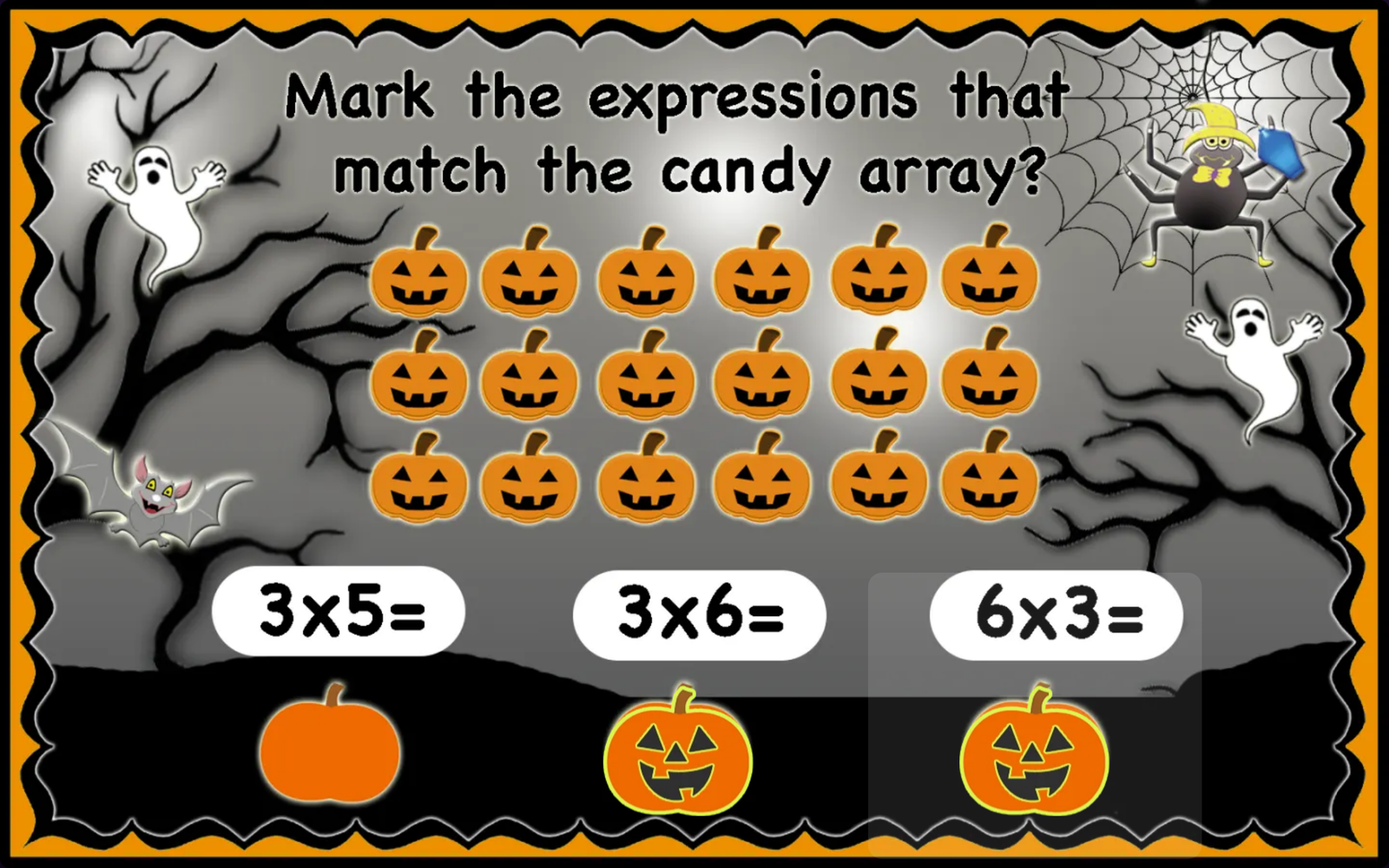
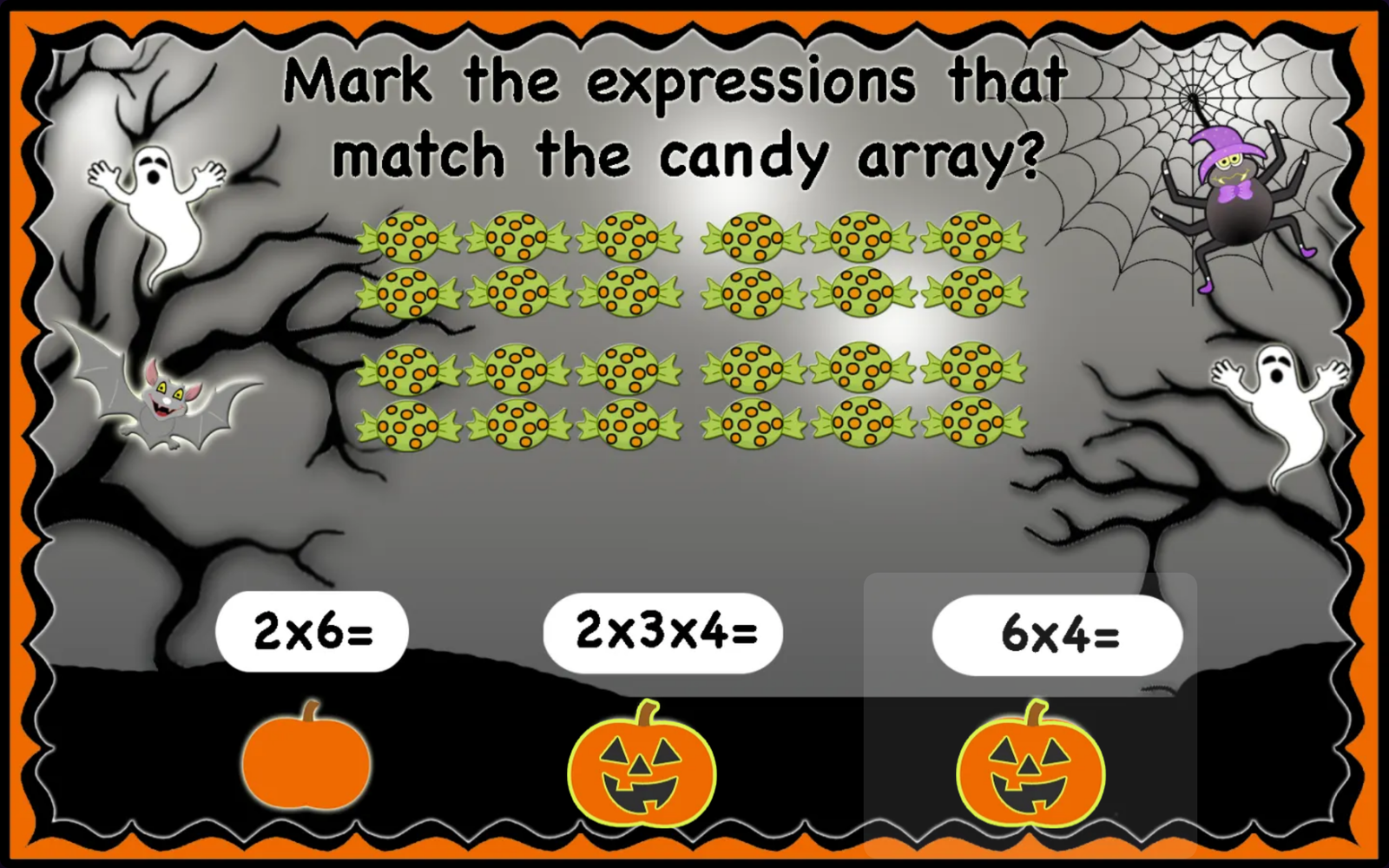
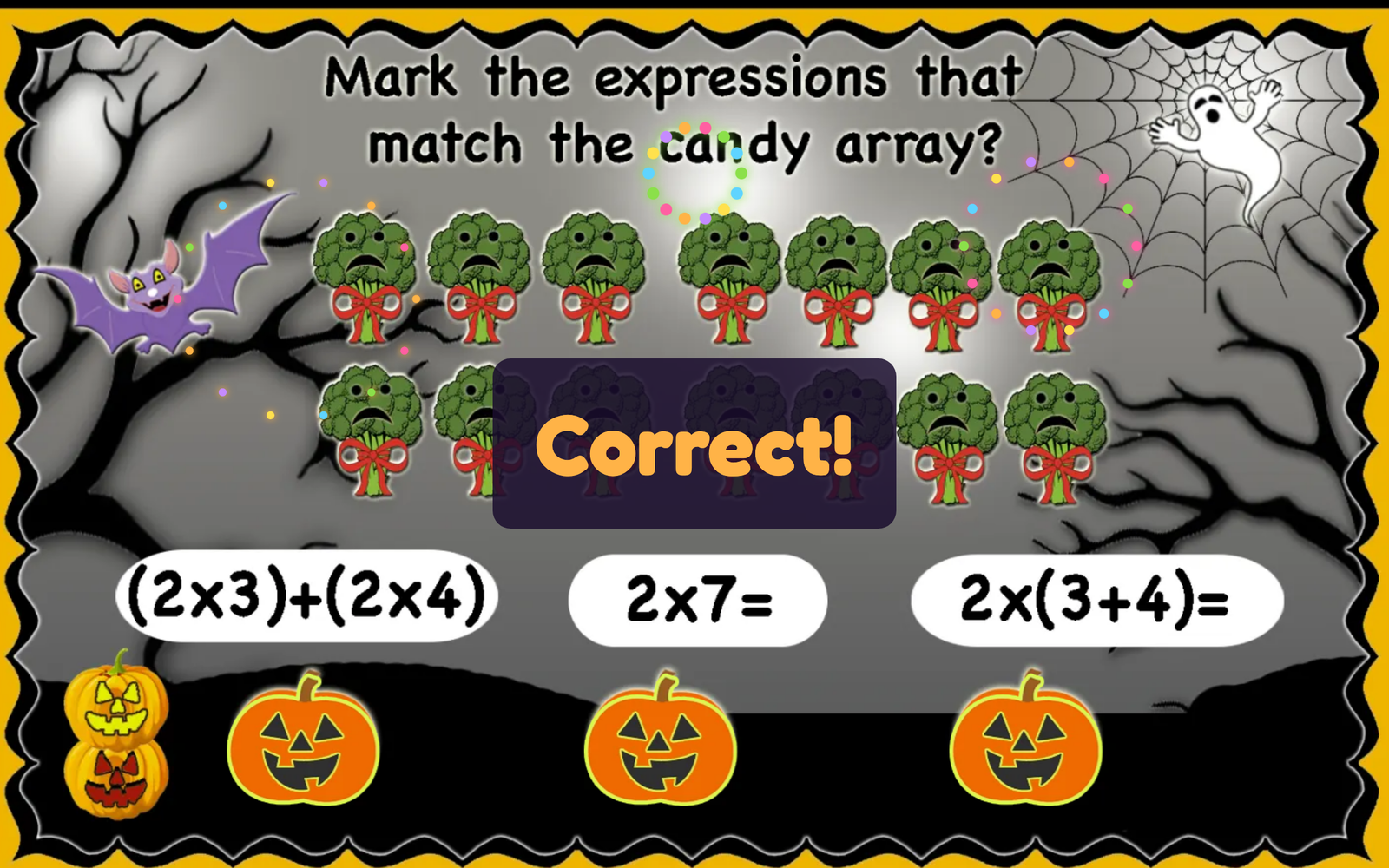
In the second half, the array is already on the slide and students tap the pumpkin under every expression that matches. There can be more than one: 3 rows of 6 pumpkins is 3 × 6 and also 6 × 3.
- Match the candy array: find the one expression that describes the array.
- Commutative property: 3 × 6 and 6 × 3 describe the same array.
- Associative property: a 4 by 6 array can be 6 × 4 or 2 × 3 × 4, two blocks of 3 columns with 4 rows each.
- Distributive property: 2 rows of 3 and 4 candies is 2 × (3 + 4) and (2 × 3) + (2 × 4).
Model the number
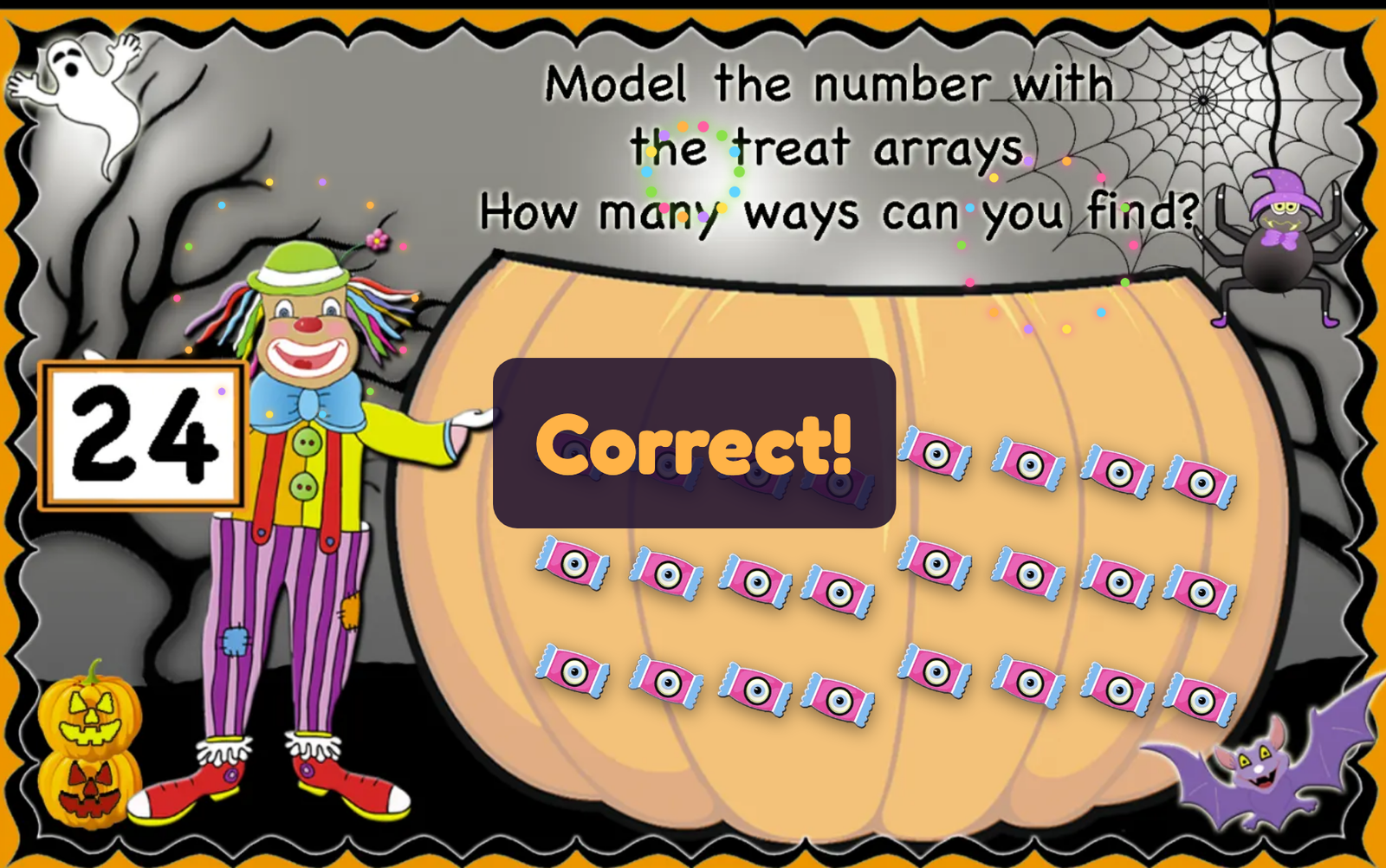
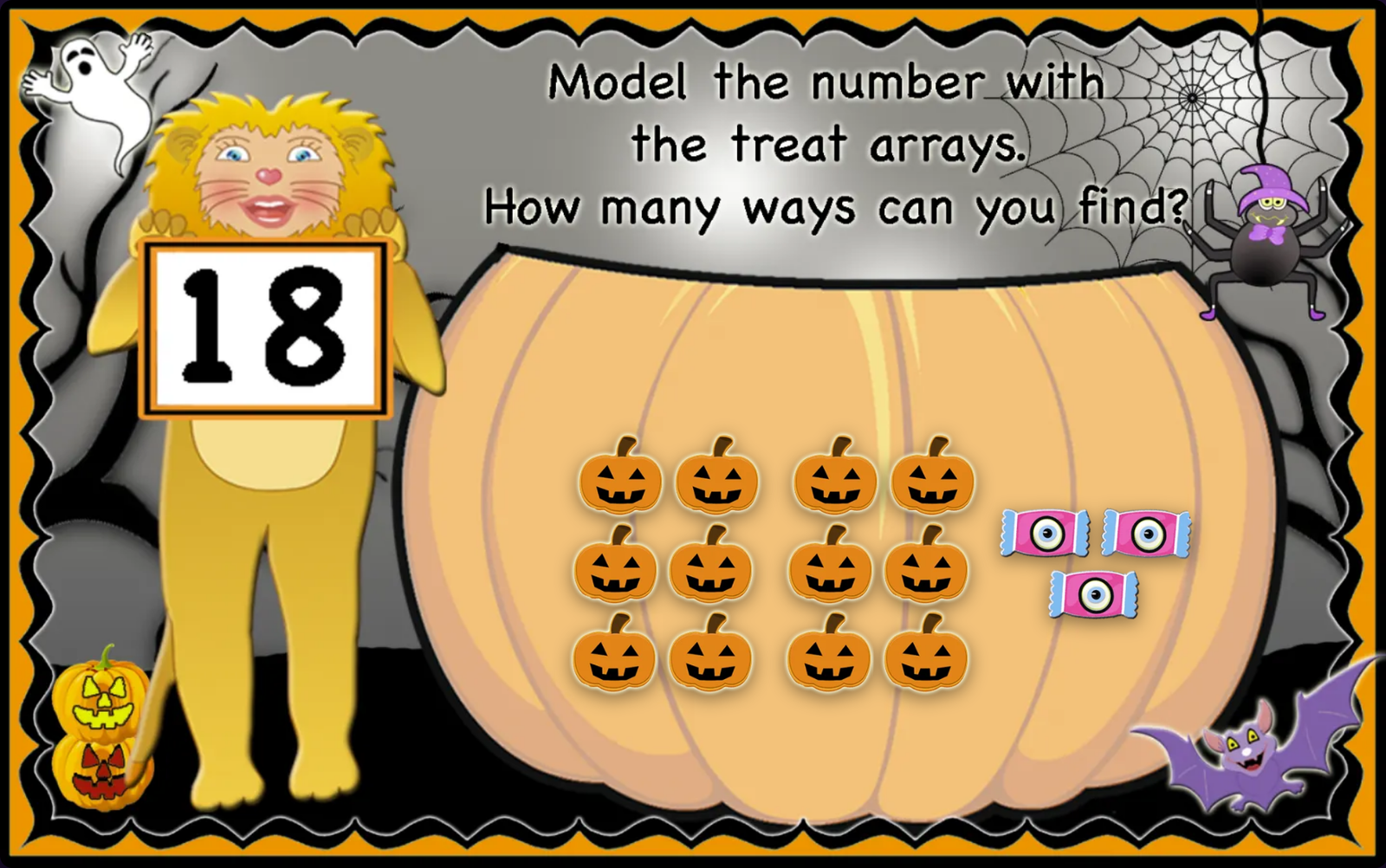
The last section turns it around: a character holds a number and students build it as an array, using one kind of candy. 24 can be 6 groups of 4, 4 groups of 6, 8 groups of 3 or 3 groups of 8. After a correct array, Try another way clears the pumpkin so they can find a different one.
What's inside
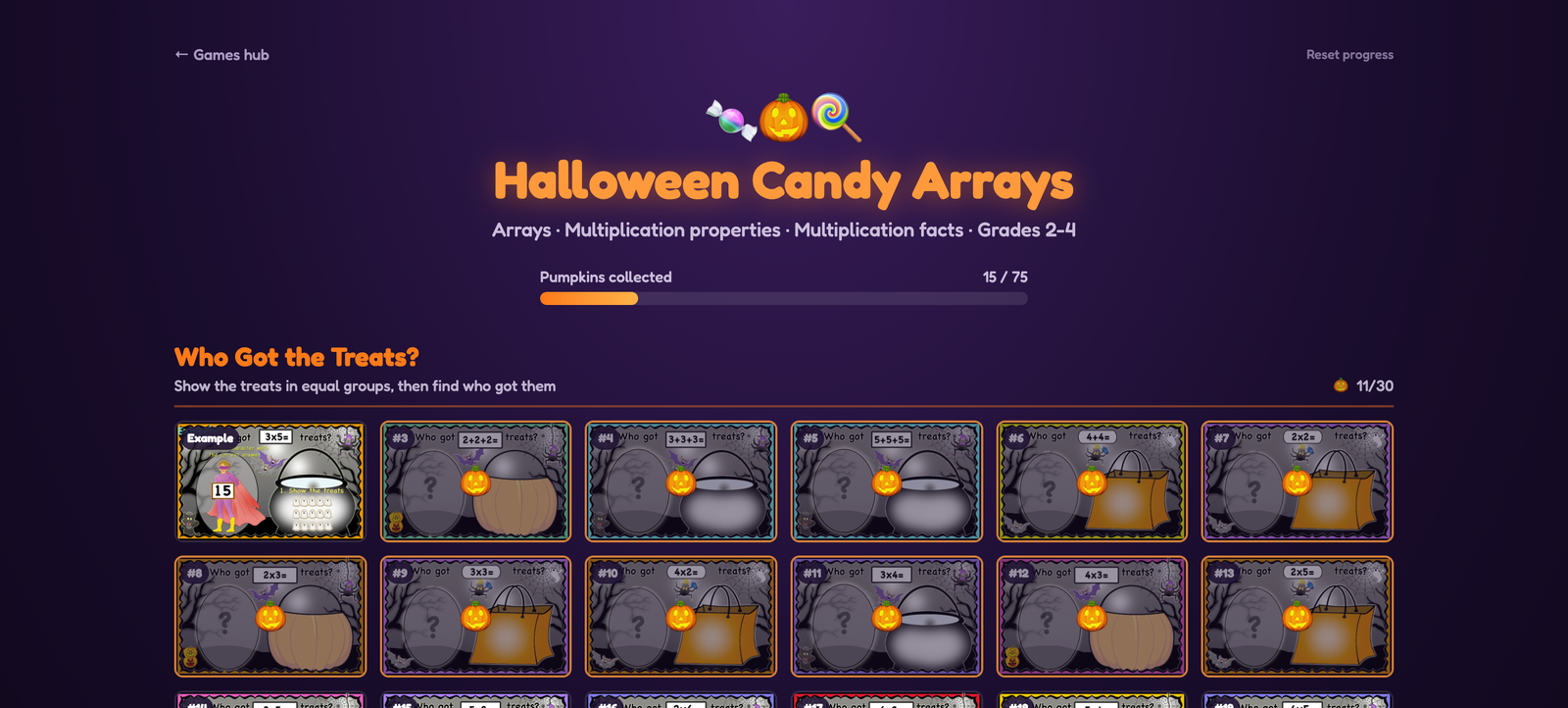
- Who Got the Treats? 30 slides
- Match the Candy Array: 4 slides
- Commutative Property: 12 slides
- Associative Property: 10 slides
- Distributive Property: 6 slides
- Model the Number: 13 slides, from 8 to 35
Each section opens with a worked example. Students can pick any slide, in any order, and their pumpkins are saved on the device.
What students practise
- Multiplication as equal groups and arrays
- Repeated addition and how it connects to multiplication
- The commutative, associative and distributive properties of multiplication
- Finding every array for a number (factor pairs)
- Multiplication facts up to 35
Teaching tips
- Say it as groups. Ask students to read 3 × 4 as "3 groups of 4" before they drag anything.
- Which number is which? On a × slide, ask which number tells how many groups and which tells how many are in each group.
- Point and prove. On the mark slides, ask students to point to the rows and columns that match each expression they marked.
- Race for every way. On Model the Number, have partners find every array, then list them on the board: 24 = 3 × 8 = 4 × 6 = 6 × 4 = 8 × 3.
- Whole class or centers. Use it on the board for a number talk, or in centers with students working at their own pace.
Prefer Google Slides?
The original Halloween Activities: Multiplication Arrays, Facts and Properties deck has the same slides for Google Slides, where students move the candy themselves. Use it for whole-class discussion, and Halloween Candy Arrays when you want the slides to check themselves.
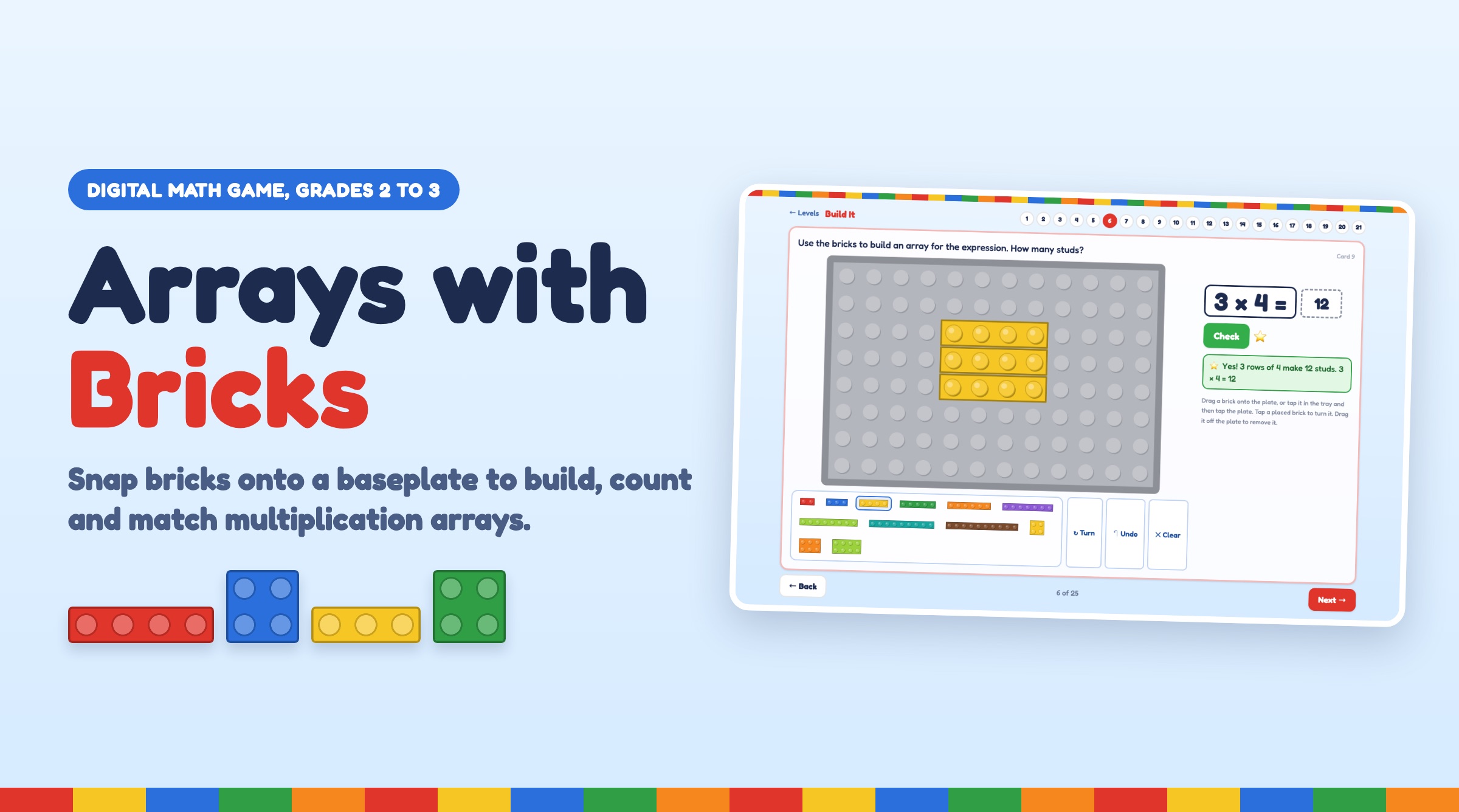
For more arrays practice all year round, Arrays with Bricks builds arrays from toy bricks.
Standards
- 2.OA.C.4: use addition to find the total in a rectangular array
- 3.OA.A.1: interpret products as equal groups
- 3.OA.A.3: use multiplication with equal groups and arrays
- 3.OA.B.5: apply the properties of operations to multiply
- 3.OA.C.7: multiply within 100
Quick answers
Do students need accounts? No. It's a link, so there's nothing to sign in to.
What devices does it work on? Any device with a web browser, including Chromebooks, tablets and the classroom board. Students can drag with a mouse or a finger, or tap.
Is the answer always one exact array? No. 2 × 3 can be 2 groups of 3 or 3 groups of 2, and on the mark slides every matching expression counts.
Get Halloween Candy Arrays
Let students build multiplication with their hands, and let the slides do the checking.