Multiplication Arrays Game: Arrays with Bricks
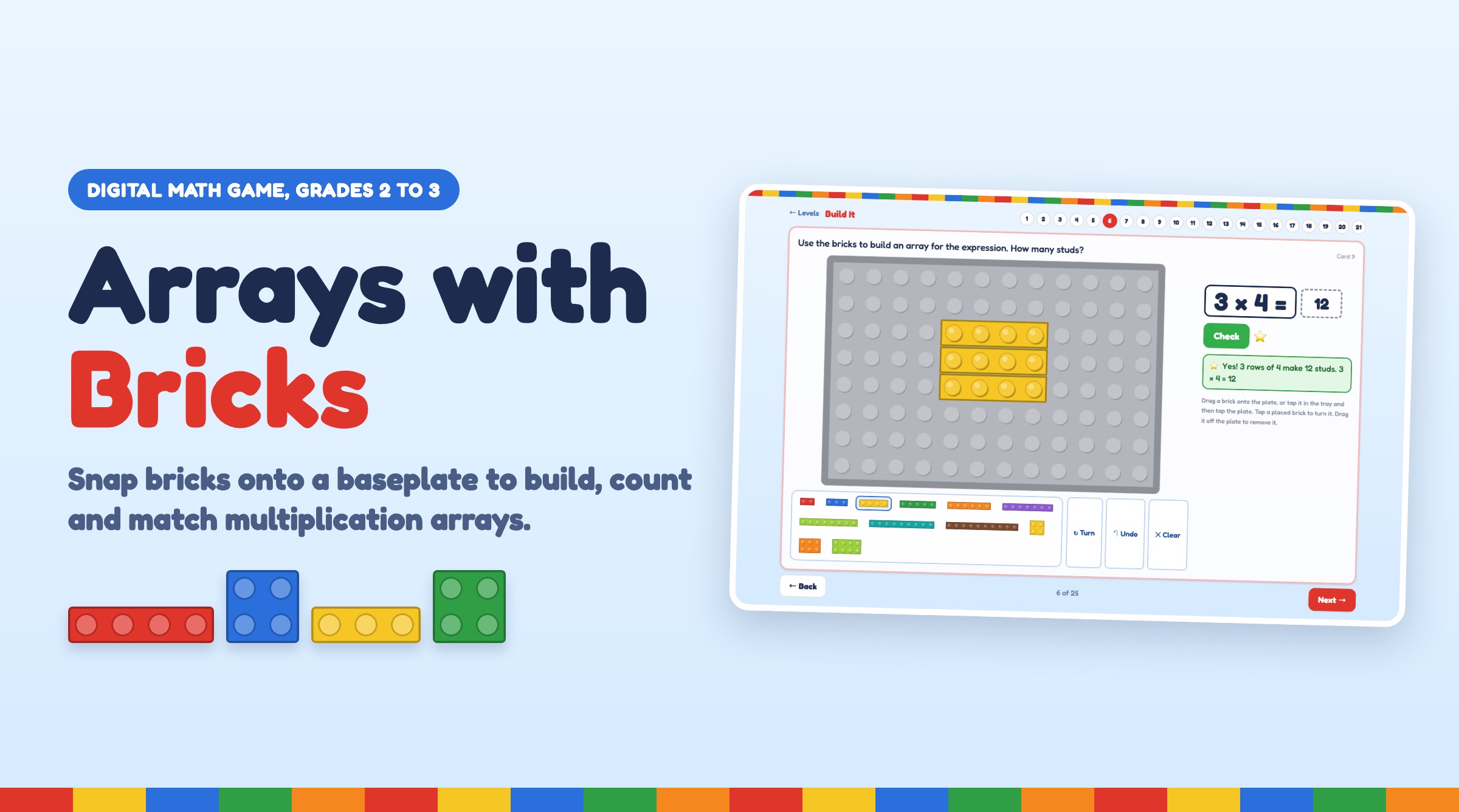
Arrays with Bricks turns multiplication into something students can build. Every array is made from colourful bricks snapped onto a baseplate, and 3 bricks with 7 studs each is 3 × 7, right there on the screen.
It's a digital game for grades 2 and 3 that practises arrays and equal groups, multiplication facts up to 10 × 10, factor pairs, and the commutative, associative and distributive properties, with 110 self-checking tasks across 6 levels, plus a Free Build mode.
Watch it in action
The game plays in any web browser. There's nothing to print, cut or laminate, and students don't need logins.
How it works
Snap bricks onto the baseplate
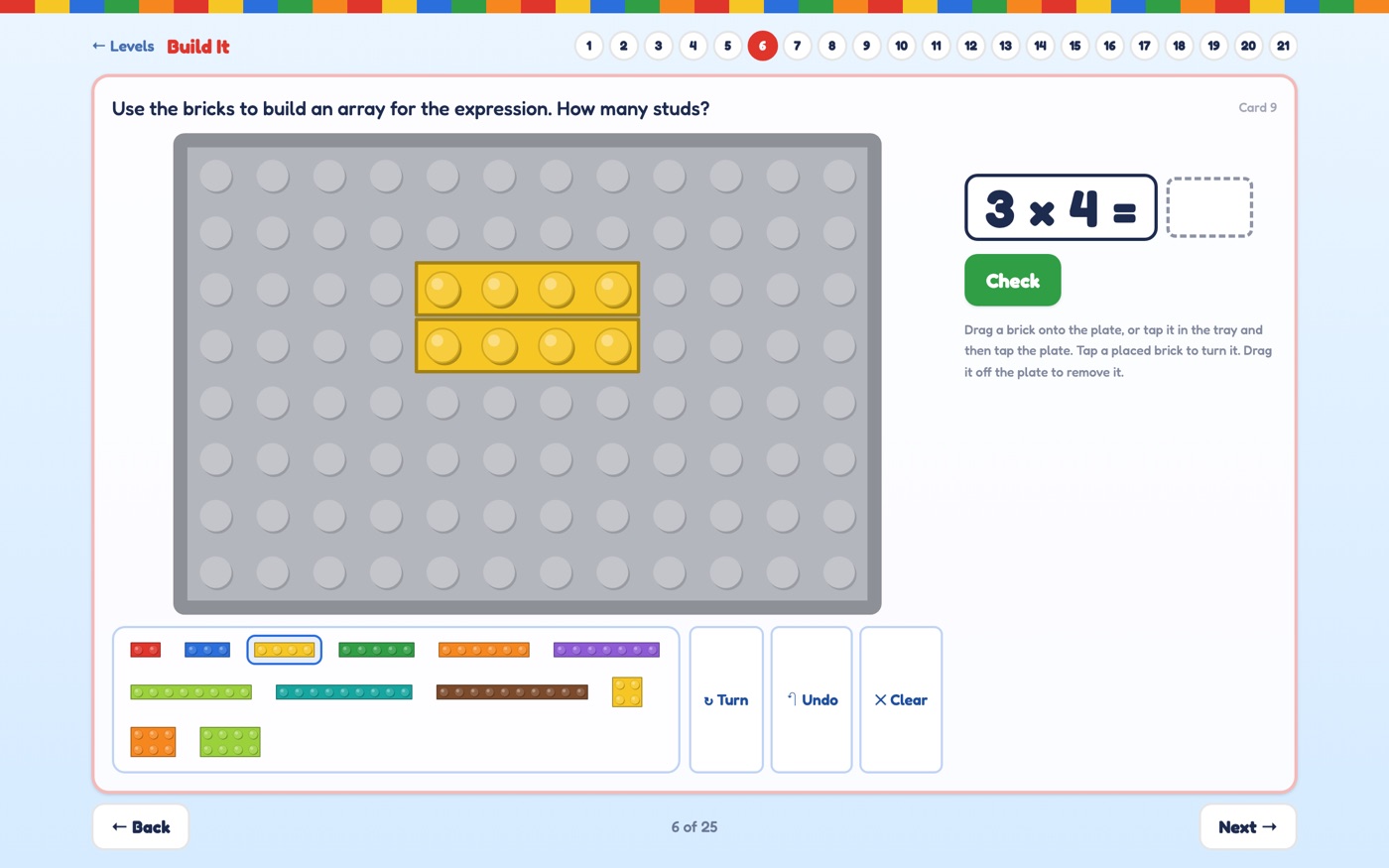
Each task shows an expression like 3 × 4. Students drag bricks from the tray onto the baseplate, or tap a brick and then tap the plate. A placed brick can be turned with a tap, or dragged off the plate to take it away.
The tray is colour-coded by size: every 4-stud brick is yellow, every 7-stud brick is purple. So an array students build is all one colour, and they can see at a glance when their groups are equal.
Count the studs and check
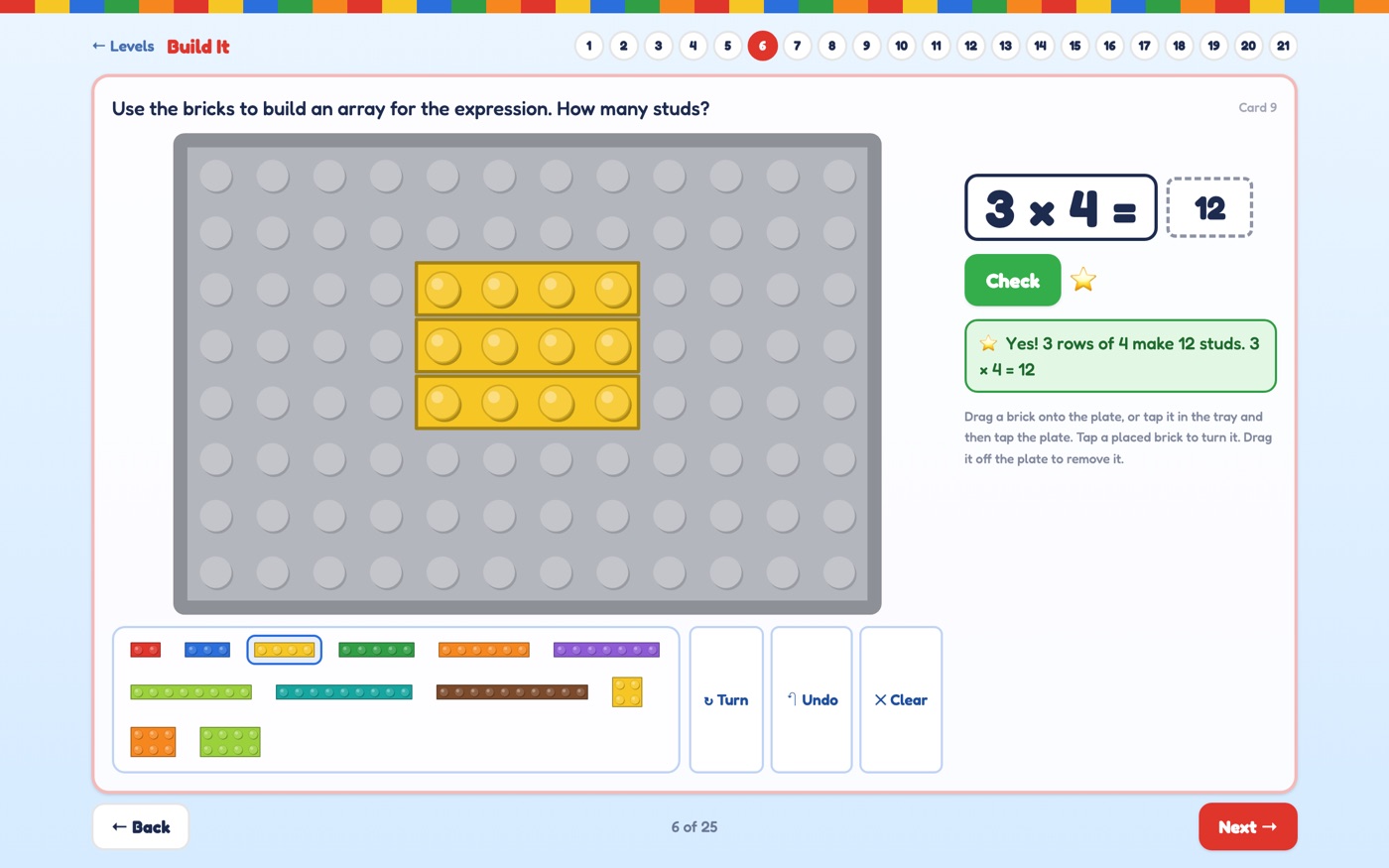
Students type how many studs and tap Check. The game checks both the array and the answer. A right answer earns a star. If something isn't right yet, the hint says exactly what: "Your bricks have 8 studs. Build 3 rows with 4 studs in each row." or "Your array is right! Count the studs again."
Start with a worked example
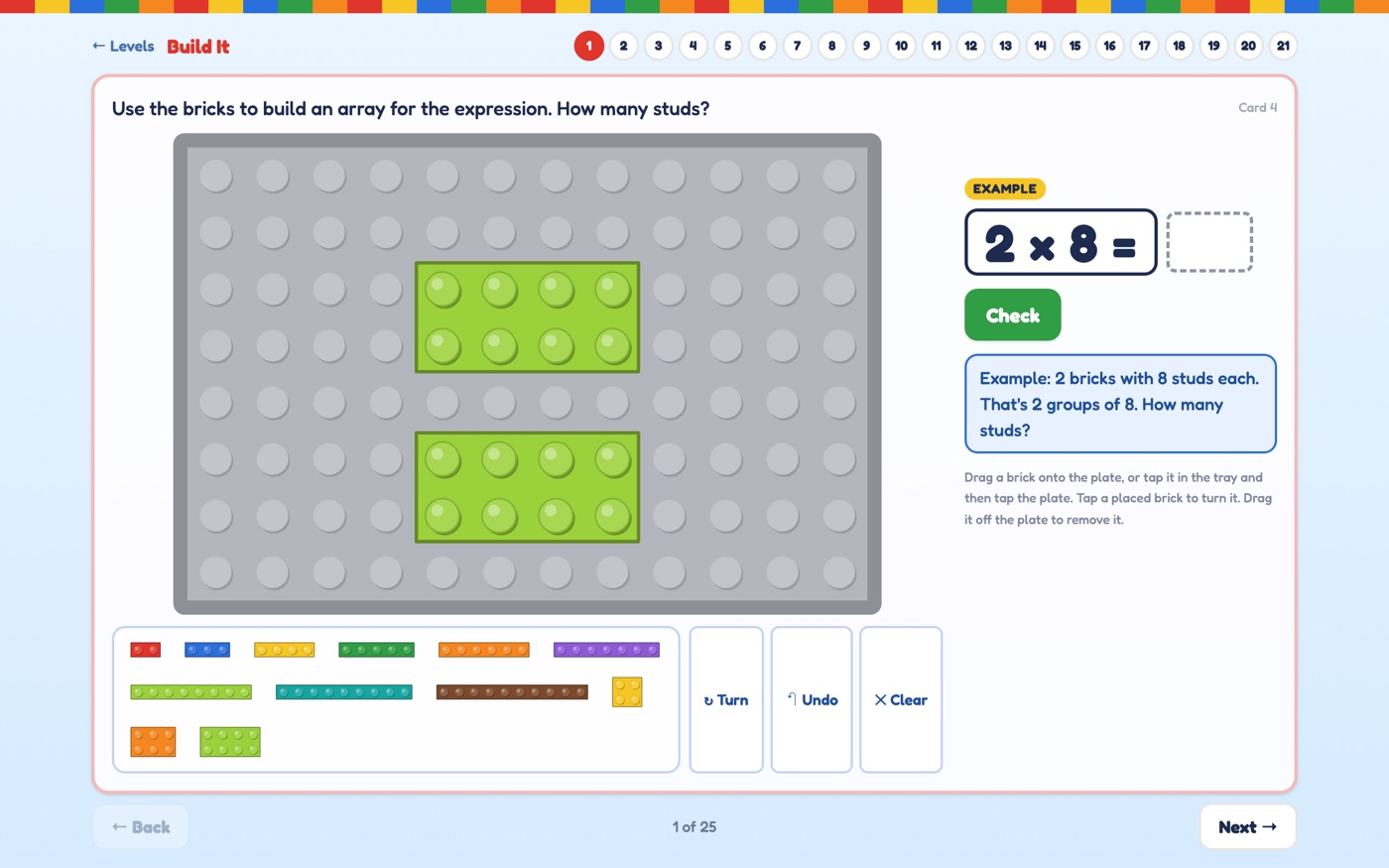
Build It and Build & Solve each open with a worked example, like 2 × 8 shown as 2 bricks with 8 studs each, and How Many Ways? opens with Brickson's arrays, so students know what to do before they start.
6 levels + Free Build
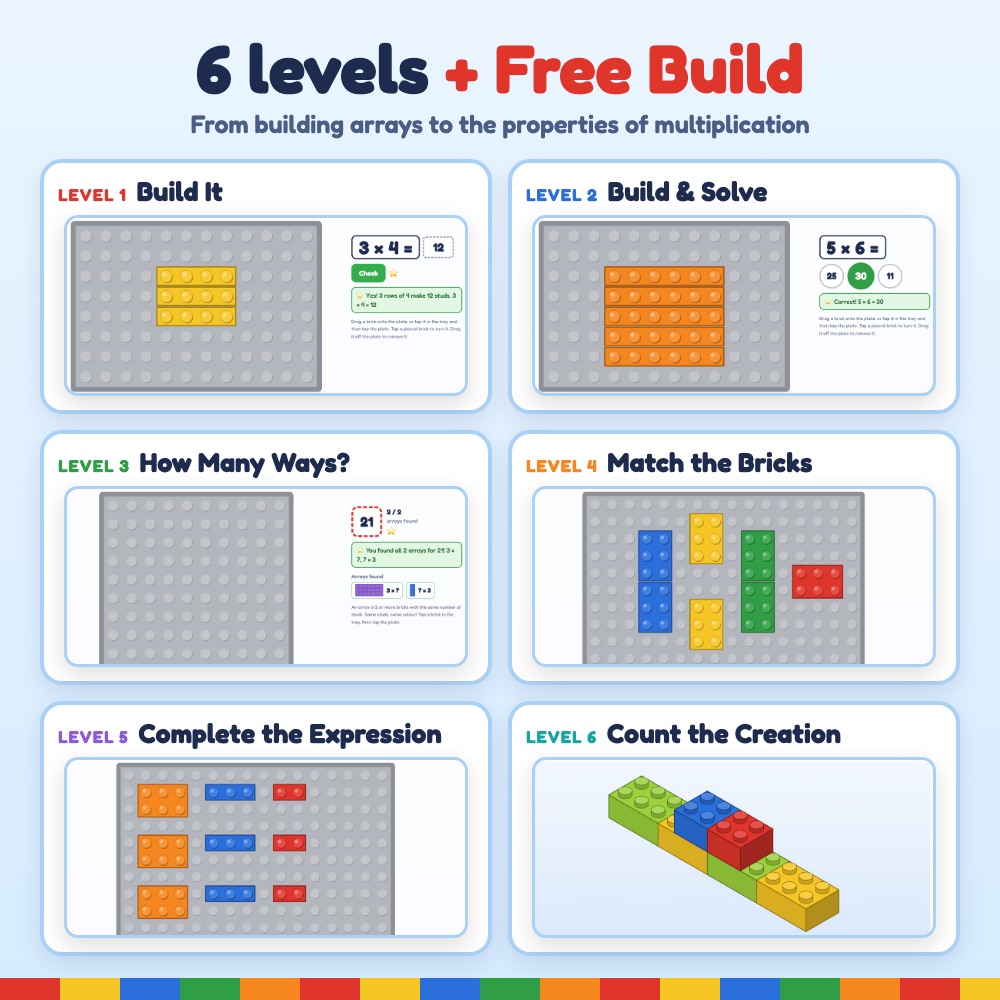
Level 1, Build It (25 tasks)
Build an array for a multiplication fact, then type how many studs. The facts go from 2 × 2 up to 5 × 10.
Level 2, Build & Solve (21 tasks)
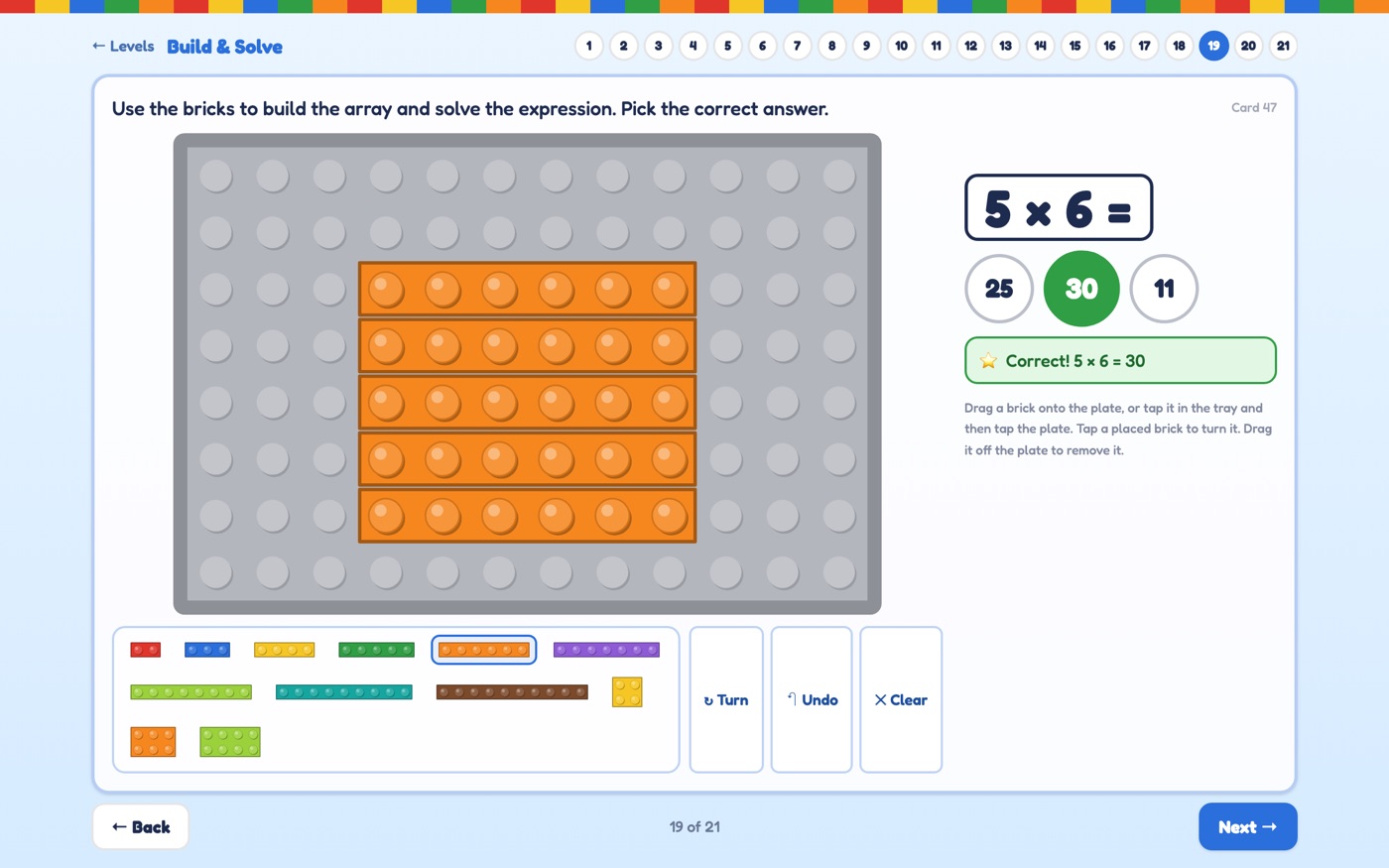
Build the array, then pick the right answer from three choices. A wrong choice is crossed out with a nudge to build it and count.
Level 3, How Many Ways? (24 tasks)
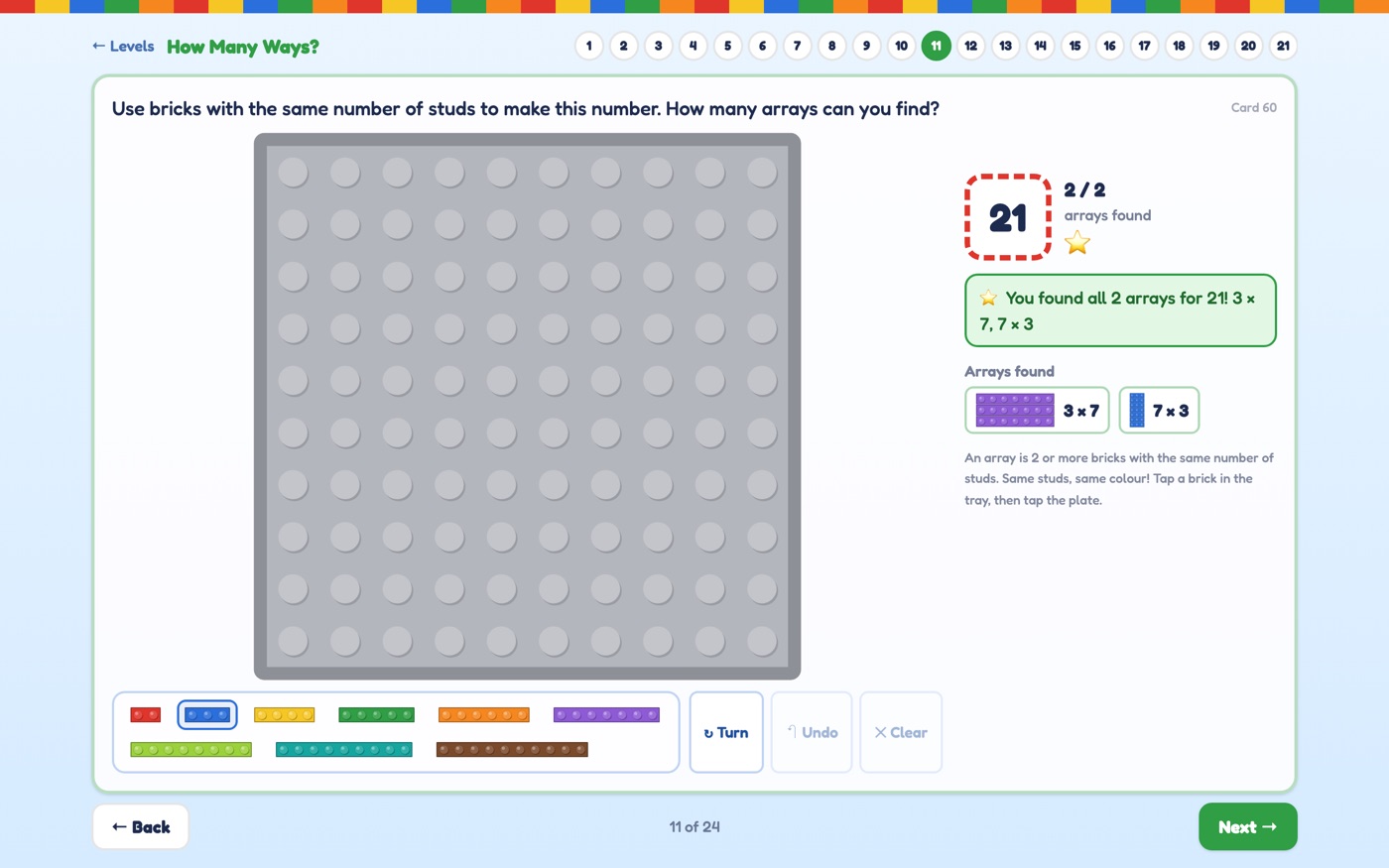
How many arrays can you make for 21? Students build with bricks that all have the same number of studs. 3 bricks of 7 is one array, and 7 bricks of 3 is another. Each array they find is saved, the plate clears, and they go looking for the next one. Mixed bricks get a friendly reminder: "An array uses bricks with the same number of studs."
It's a hands-on way into factor pairs and the commutative property: 3 × 7 and 7 × 3 make the same 21 studs, but they look different.
Level 4, Match the Bricks (10 tasks)
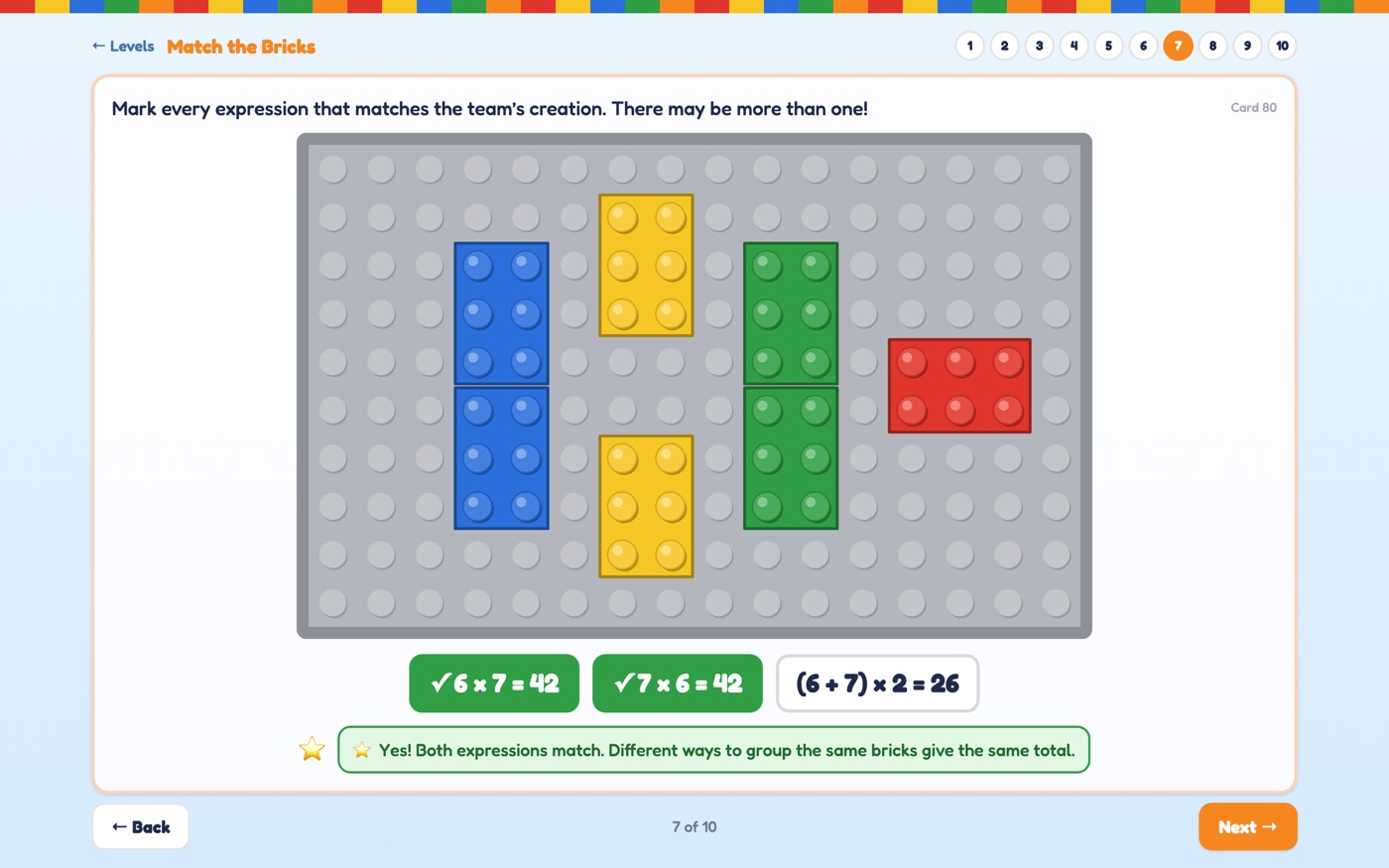
Students look at a team's brick creation and mark every expression that matches. Some have two right answers, like 6 × 7 and 7 × 6, or (4 × 3) × 2 and (4 × 2) × 3. That's where the conversations about the properties of multiplication begin.
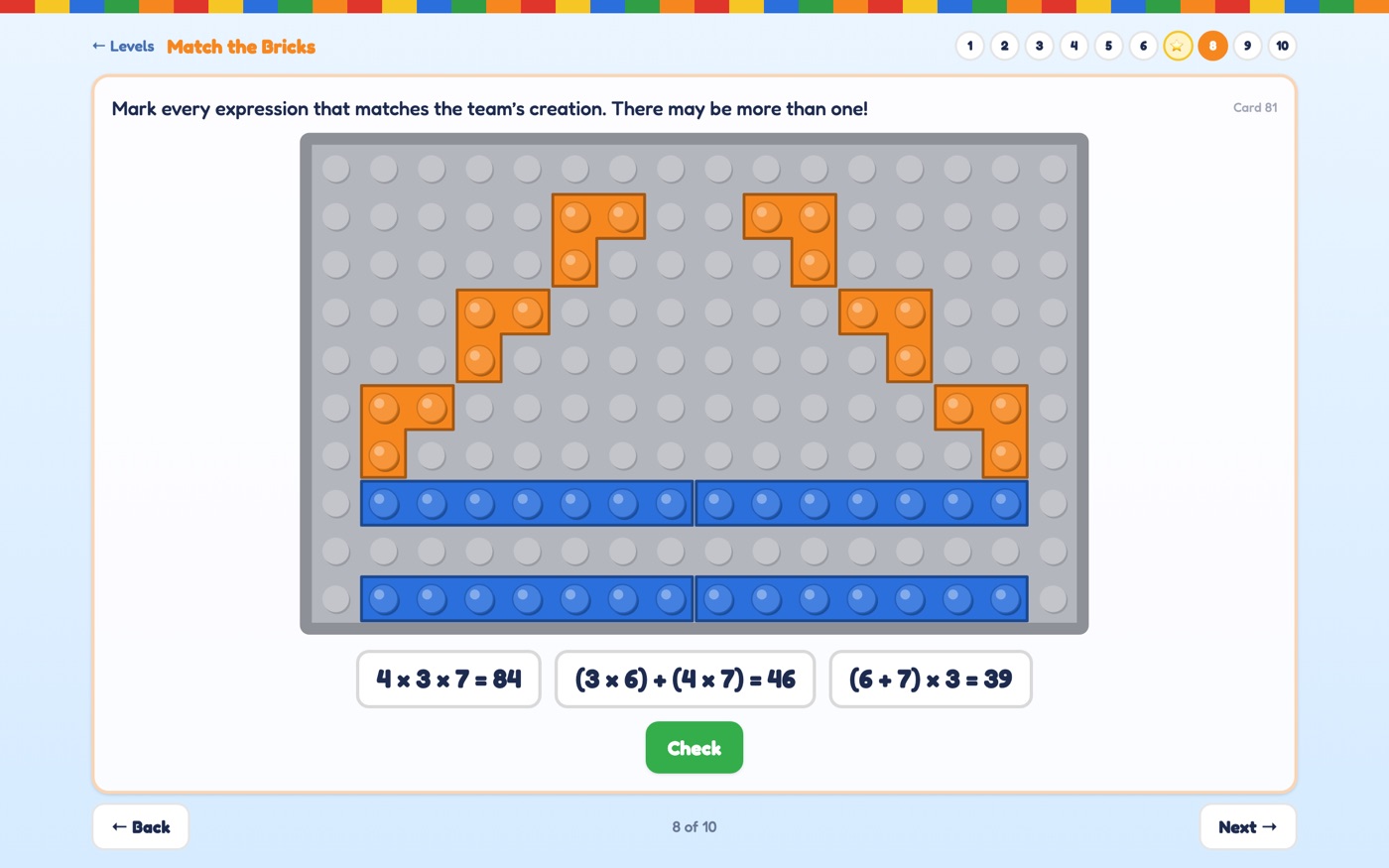
Later creations mix brick sizes, so students need expressions like (3 × 6) + (4 × 7).
Level 5, Complete the Expression (16 tasks)
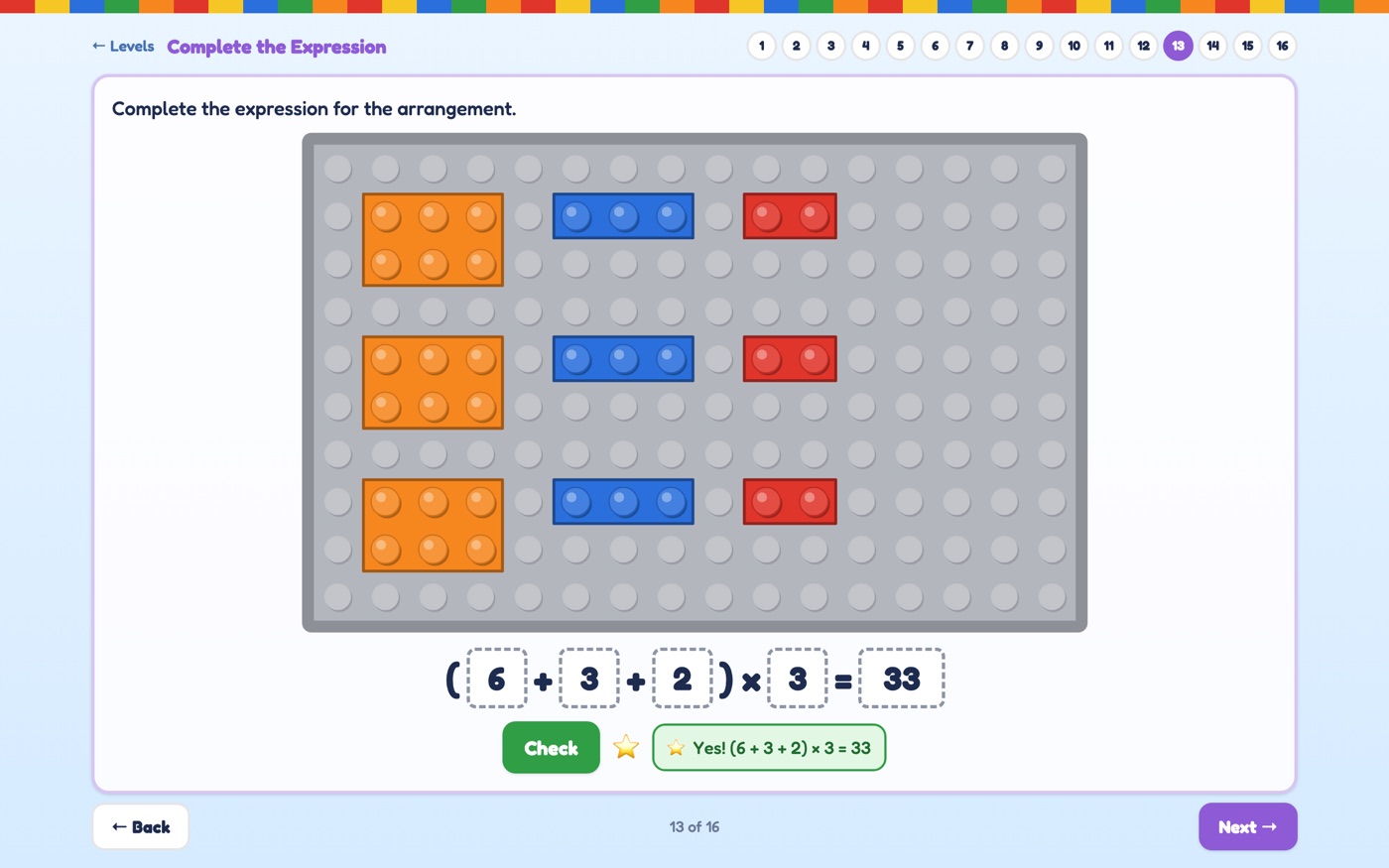
Students fill in the boxes for an arrangement: (□ + □) × □, □ × □ × □, (□ × □) + (□ × □) and more. Factors can go in any order where order doesn't matter, so (3 + 6 + 2) × 3 is just as right. If the total is right but the grouping isn't, the game says so.
Level 6, Count the Creation (14 tasks)
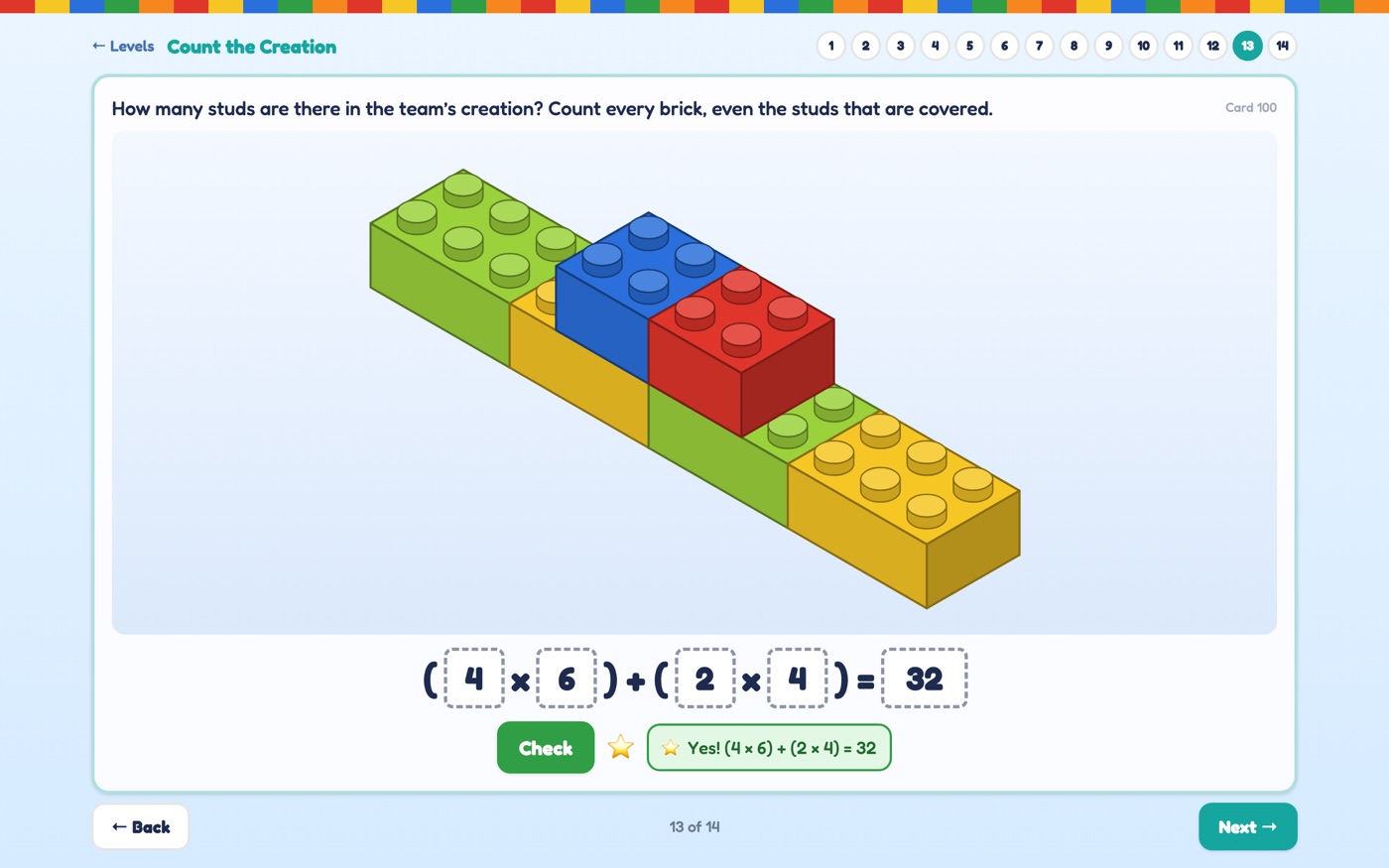
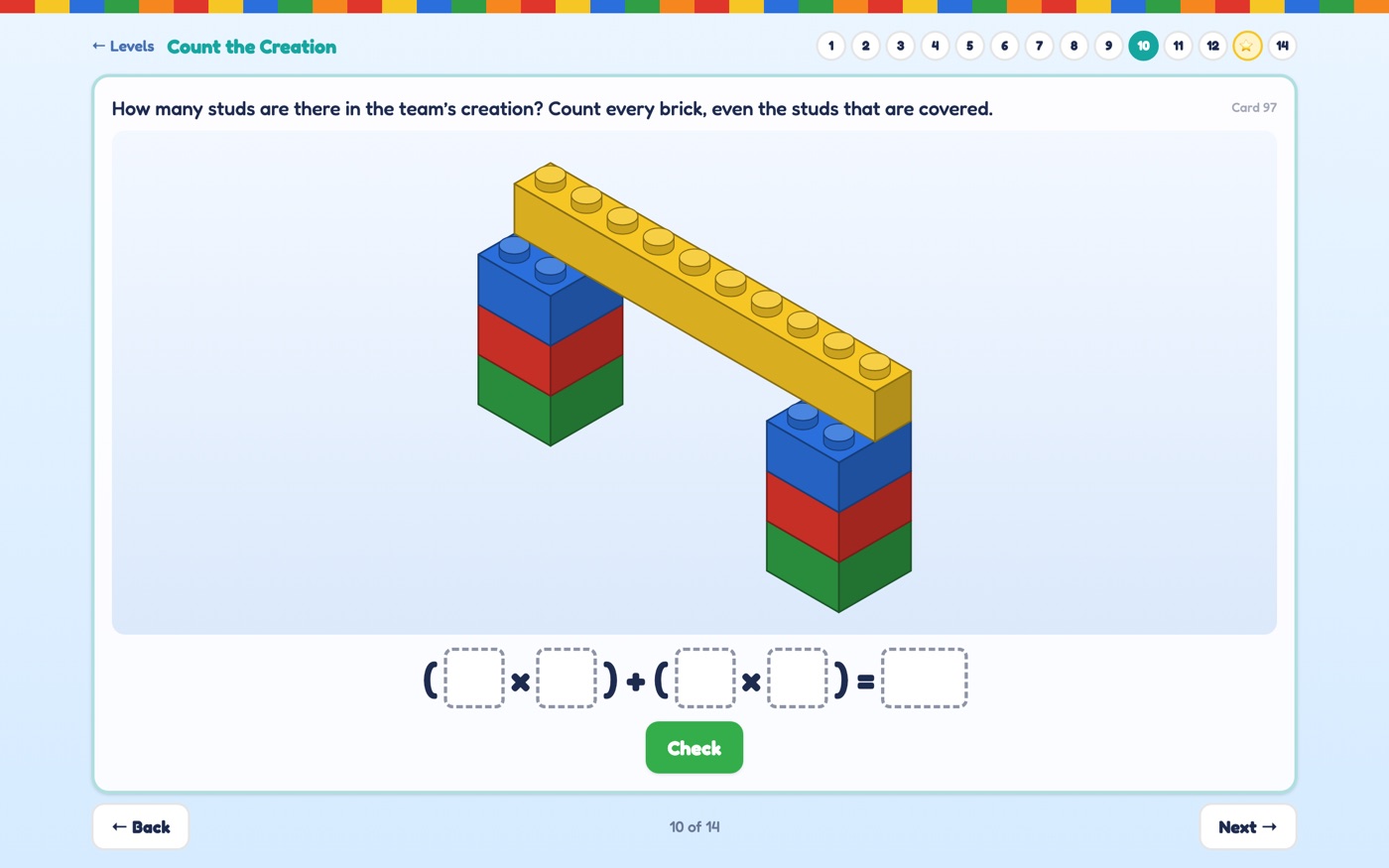
Now the bricks are stacked into 3-D models: towers, pyramids, bridges and gates. Students count every stud, even the ones covered by other bricks, which means thinking in groups rather than counting what they can see.
Bonus: Free Build
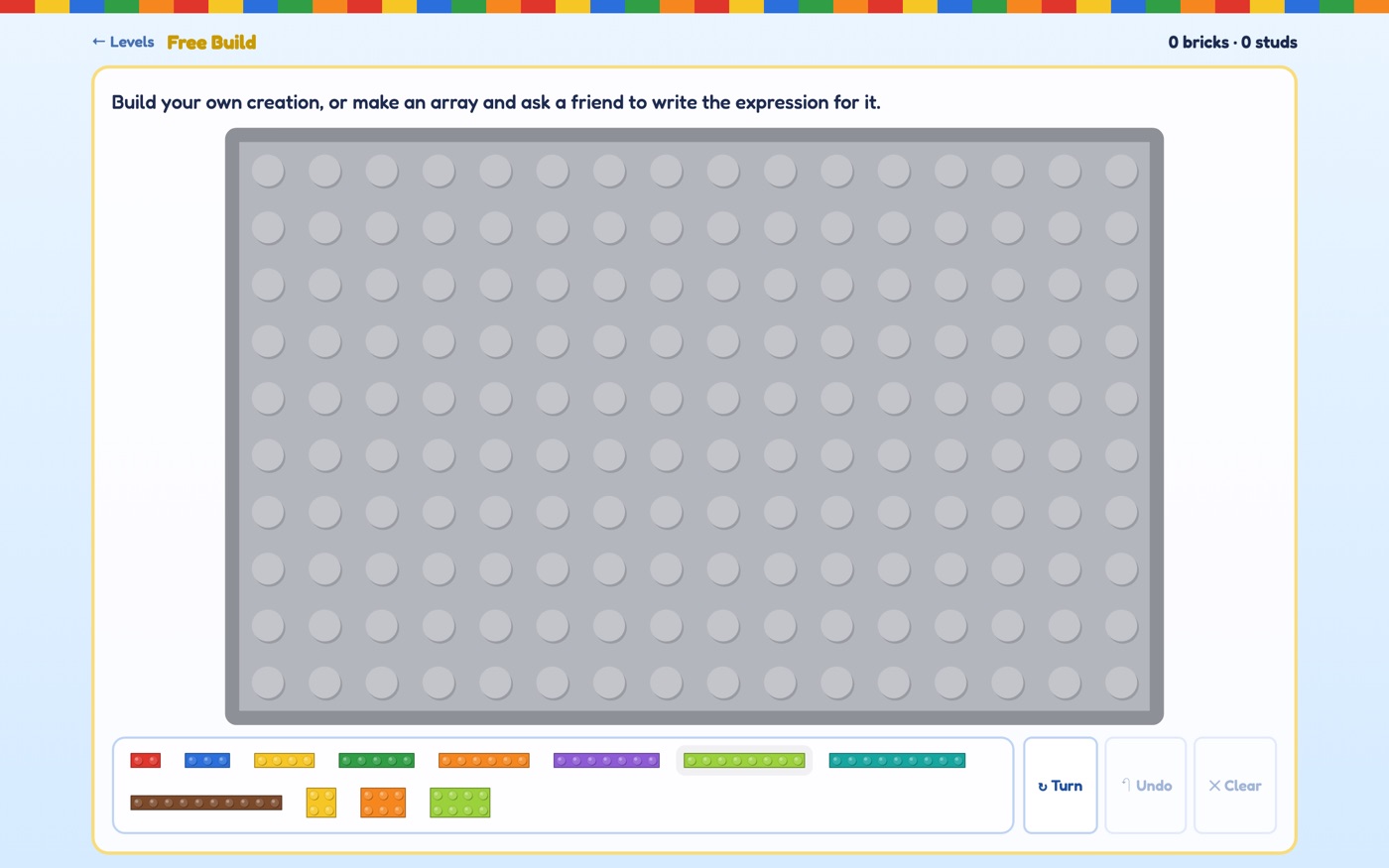
A big empty baseplate for building anything. A counter shows how many bricks and studs are on the plate. It works well for partner work: one student builds an array, and the other writes the expression for it.
What students practise
- Arrays and equal groups
- Multiplication as repeated addition
- Multiplication facts up to 10 × 10
- Factor pairs: finding every array for a number
- The commutative property: 3 × 7 = 7 × 3
- The associative property: (4 × 3) × 2 = (4 × 2) × 3
- The distributive property: 3 × (10 + 5) = (3 × 10) + (3 × 5)
- Writing expressions with brackets for a picture or model
Where it fits in your week
- Introducing multiplication. Build the first arrays together on the board.
- Math centres and stations. One device per student or pair.
- Small groups and intervention for students who still count every stud one by one.
- Early finishers. Can they find every array for 24?
- Review before an arrays or properties assessment.
Teaching tips
- Say the array out loud. "3 bricks with 7 studs each is 3 × 7."
- Use the colours. When students build, bricks of the same size are the same colour, so an array with two colours doesn't have equal groups.
- Turn it around. After 3 bricks of 7, ask what 7 bricks of 3 would look like, and whether it has the same number of studs.
- Talk about Match the Bricks. Why are (4 × 3) × 2 and (4 × 2) × 3 both right? Point to the bricks for each one.
- Count in groups in Level 6. Ask how many bricks of each size there are before counting any studs.
Standards
- 2.OA.C.4: Use addition to find the total number of objects arranged in rectangular arrays; write an equation to express the total as a sum of equal addends
- 3.OA.A.1: Interpret products of whole numbers as the total number of objects in equal groups
- 3.OA.A.3: Use multiplication within 100 to solve problems involving equal groups and arrays
- 3.OA.B.5: Apply properties of operations as strategies to multiply
Quick answers
Do students need accounts? No. It's a link, so there's nothing to sign in to.
What devices does it work on? Any device with a web browser, including Chromebooks, tablets and the classroom board. Bricks can be dragged, or tapped and placed, so it works well on touch screens.
What grades is it for? Grades 2 and 3. Levels 1 to 3 fit second grade arrays and equal groups, and Levels 4 to 6 bring in the third grade properties of multiplication.
Get Arrays with Bricks
Give students bricks to build with, and arrays stop being dots on a worksheet.
Get Arrays with Bricks on Teachers Pay Teachers
More from Math Curious
- Free the Monsters: a multiplication, division and factors game for grades 4 to 6
- Halloween Memory Match: Arrays: match arrays to their multiplication sentences
- Multiplication Facts Escape Room Adventures