Math Talks for Grades 3-5: Why Open-Ended Questions Matter, and 150 That Check Themselves
A Math Talk is a short, focused conversation about one picture or one problem, where the thinking matters more than the answer. Done regularly, math talks are one of the simplest ways to build number sense, reasoning and confidence in an elementary classroom.
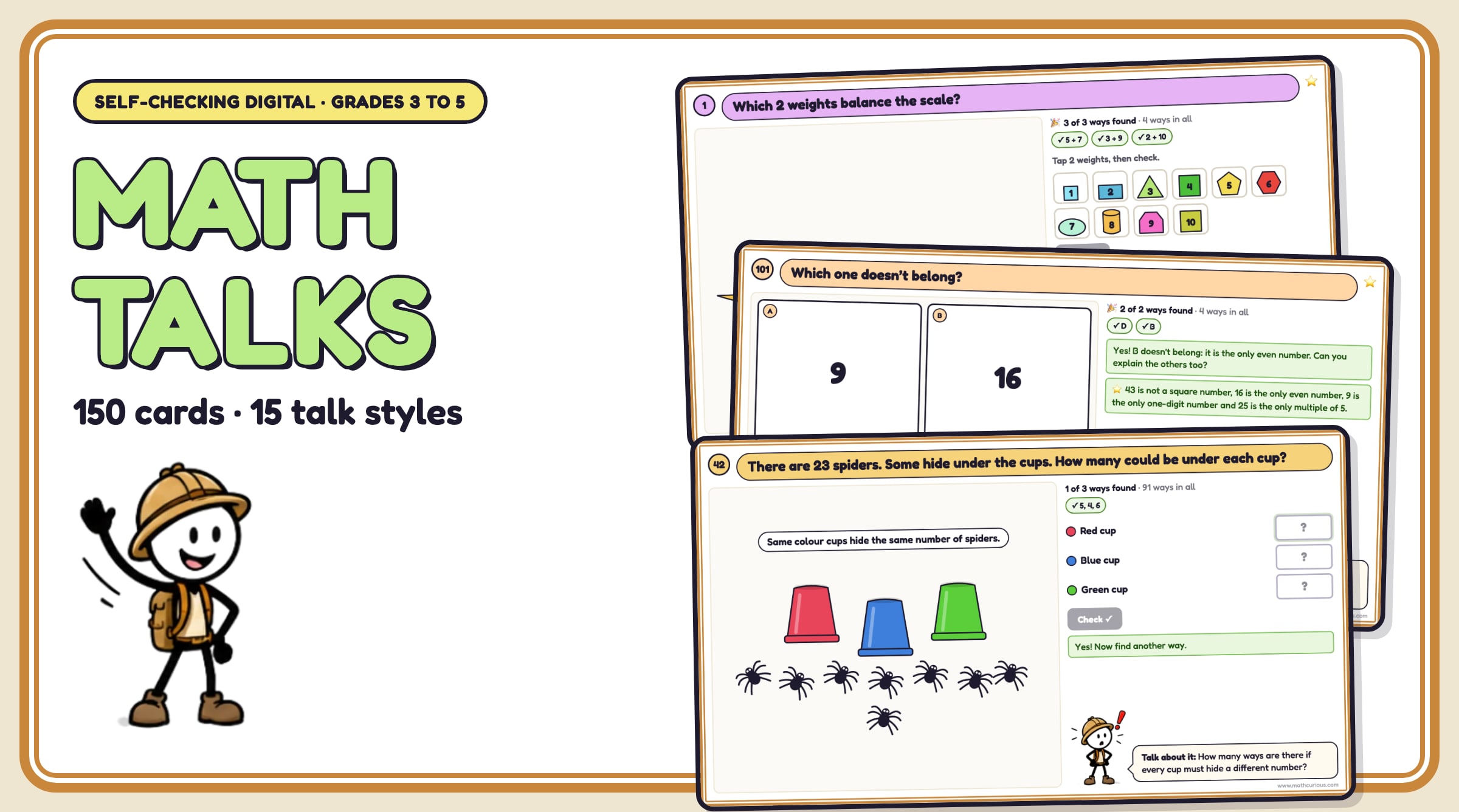
Math Talks 2 is our new set of 150 self-checking math talk cards for grades 3 to 5, in 15 different talk styles. Many cards have more than one right answer, and every card has a picture and a question to talk about. Below we look at why math talks work, why open-ended questions matter most, and what makes this set different.
Watch it in action
It runs in any web browser, one card at a time, so you can project it for the whole class or put it on student devices. There's nothing to print and no logins.
Why math talks matter
A worksheet tells you whether a student got the answer. A math talk tells you how they think. In a few minutes a day, students practise the skills that are hardest to teach with practice sheets:
- Explaining their reasoning. "I saw 4 rows of 6" or "I took 3 off both sides" puts a strategy into words. Students who can explain a strategy can use it again.
- Listening to other strategies. When a classmate saw the dots as 5 × 5 − 1, students learn a way they would never have tried on their own.
- Flexible number sense. Talks reward seeing numbers in more than one way: 24 as 4 × 6, as 3 × 8, or as 25 − 1.
- Critiquing reasoning. "Is that always true?" and "How do you know?" are exactly what the Common Core Standards for Mathematical Practice ask for, especially MP3: construct viable arguments and critique the reasoning of others.
- Confidence. When the discussion is about ideas, not speed, more students join in. A wrong idea becomes something to look at together rather than something to hide.
It's why number talks have become a daily routine in so many classrooms, and why the NCTM lists facilitating meaningful mathematical discourse among its core teaching practices.
Why open-ended questions matter most
Not every question starts a conversation. "What is 7 × 8?" has one answer: once someone says 56, the talk is over. Compare that with:
- "Which weights could balance the scale? How many ways can you find?"
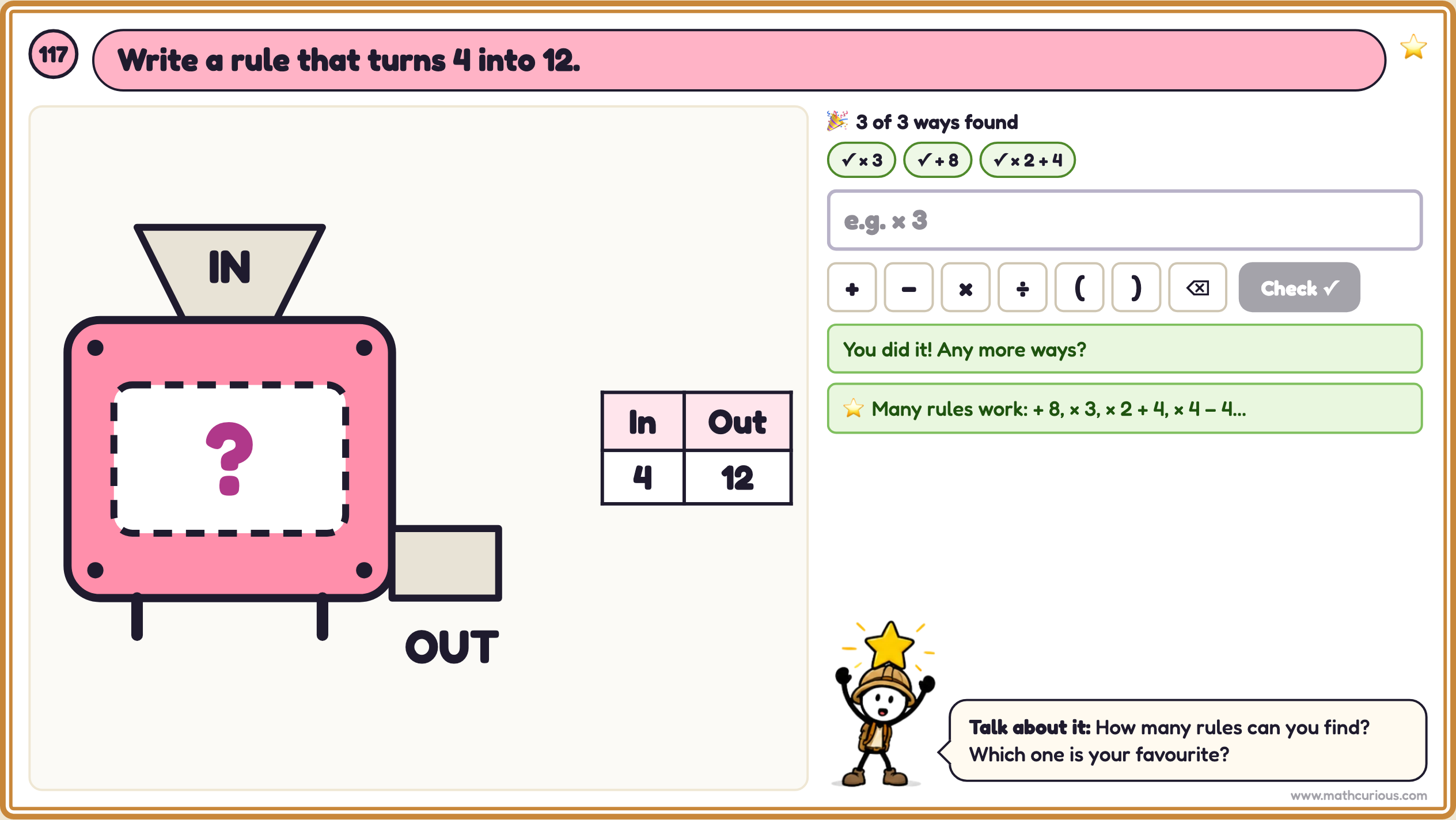
- "Write a rule that turns 4 into 12."
- "Which one doesn't belong? Why?"
- "How do you see the dots?"
These are open-ended. There's more than one right answer, so the first answer is the start of the talk, not the end of it. Open-ended questions:
- Give every student a way in. A student who finds one way to balance the scale has succeeded. A student who finds all of them, and can explain why there are no more, has gone much further. Both were working on the same question.
- Keep fast finishers thinking. "Can you find another way?" is a built-in extension.
- Show the structure of the maths. When the class lists every rule that turns 4 into 12 (+ 8, × 3, × 2 + 4…), the conversation turns to what the rules have in common. That's algebraic thinking in grade 3.
- Make comparing natural. With several right answers on the board, "Which way is quickest?" and "Why do they all work?" come up on their own.
The problem with open-ended questions
Teachers know all this, so why aren't open-ended questions everywhere? Because they're hard to check. A worksheet with one answer per question has an answer key. A question with dozens of right answers doesn't, and in a class of 25 there's no time to check every student's different way.
That's what we set out to solve.
What makes these Math Talks different
1. Open-ended cards that still check themselves
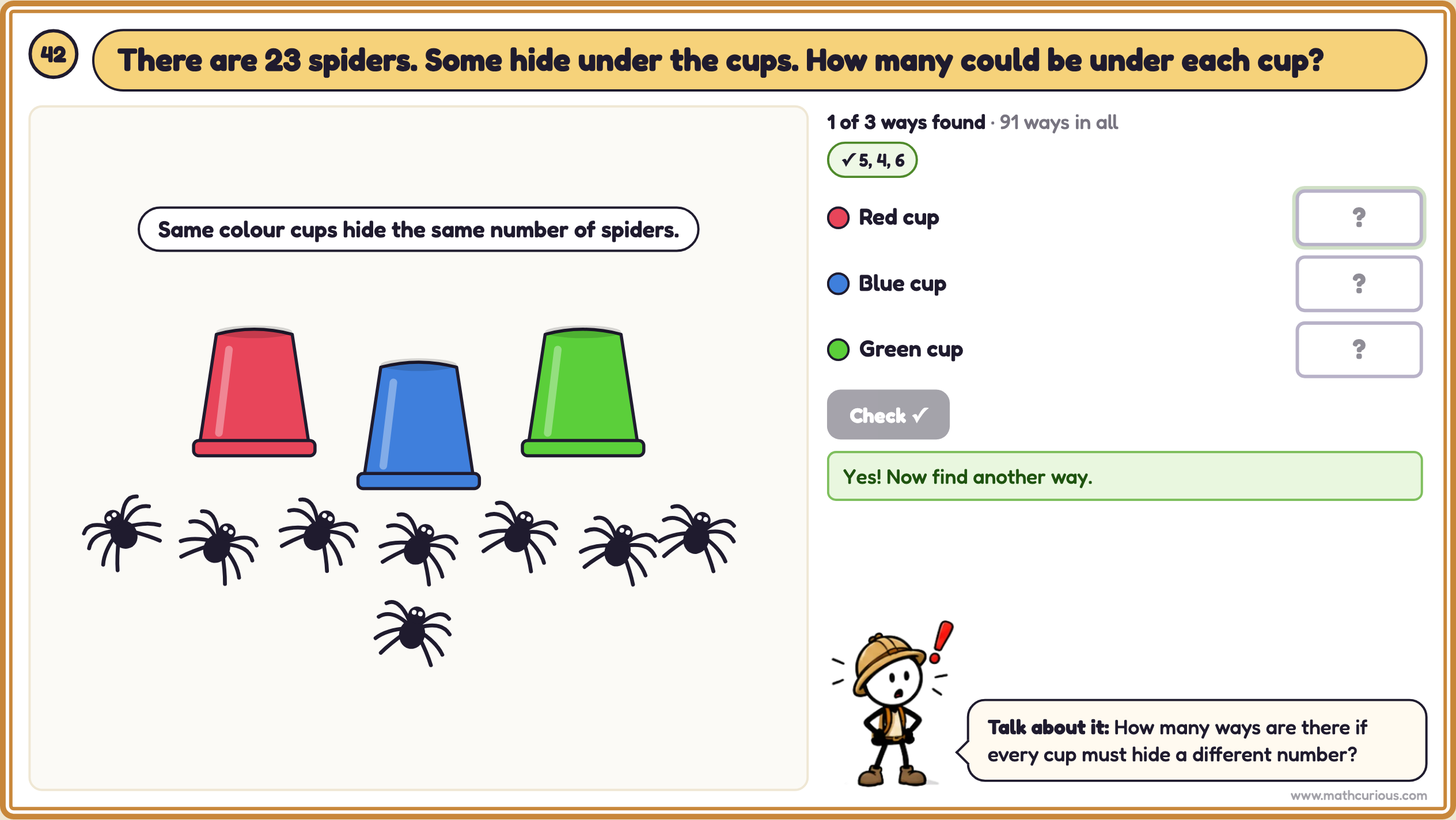
On an open-ended card, Math Talks accepts every correct answer, not just the one on an answer key. Students are asked for two or three different ways, and they see their ways collect on the card. Where there's a limit, it tells them how many ways exist in all, which starts the best talk question of all: "How do you know you found them all?"
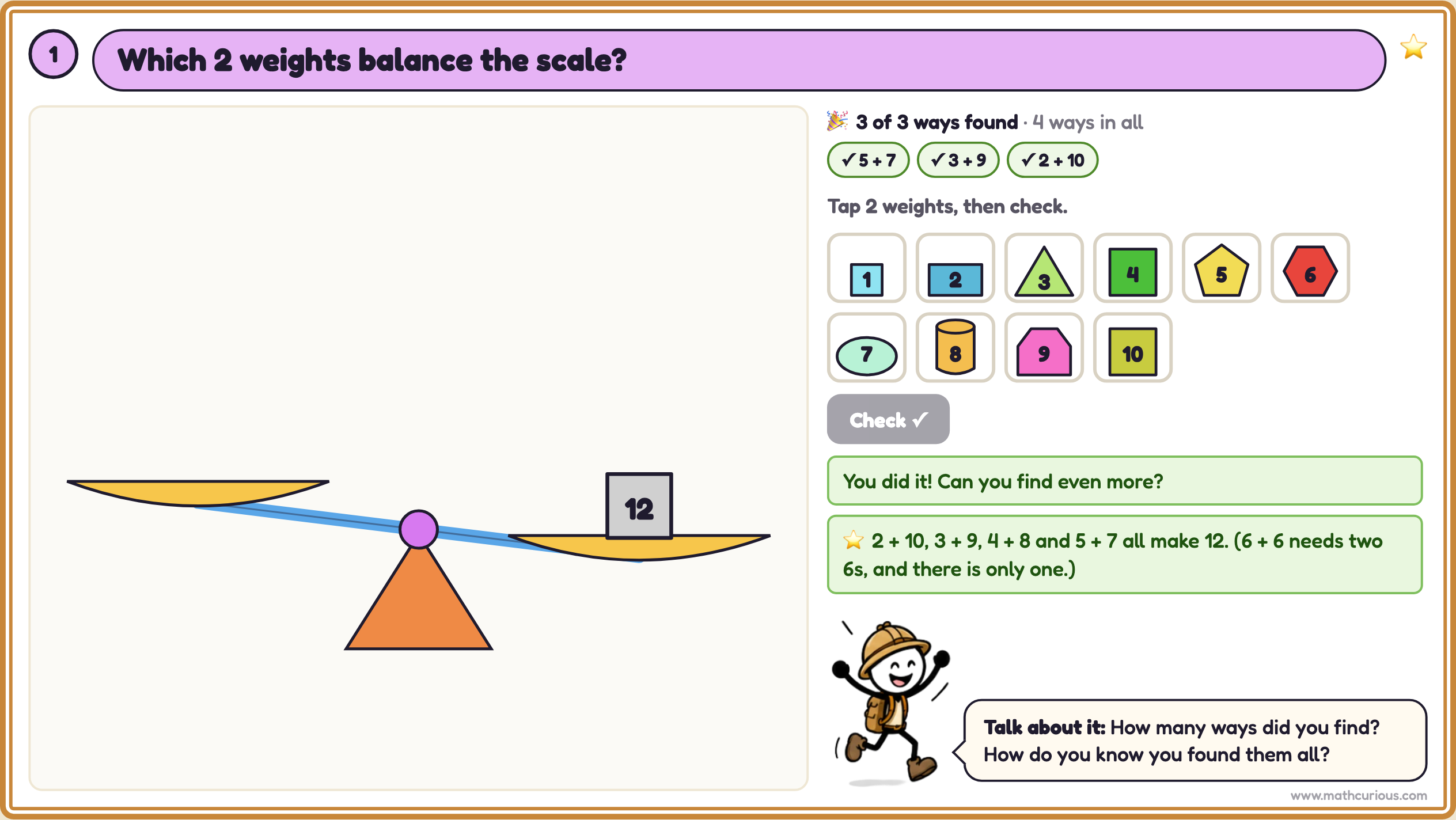
It works with numbers, tapped tiles, written rules and expressions. If a student writes a function-machine rule we never thought of, the card still knows whether it works.
2. Feedback that explains, not just "wrong"
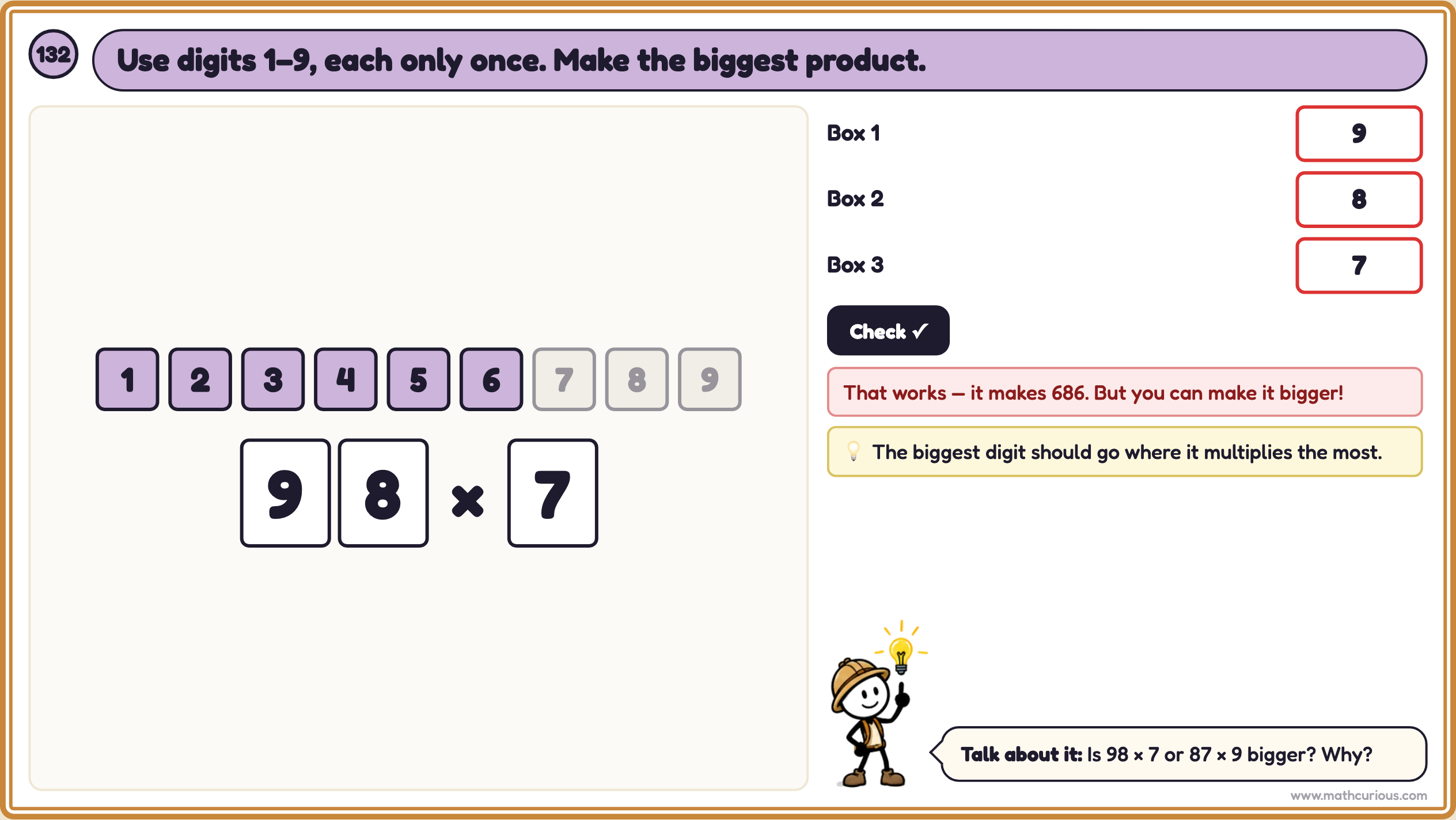
A wrong answer tells students what their answer actually does, like "Those add to 11. That side is still too light" or "Your rule turns 4 into 11, not 12". Then a hint appears. On "make the biggest" puzzles, a working answer that isn't the best yet gets "That works, but you can make it bigger!", so students keep improving instead of stopping at the first answer.
3. "Which one doesn't belong?" with real reasons
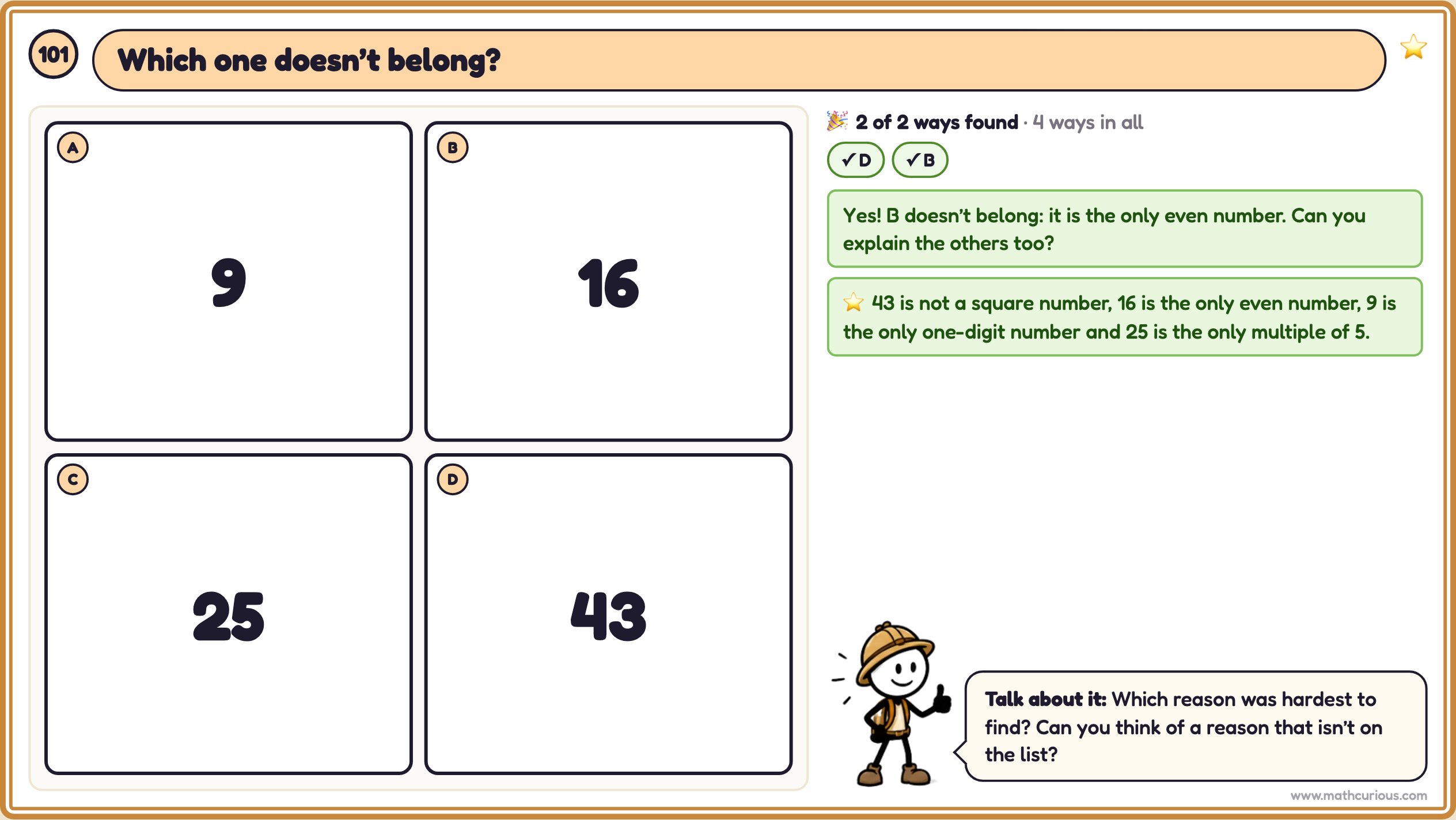
In Which One Doesn't Belong, every choice can be right. Students tap the one they think doesn't belong, then the reason, and the card checks that the reason really is true for that one alone. They're asked for two different answers, so they have to look at the set from more than one angle.
4. A question to talk about on every card
Every card ends with a Talk about it question, asked by our explorer buddy: "Did you count the hidden cubes?", "Why does the bag with fewer tens have more candy?", "Would you get the same answer if you swapped the machines?" Checking the answer is only half of a math talk. The talk question is the other half.
The buddy also reacts as students work: holding up a lightbulb when a hint appears, and cheering, jumping or lifting a trophy when the card is solved.
5. A picture on every card
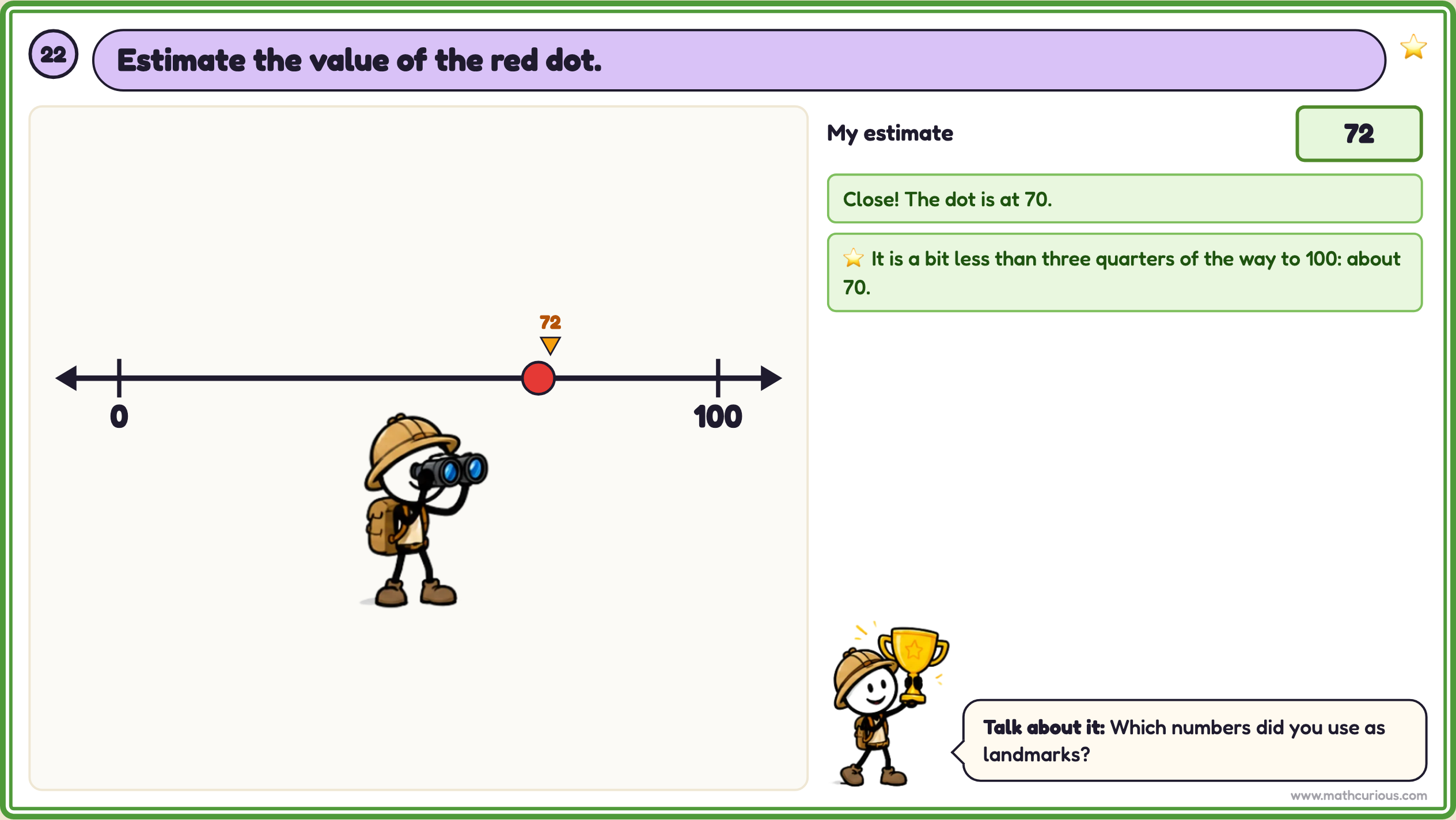
Math talks start with something to look at. Every card has a clear picture: balance scales, number lines, base-ten blocks, fraction strips, 3D cube structures, function machines, bar graphs and line plots. On number lines, the student's estimate appears right on the line, so they can see how close it was.
6. Fifteen talk styles
Doing the same kind of talk every day gets stale. Math Talks has 15 styles with 10 cards each, so you can match the talk to what you're teaching:
- Balance the Scales: weights and number sentences that must balance
- How Do You See It?: dot and ant pictures, counted in clever ways
- Number Lines: estimating whole numbers, fractions and decimals
- Representing Numbers: base-ten blocks, place value and fractions
- Spiders under the Cups: same colour cups hide the same number of spiders
- Shapes and Space: cube structures, area, perimeter and shape properties
- Would You Rather?: work out both deals, then decide
- Same or Different?: compare, then tick the true sentences
- Solution Steps: find the problem, find the mistake
- Puzzles: logic, patterns and number puzzles
- Which One Doesn't Belong?
- Function Machines: in, rule, out
- True or False?: number sentences to test and fix
- Open Middle: place the digits to make it work, or make the best answer
- Graph Talks: bar graphs, pictographs, line plots and tallies
7. Stars that mean something
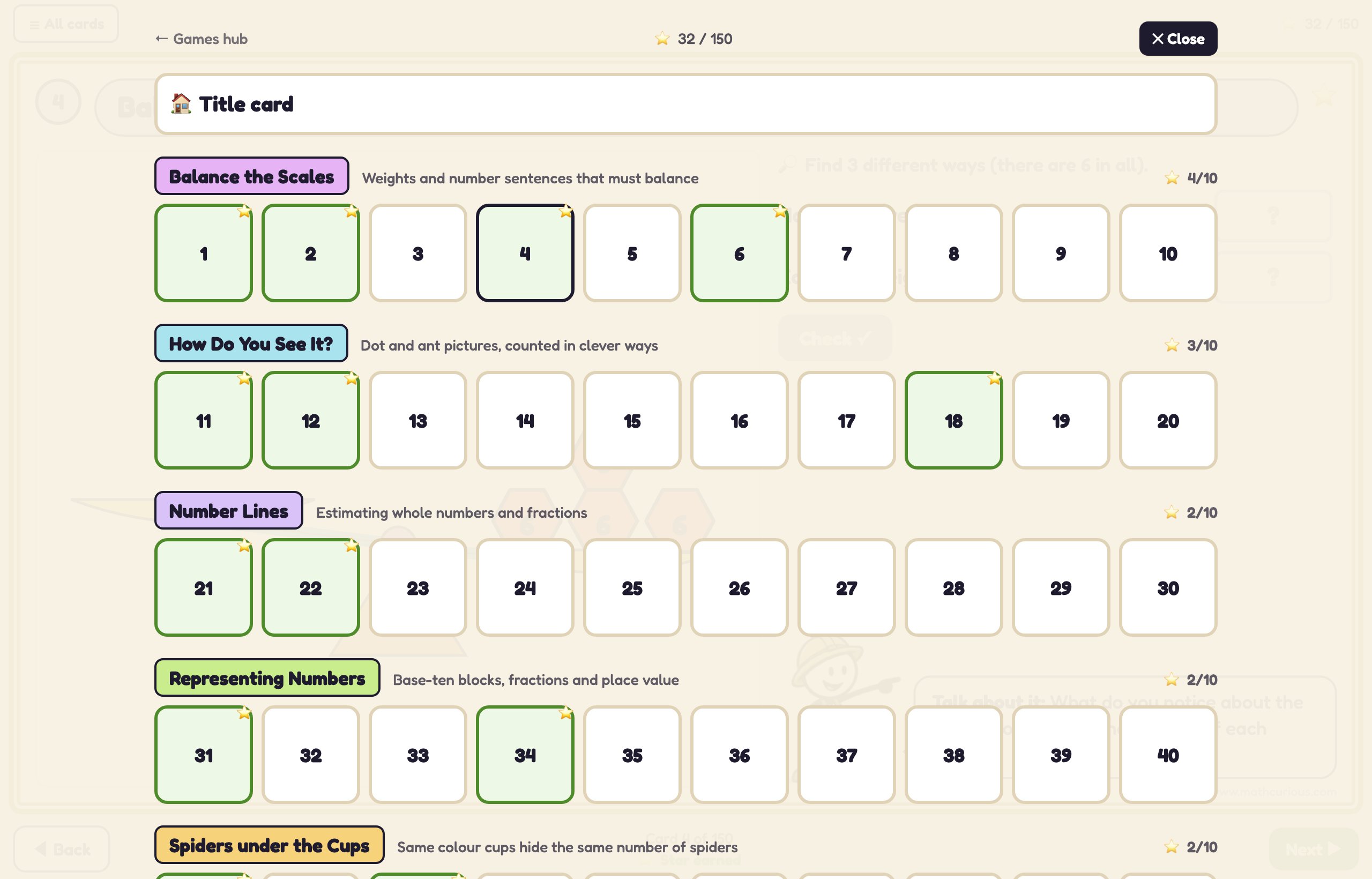
A right answer earns a star, but only if the student didn't ask to see the answer first. On multiple-choice and true-or-false cards the star only counts on the first try, so guessing doesn't pay. Stars are saved on the device, and All cards shows which ones each student has finished.
How to use Math Talks in your classroom
- Daily warm up. Project one card. Give quiet think time with no hands up, then collect strategies before anyone presses Check.
- Collect every answer. On open-ended cards, write each different answer on the board, then ask what they have in common and whether there are more.
- Use the talk question to close. It works well as a turn-and-talk or a quick exit ticket.
- Centers and early finishers. Because every card checks itself, students can work through a section on their own.
- Pick by topic. Teaching fractions? Use Number Lines and Representing Numbers. Graphs? Graph Talks. Multiplication? Spiders under the Cups and How Do You See It?
Quick answers
Do students need accounts? No. It's a link, so there's nothing to sign in to.
What devices does it work on? Any device with a web browser, including Chromebooks, iPads, laptops and the classroom board.
What grades is it for? Grades 3 to 5. Every section starts gently and gets harder, so third graders and fifth graders can both find the right card.
Do I need an answer key? No. Every card checks itself, including the open-ended ones, and every card has a hint.
Get Math Talks
150 cards, 15 talk styles, and open-ended questions that check themselves. Bring better math conversations to your classroom every day.
Get Math Talks on Teachers Pay Teachers
More from Math Curious
- Math talks, number talks and meaningful math discussions
- Mental Math Strategies for Multiplication: 107 self-checking problems for grades 3 to 5
- Problem Solving Strategies: 112 self-checking word problems
- Math Puzzles