Balance Builders: Solving Equations with Integers on a Balance Scale
"Do the same thing to both sides." Every student who has solved an equation has heard it, and most can recite it. But ask why it works, or what to do with x − (−15) = −40, and the rule starts to wobble. Add negative numbers to the mix and equations become a place where students guess at signs instead of reasoning.
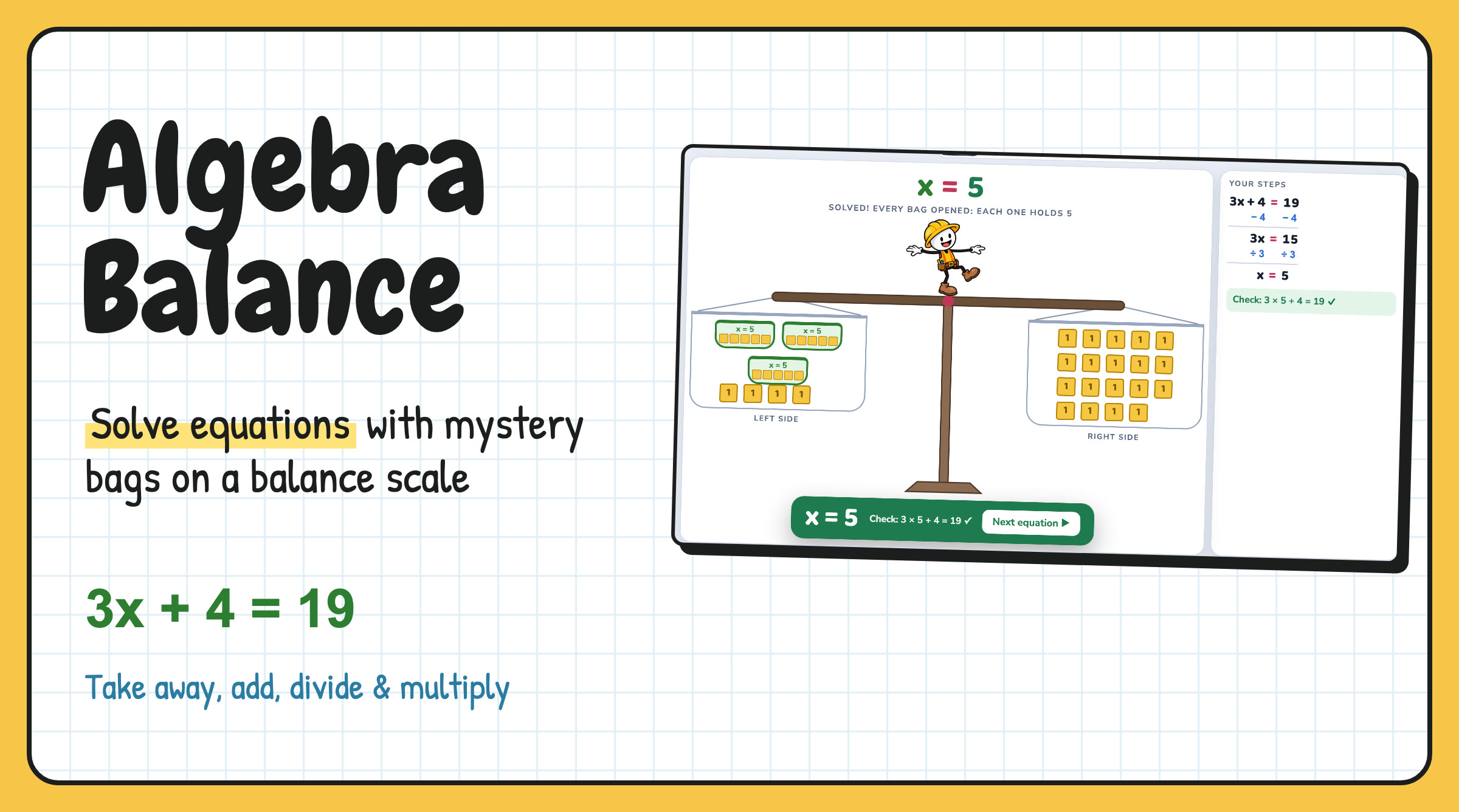
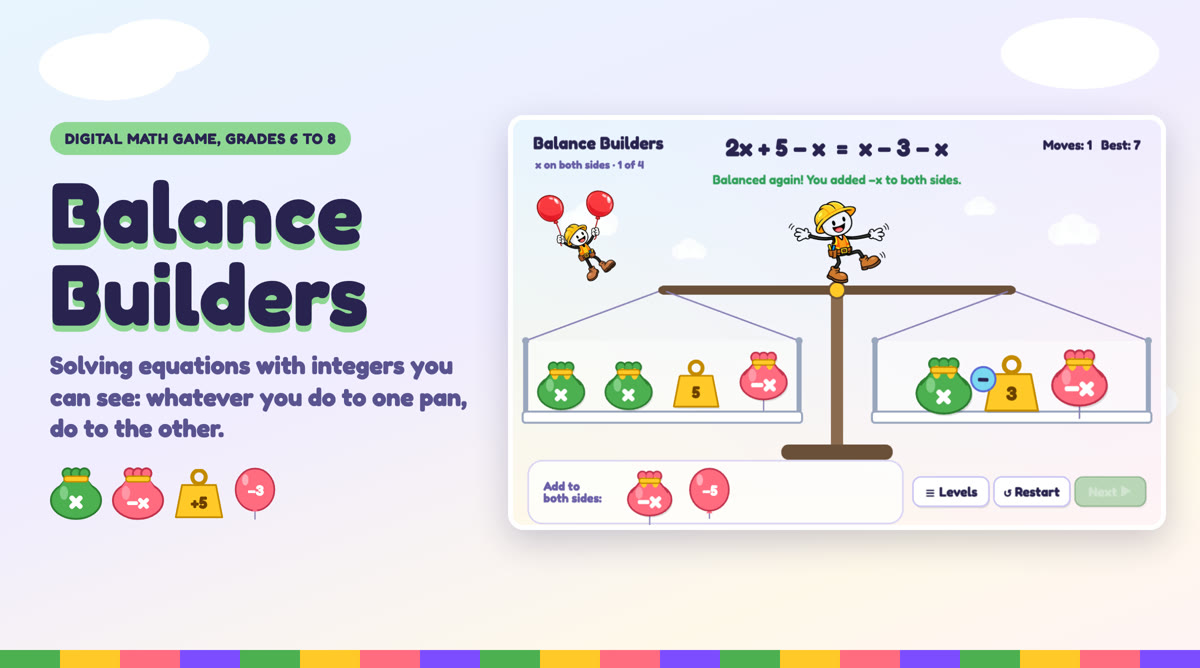
A balance scale fixes that, because it shows the rule instead of telling it. Balance Builders is a digital puzzle game for grades 6 to 8 where students solve equations with integers on a scale: weights pull a pan down, balloons lift it up, and a green bag hides x.
Watch it in action
It plays in any web browser. There's nothing to print or set up, and students don't need logins.
The big idea: a scale that never lies
An equation says two things are equal, so the scale starts level. Each piece on a pan is a term:
- A gold weight is a positive number. It pulls its pan down.
- A pink balloon is a negative number. It lifts its pan up.
- The green bag is x, the mystery number.
- A pink bag is −x, the opposite of x.
A weight and a balloon of the same size cancel out: that's a zero pair. So do x and −x. And there's one rule for every move in the game: whatever you do to one pan, do to the other. If a student puts something on one pan only, the scale tips and the equation turns red with ≠.
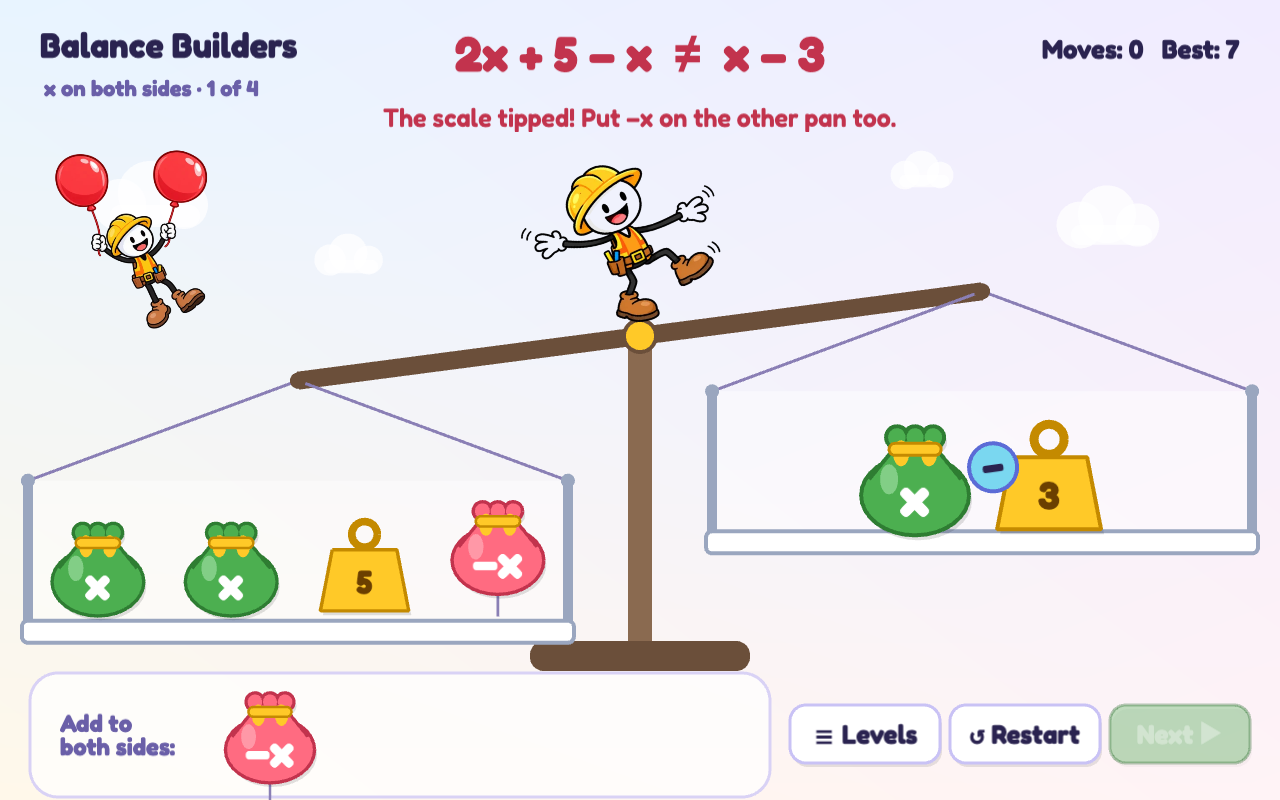
Step by step: 2x + 5 = x − 3
Here's how a student solves an equation with x on both sides. The game writes the equation after every move, so the algebra is always on screen.
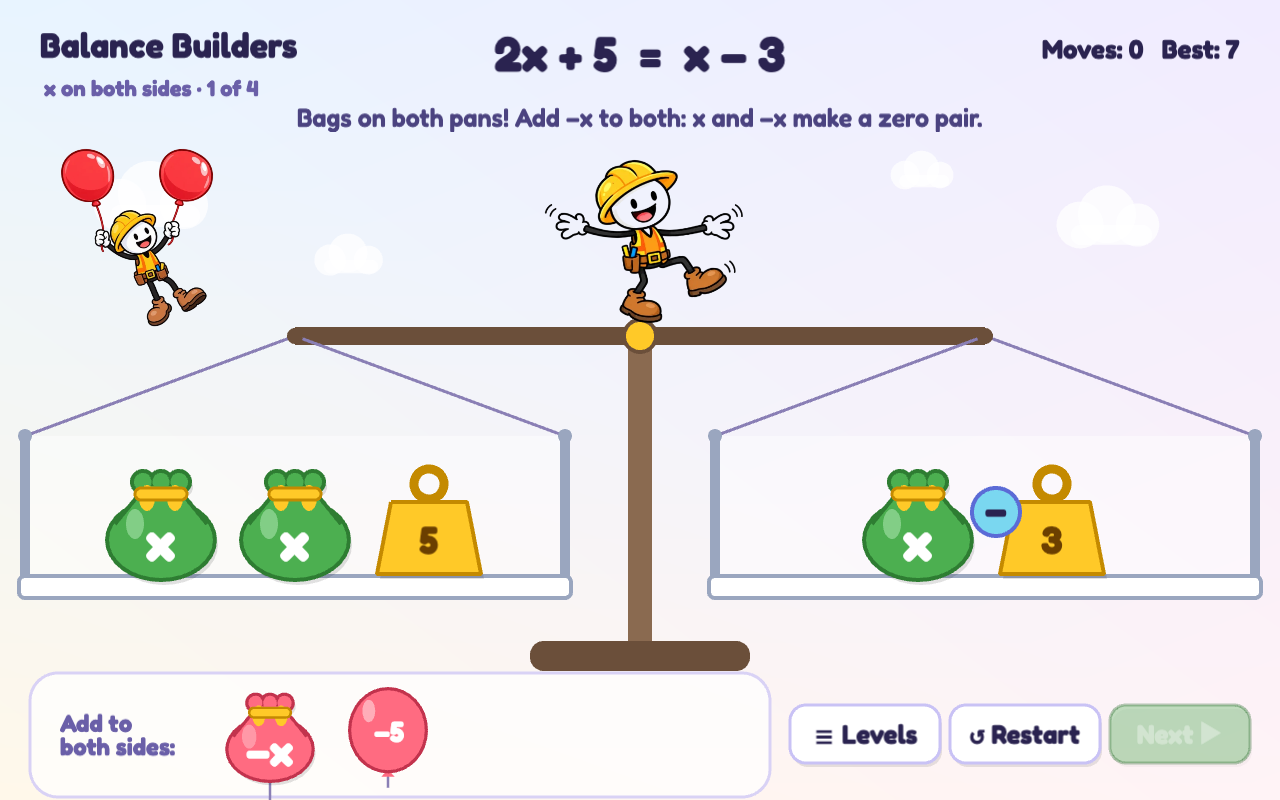
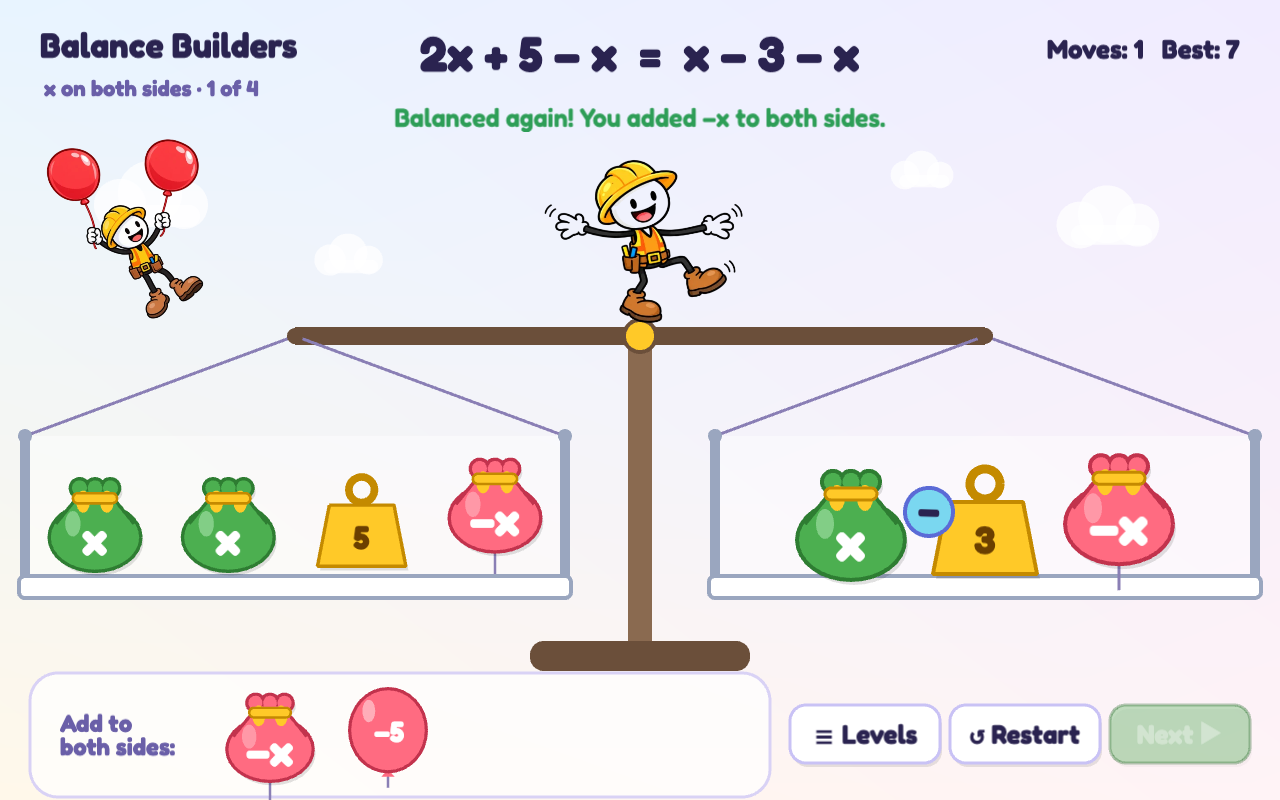
- Add −x to both sides. The student drags the pink −x bag from the tray onto the left pan (the scale tips), then onto the right pan (it's level again).
- Cancel the zero pairs. On each pan, x and −x disappear: x + (−x) = 0. Now it's x + 5 = −3.
- Flip the subtraction. The 3 has a − badge because it's being subtracted. One tap turns − 3 into + (−3), and the weight becomes a balloon.
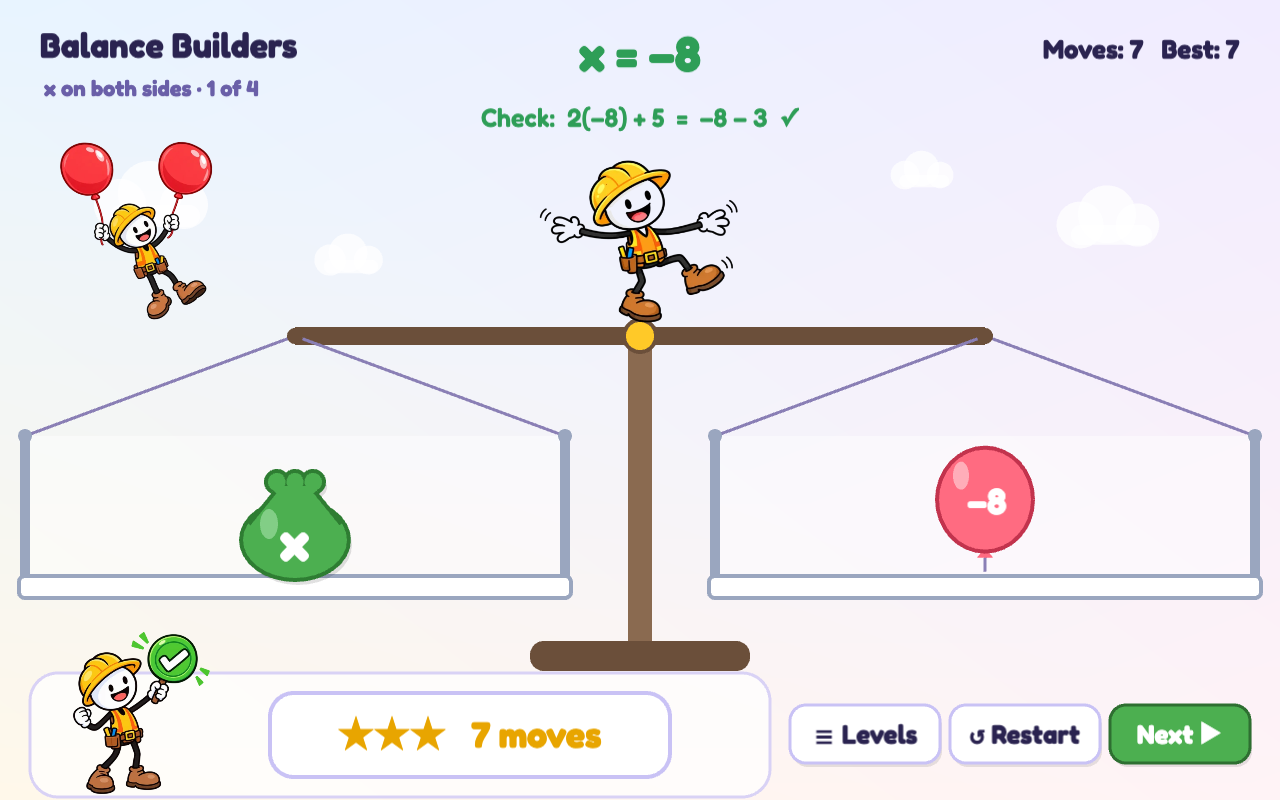
- Add −5 to both sides and cancel again: 5 + (−5) = 0 on the left, −3 + (−5) = −8 on the right.
When the bag is alone, the game checks the answer by putting it back into the original equation: 2(−8) + 5 = −8 − 3 ✓. Seven moves earns three stars, and a student who took ten moves will want to try again and find a better plan.
Where the integers come in
Subtracting a negative
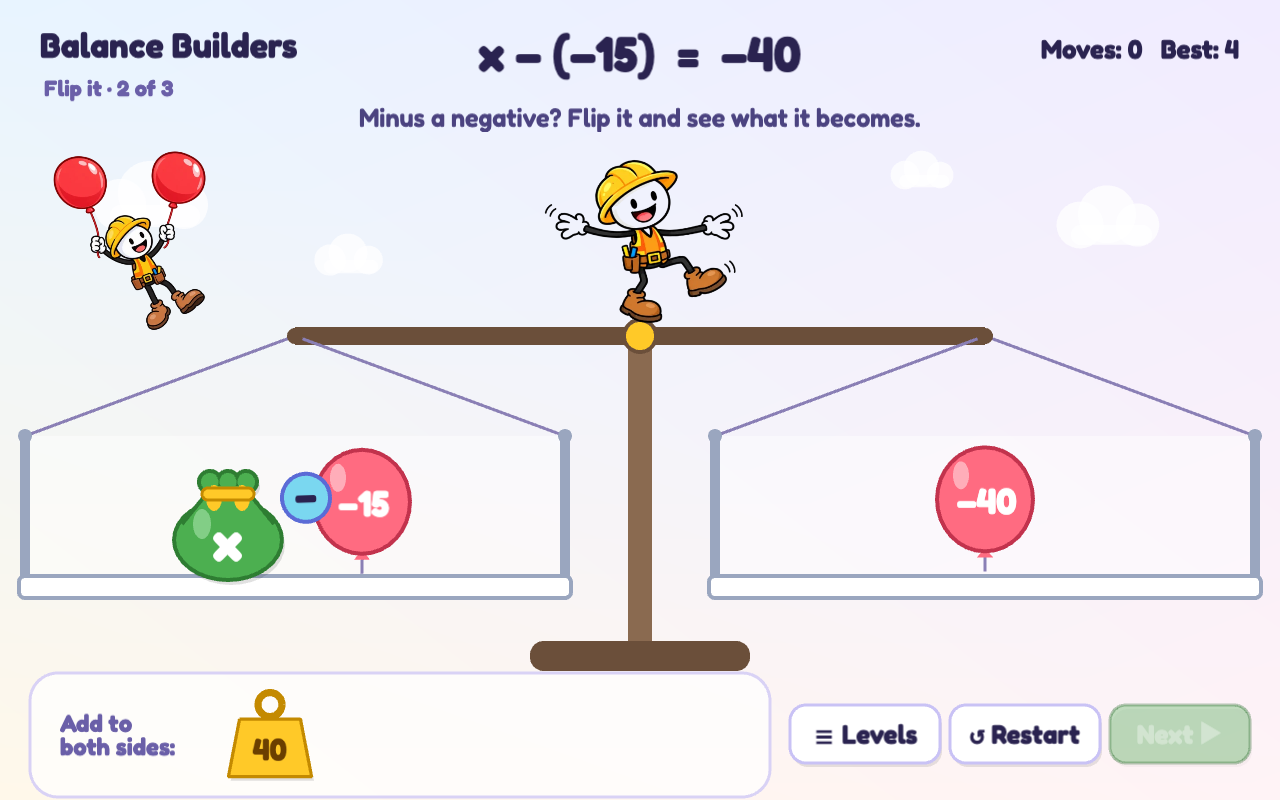
Most of the answers in the game are negative, and many equations subtract a negative, like x − (−15) = −40. On the scale, the −(−15) is a balloon with a − badge: it's being taken away. Taking away a balloon makes the pan heavier, the same as adding a weight. So when a student taps it, the balloon turns into a 15 weight, and the game says so: "taking away a balloon pulls down like a weight!"
Share it: dividing both sides
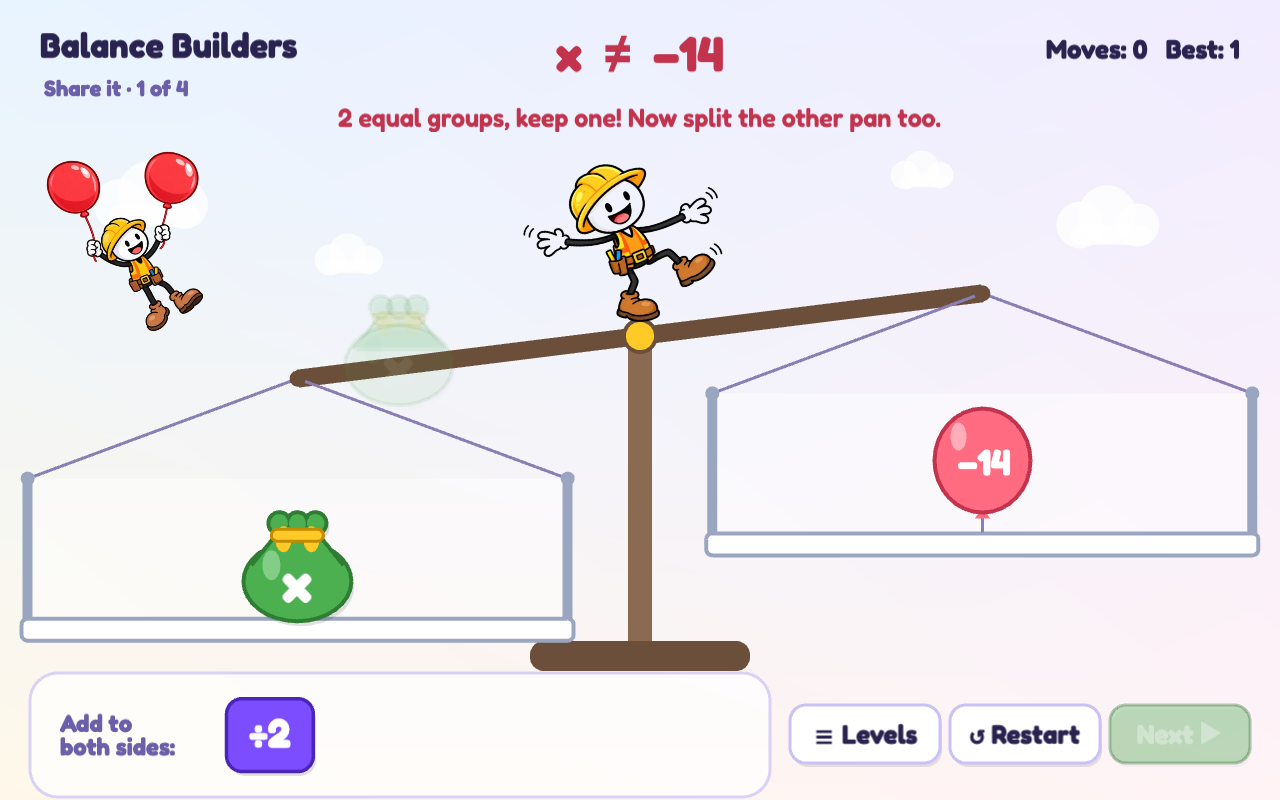
For 2x = −14, students drag a ÷2 card onto each pan. Each pan splits into two equal groups and keeps one: one bag on the left, a −7 balloon on the right. The ÷ card only shows up when everything on the scale splits evenly, which starts a great conversation about why 4x − 6 = −30 can't be divided by 4 until the 6 is gone.
Opposite x
What about −x = 9? The pink −x bag is alone, but it's the opposite of x. Students tap it to flip both pans: if the opposite of x is 9, then x is −9. It's the same idea as multiplying both sides by −1, shown as one clear move.
- x = −9. Add −7 to both sides.
- x = −2. Flip: x + 6 = 4, then add −6 to both sides.
- x = −9. Join −9 and 3 to get −6, then add 6 to both sides.
- x = −8. Split both sides into 3 equal groups.
- x = −6. Add 5 to both sides (2x = −12), then split into 2 groups.
- x = −7. Add −x to both sides (2x + 4 = −10), add −4 (2x = −14), then split into 2 groups.
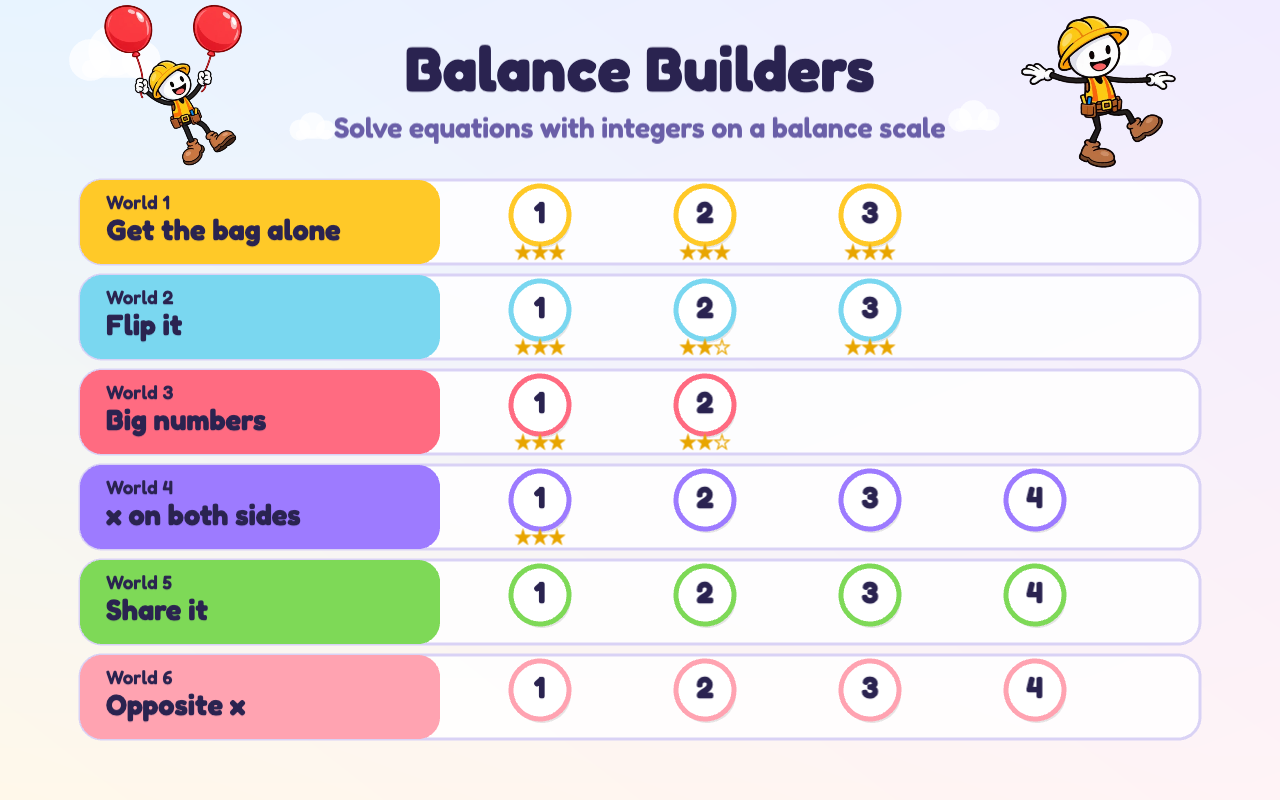
Six worlds, 20 levels
- World 1, Get the bag alone: x + 4 = 9, x + (−3) = 5, −7 + x + 12 = −20
- World 2, Flip it: x − 6 = −10, x − (−15) = −40, 25 = x − 40
- World 3, Big numbers: 120 + x − 80 = −35, −60 + x − (−15) = 90 − 140
- World 4, x on both sides: 2x + 5 = x − 3 up to −35 + 2x + 60 = x − 90 + 15
- World 5, Share it: 2x = −14 up to 3x + 8 = x − 12
- World 6, Opposite x: −x = 9 up to −35 − 3x = 25
Tips for the classroom
- Predict before you move. On the board, ask "What will the scale do if we only add to the left pan?" before anyone drags a piece.
- Write it down. Have students copy the equation after each move. By the end of a level, they've written a full worked solution.
- Chase three stars. The fewest moves is a great challenge for early finishers, and it rewards planning: tidy each pan first, then cancel.
- Talk about the ÷ card. Why does it appear in some levels and not others? That question is all about factors and like terms.
Get Balance Builders
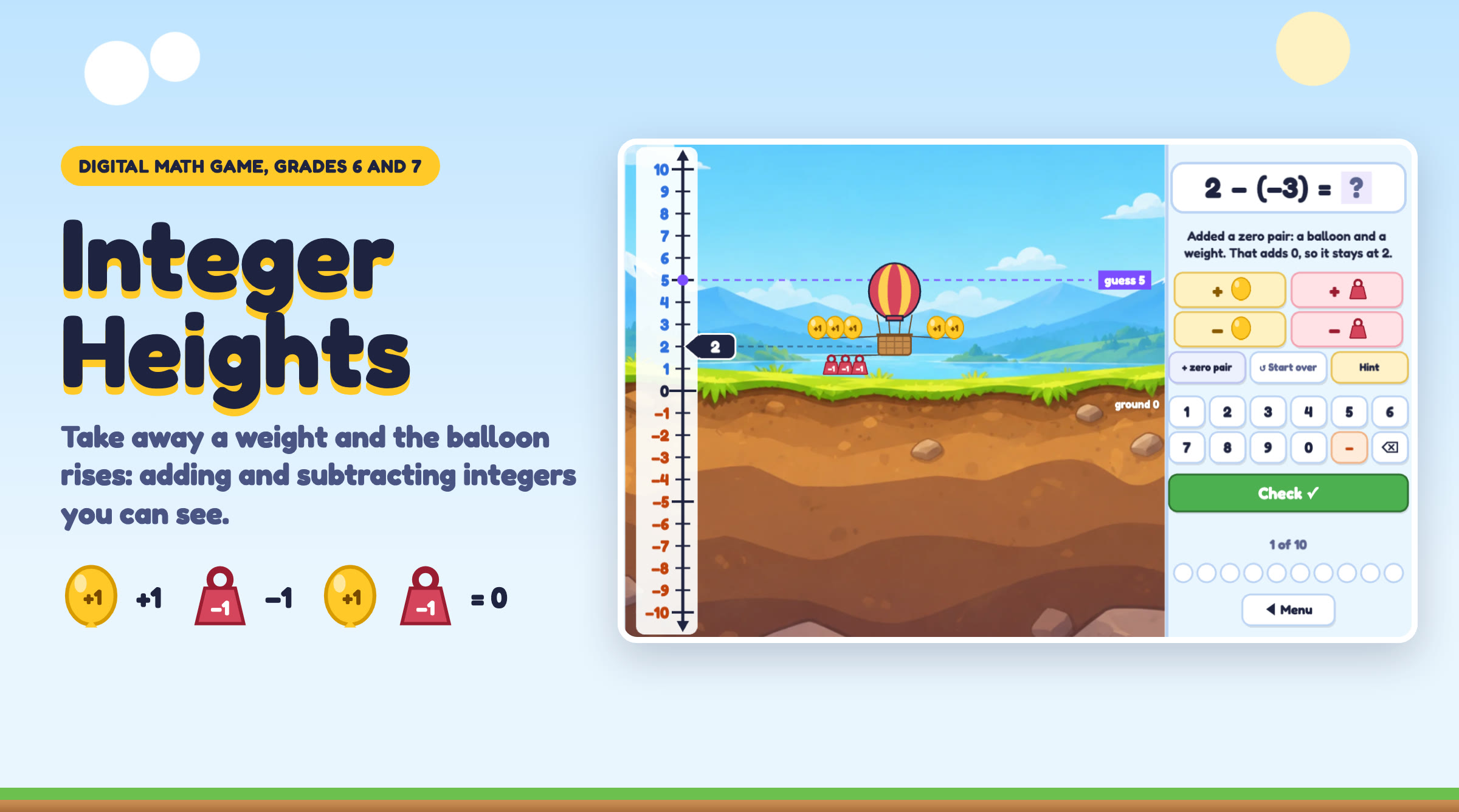
Balance Builders covers integer operations (7.NS.A.1), one-step and two-step equations (6.EE.B.7, 7.EE.B.4a) and equations with variables on both sides (8.EE.C.7b), with self-checking and no prep. Pair it with Integer Heights to build integer understanding first.