Adding and Subtracting Integers You Can See: Zero Pairs and a Hot Air Balloon
Subtracting a negative is the moment many students stop understanding integers and start memorising rules, and rules that aren't understood get mixed up: "two negatives make a positive" turns into −2 + (−3) = 5.
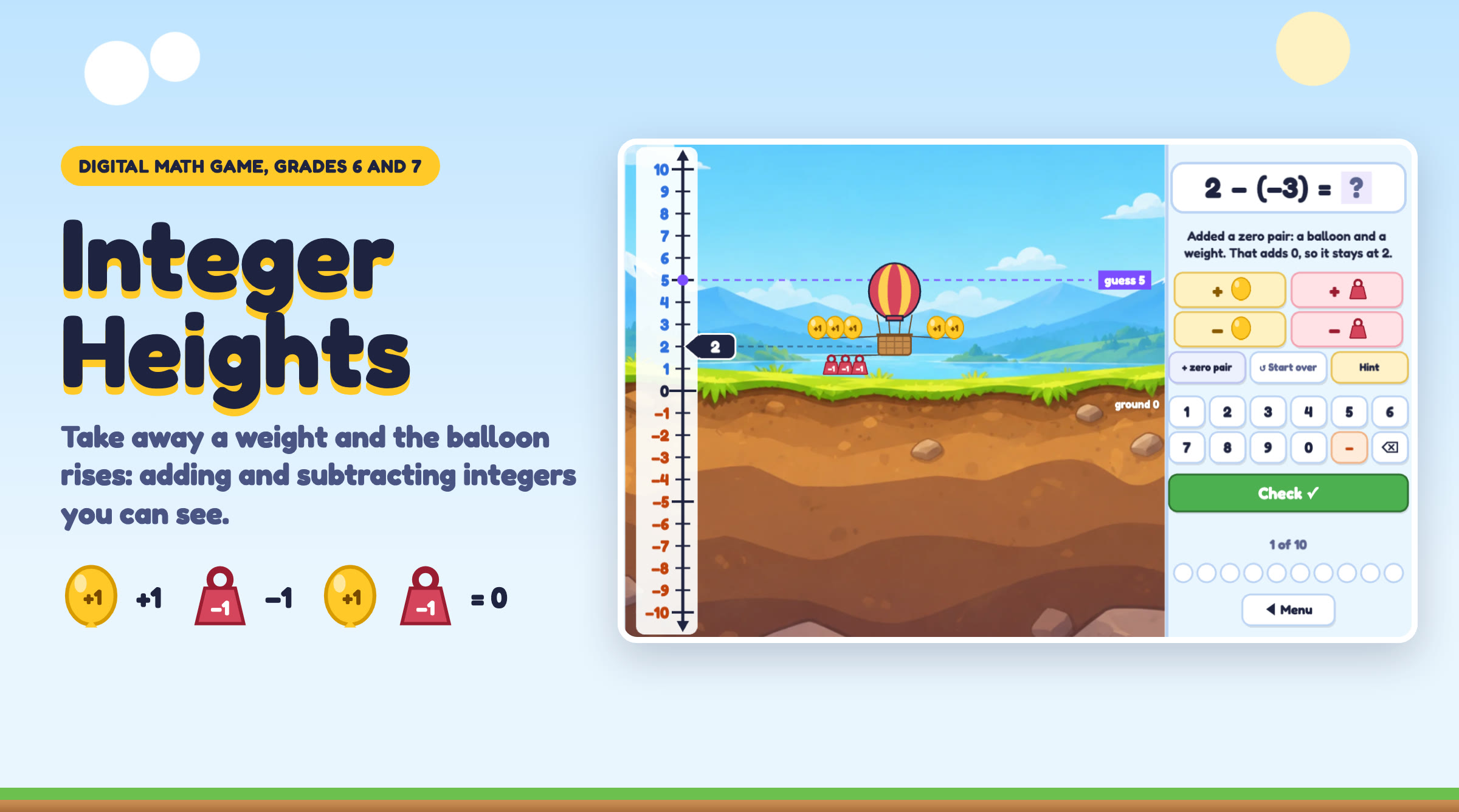
The fix is a model students can see. Integer Heights is a digital game for grades 6 and 7 where a hot air balloon floats on a vertical number line from −10 to 10. Balloons lift it up, weights pull it down, and every integer expression becomes something students can act out and watch.
Watch it in action
It plays in any web browser. There's nothing to print or set up, and students don't need logins.
The big idea: balloons and weights
Every balloon tied to the basket is +1: it lifts the basket one step. Every weight hanging underneath is −1: it pulls the basket down one step. A balloon and a weight together cancel out. That's a zero pair, worth 0.
The basket's height is the number. Above 0 is the sky, below 0 is underground.
Now the operations have a meaning students can see:
- + a positive: add balloons. Lighter, so it rises. 3 + 2 = 5
- + a negative: add weights. Heavier, so it sinks. 3 + (−5) = −2
- − a positive: take away balloons. Heavier, so it sinks. 3 − 4 = −1
- − a negative: take away weights. Lighter, so it rises! −1 − (−4) = 3
That last one is the whole point. Subtracting a negative makes the number bigger because taking away a weight makes the balloon rise. Students don't need a rule; they can see it.
When there's nothing to take away: zero pairs
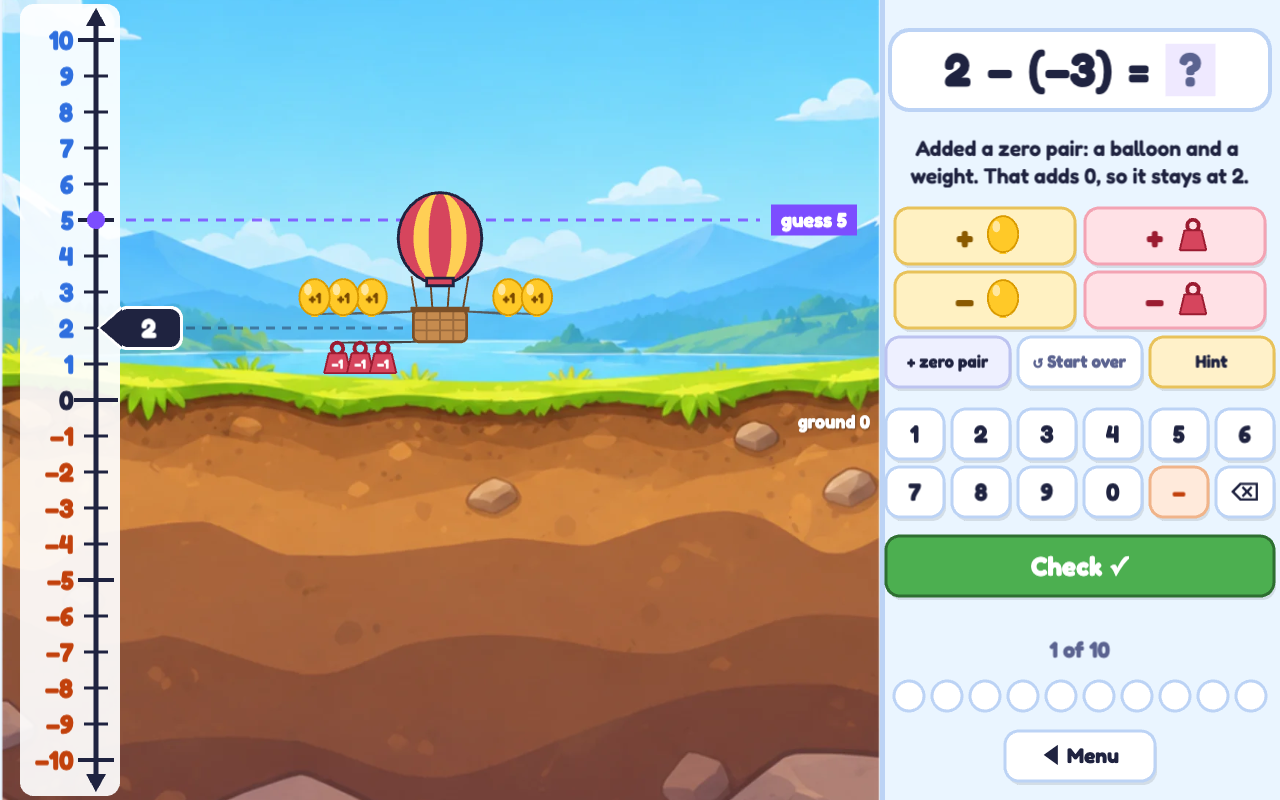
What about 0 − (−2)? The balloon starts at 0 with nothing on it, so there are no weights to take away.
- Add 2 zero pairs: 2 balloons and 2 weights. They add 0, so the balloon stays at 0.
- Now take away the 2 weights.
- Only the 2 balloons are left, and the balloon rises to 2.
So 0 − (−2) = 2, the same as 0 + 2. The first time students need zero pairs, the game works an example for them, then it's their turn.
Inside Integer Heights: 7 levels
1. Free Flight
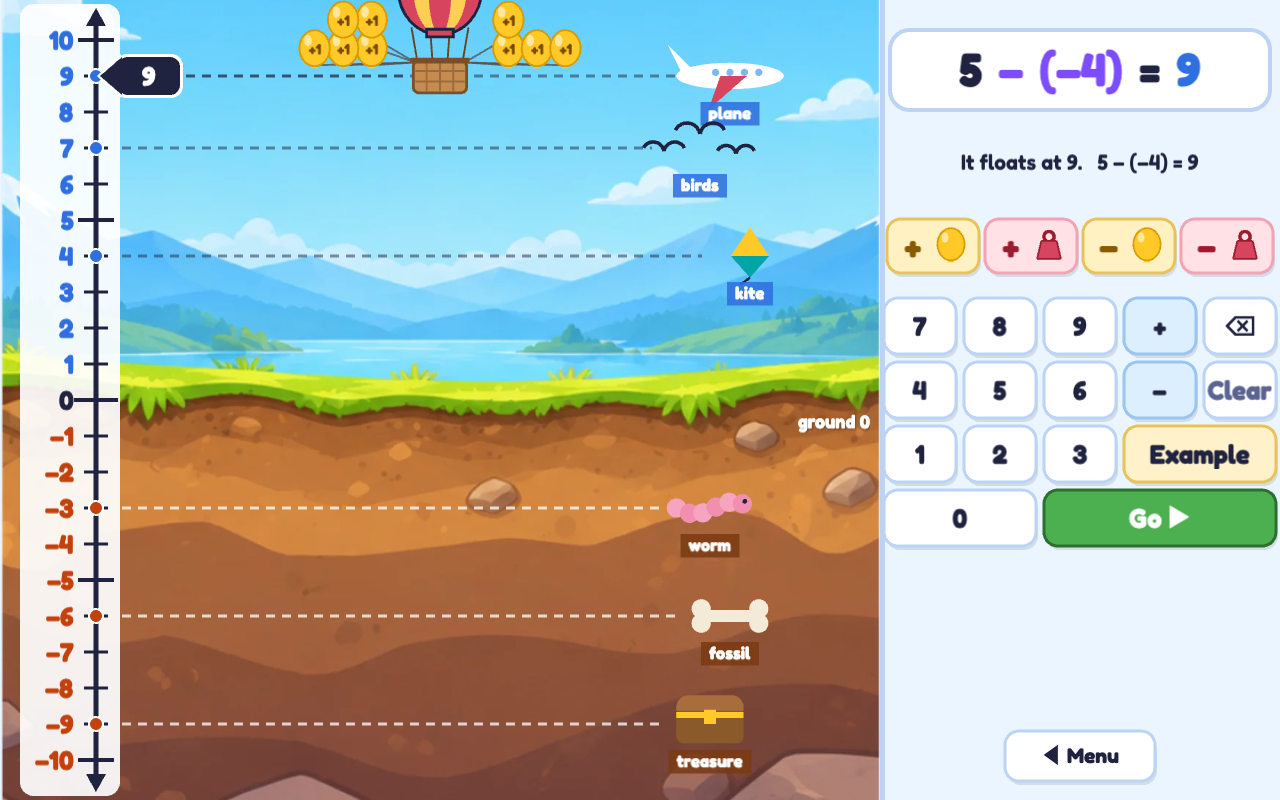
Students add and take away balloons and weights one at a time, or type any expression and watch the balloon act it out, step by step, with every move explained in words. Landmarks give them places to fly to: a plane, birds and a kite in the sky, and a worm, a fossil and buried treasure underground.
2. Solve It: predict, act it out, explain
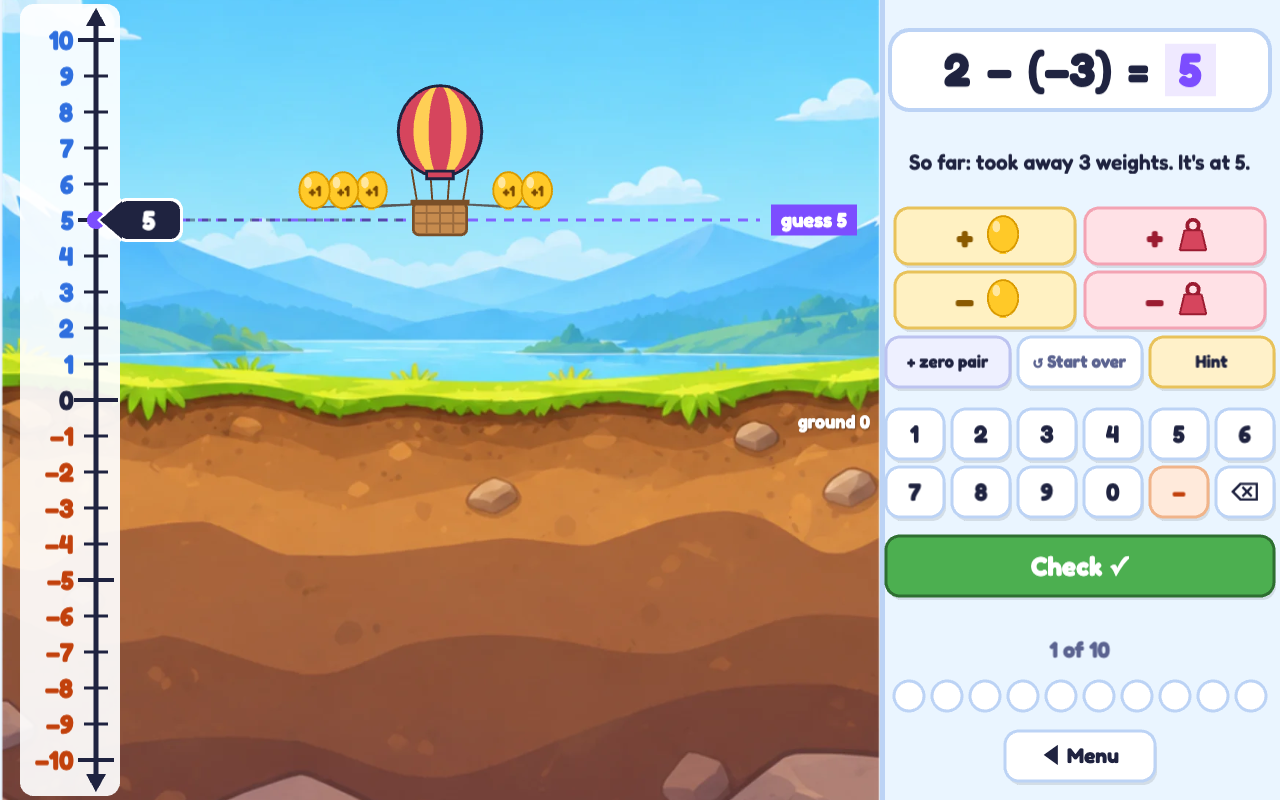
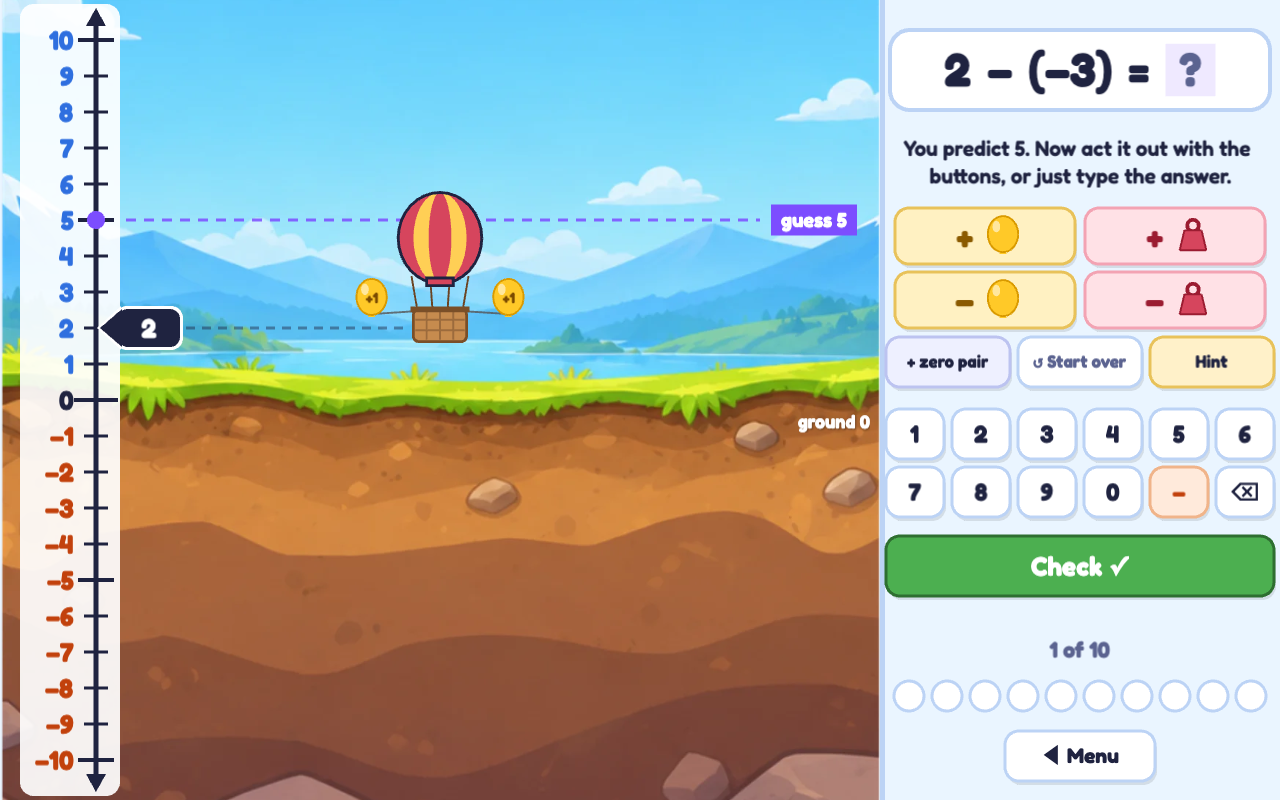
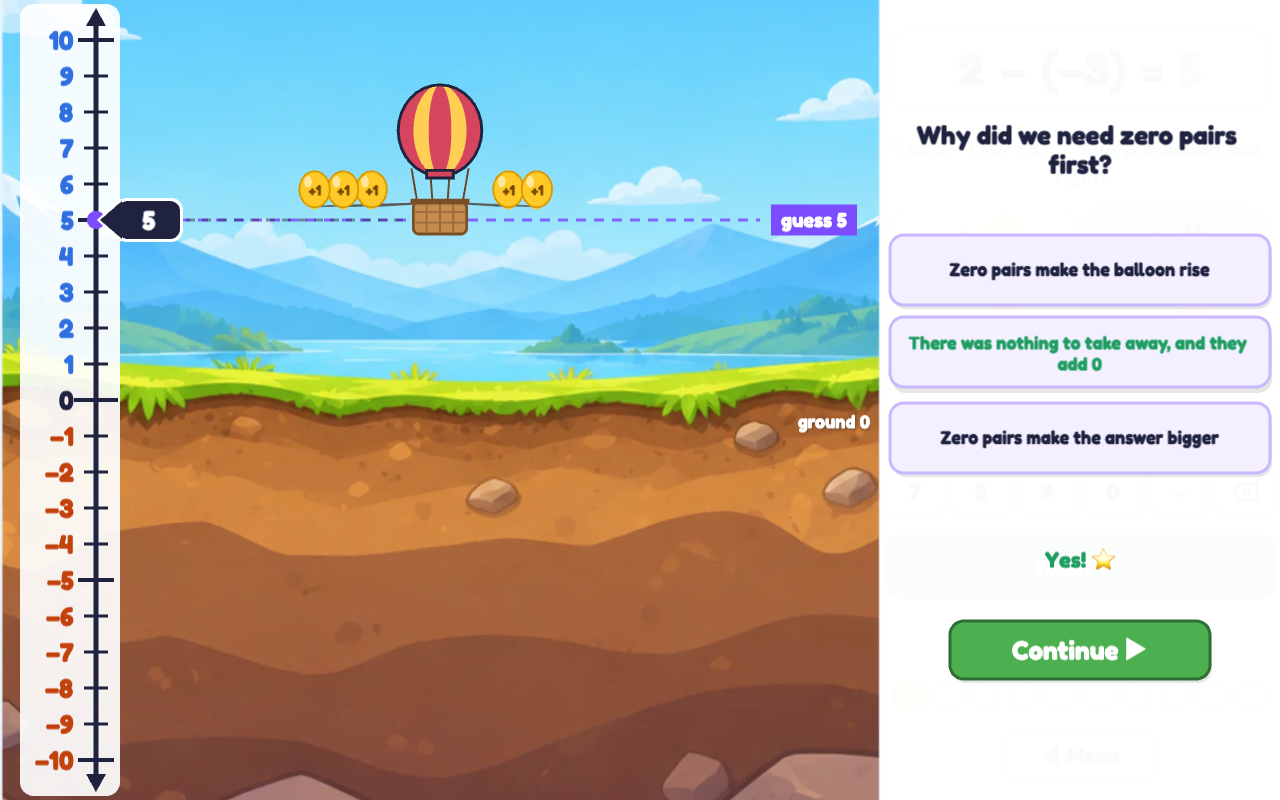
Before anything moves, students predict: they tap the number line where they think the balloon will land. Then they act out the expression with the balloon and weight buttons, or just type the answer. A right prediction earns a star.
After key rounds, a quick question checks the idea, not just the answer, like Why did we need zero pairs first?
3. Same Answer
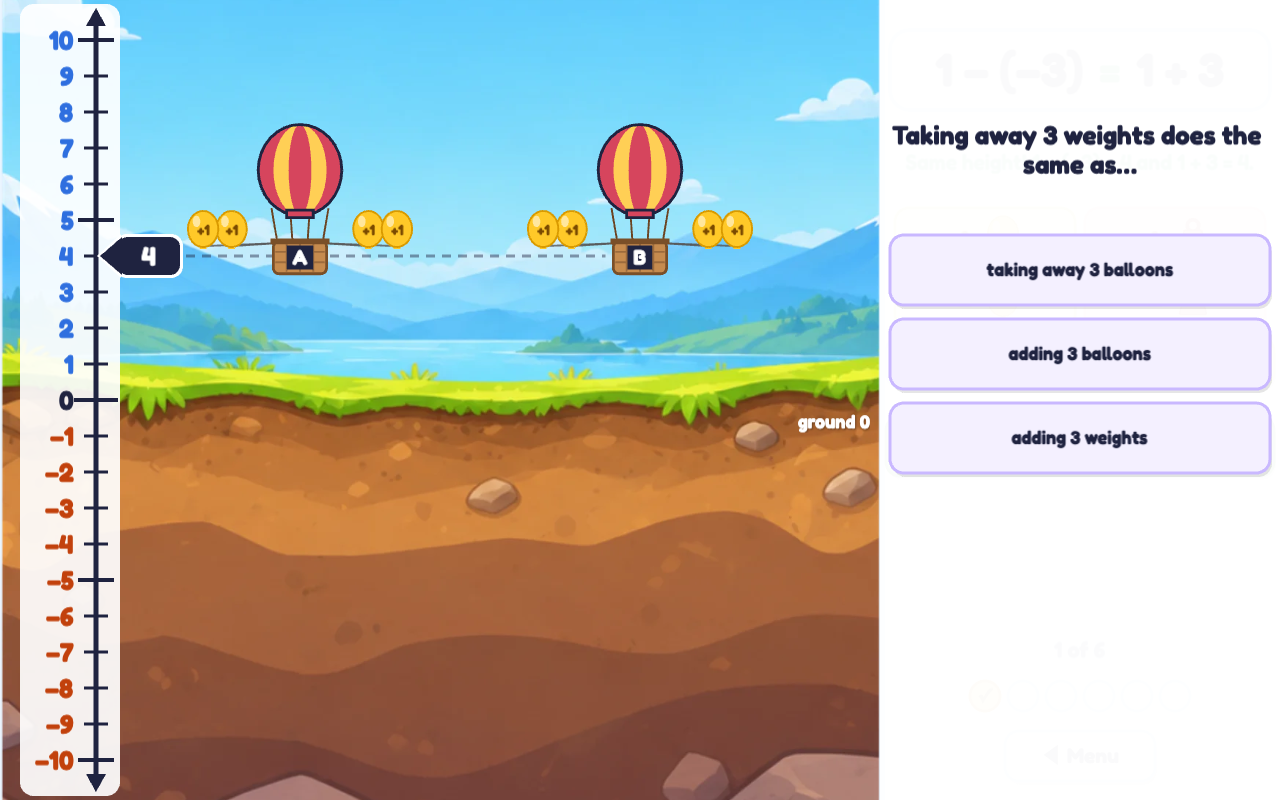
Two balloons side by side. Students act out 1 − (−3) on one and 1 + 3 on the other, and watch them land at the same height. Then they finish the sentence: Taking away 3 weights does the same as… adding 3 balloons. This is where "subtracting a negative is adding the opposite" comes from, and students find it themselves.
4. Many Ways
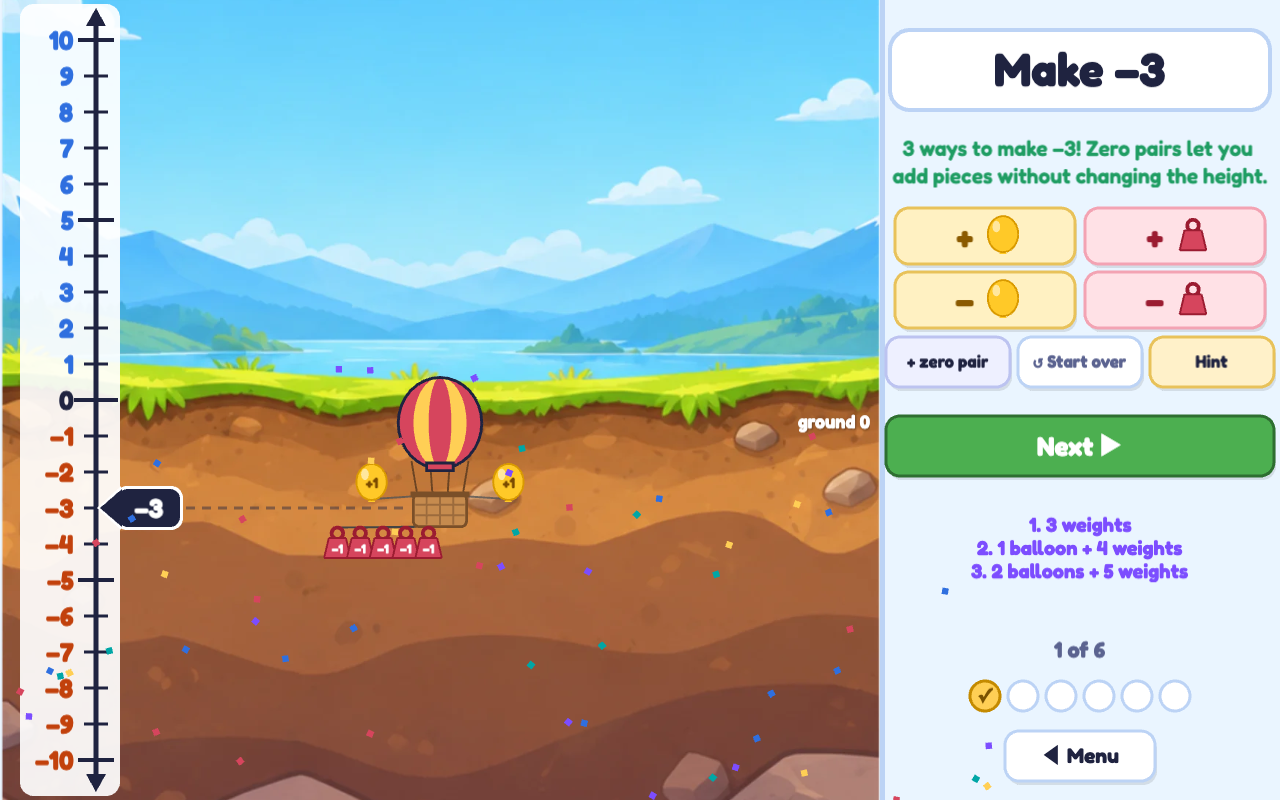
Make −3 three different ways: 3 weights, or 1 balloon and 4 weights, or 2 balloons and 5 weights. Then keep a height while adding extra pieces: "Stay at −1, but with exactly 3 balloons on it." Both build a real understanding of zero pairs.
5. No Balloons
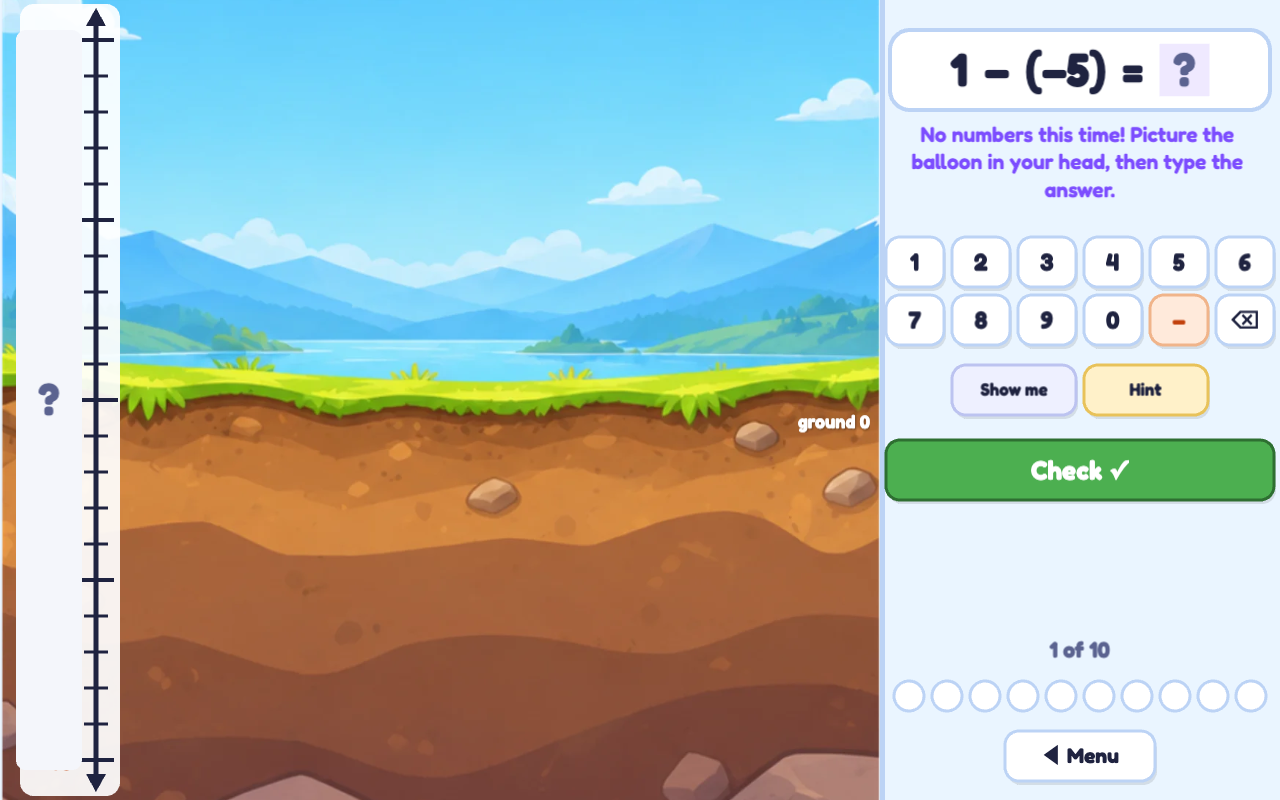
The balloon disappears. First students solve with the number line only, then with no numbers on it at all, just the ticks. After each answer the balloon appears and checks it. It's the step from the model to mental math.
6. How Far?
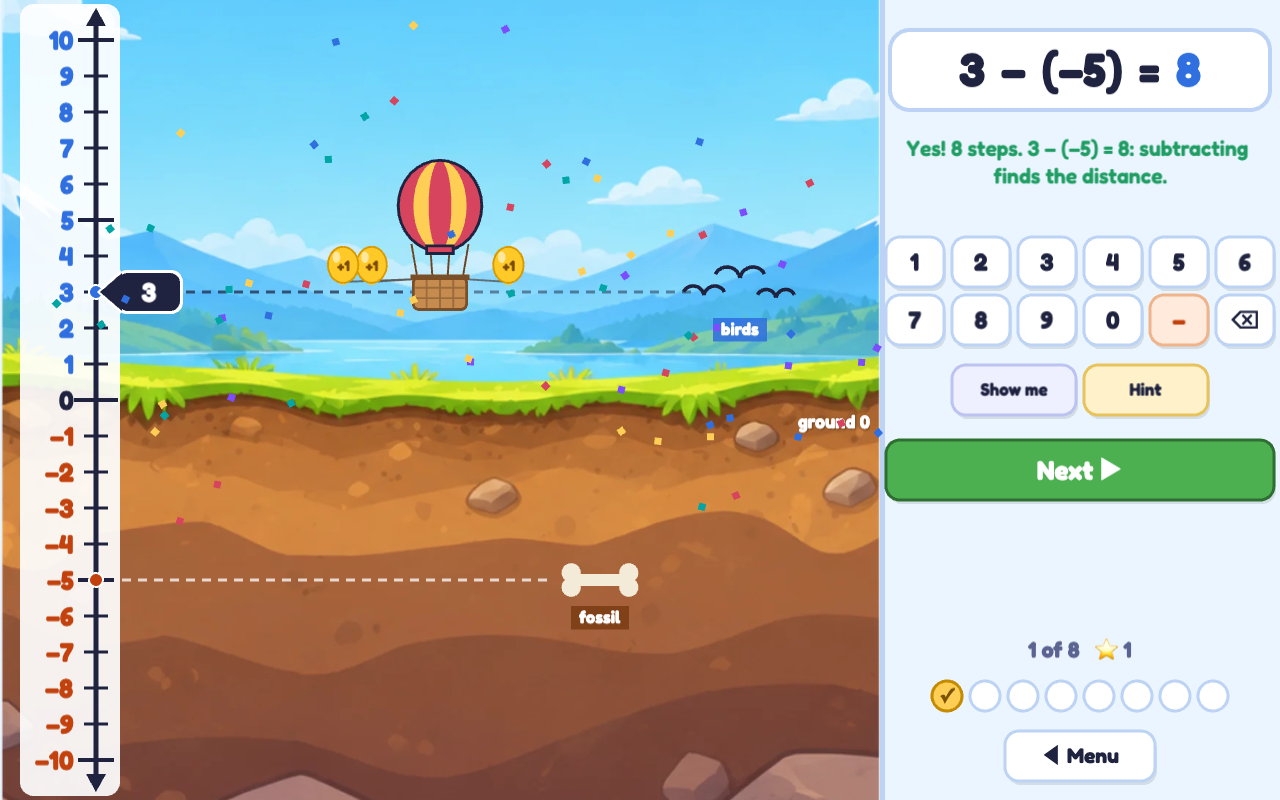
How far are the birds above the fossil? Students count the steps, including across zero, and the game shows the subtraction: 3 − (−5) = 8. Subtraction as distance is the second big idea of integer subtraction, and it makes "minus a negative" make sense a second way.
7. Reach the Cloud
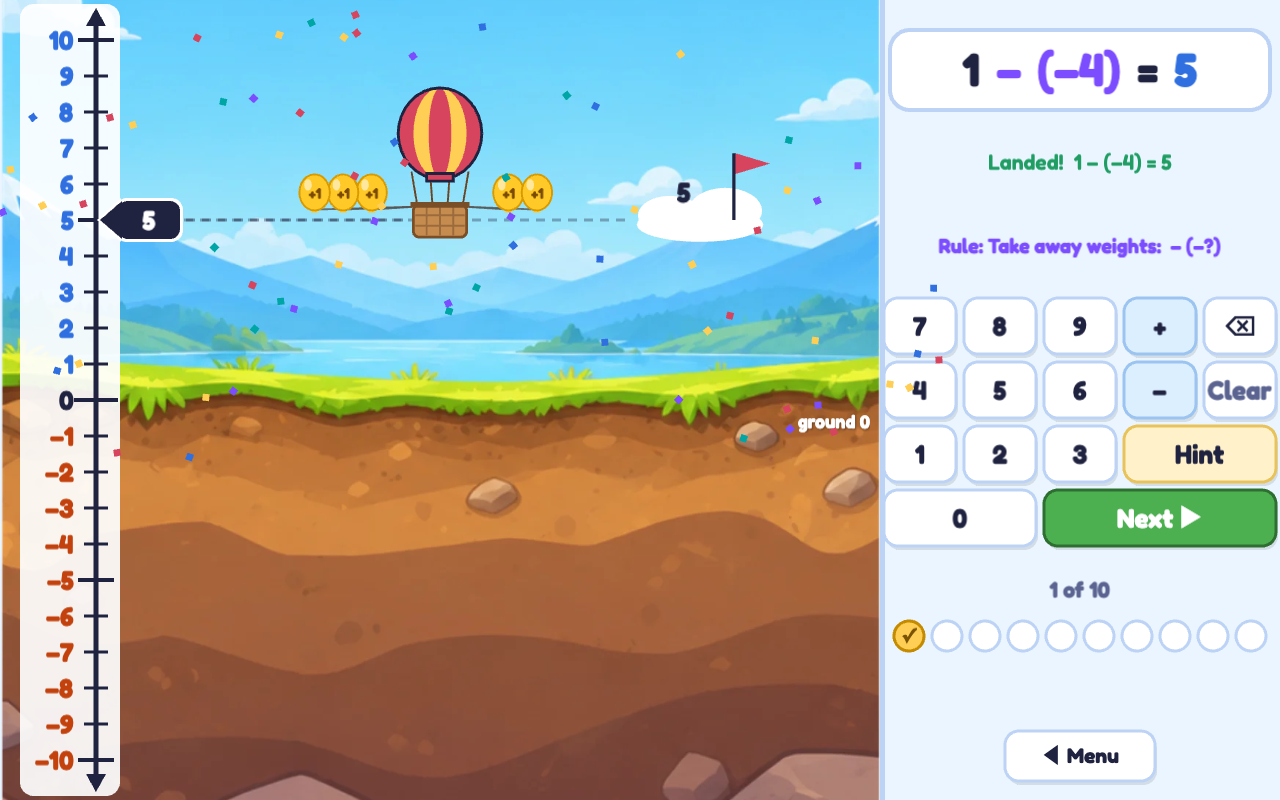
The balloon starts at one height and a cloud (or a rock ledge underground) waits at another. Students write the expression that lands it there, sometimes with a rule like "take away weights". There's more than one right answer.
Teaching tips
- Model Free Flight first. On the board, add a few balloons and weights, then ask "What happens if I take a weight away?" before you press the button.
- Always predict out loud. "It'll sink, because we're adding weights." Predictions are where the thinking happens.
- Write the rule after Same Answer. Ask students to write, in their own words, why 1 − (−3) and 1 + 3 are the same.
- Use No Balloons as an exit ticket. Can students solve without the model? If not, the balloon is one click away.
- Connect to the real world. Temperatures, elevations and money all go up and down the same way.
Get Integer Heights
Give students a picture of integer addition and subtraction they won't forget: take away a weight, and the balloon rises.
Get Integer Heights on Teachers Pay Teachers
More integer activities from Math Curious
- Introducing, adding, subtracting, multiplying and dividing integers: ideas, games and task cards for the whole integers unit