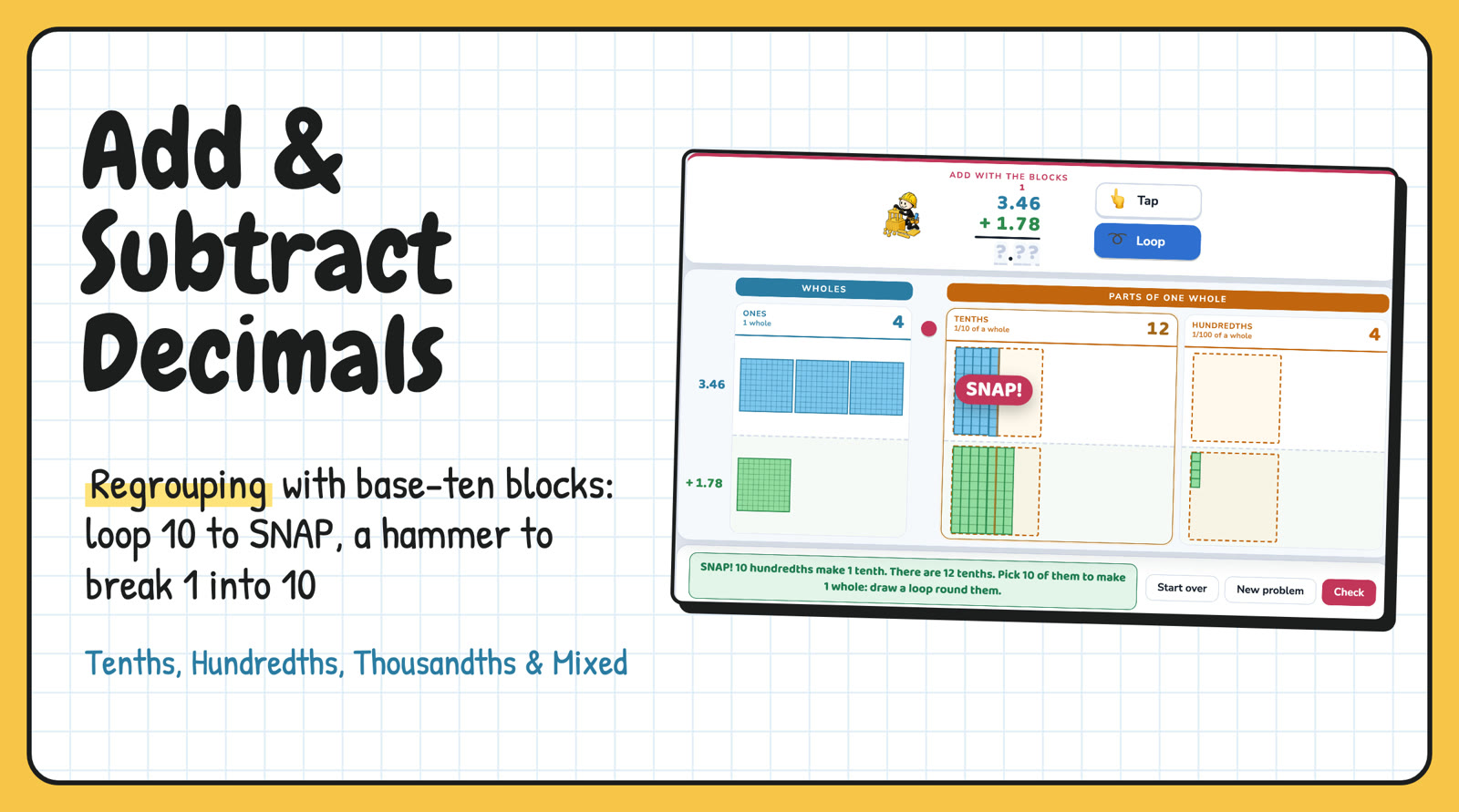
Adding and Subtracting Decimals with Base-Ten Blocks: Add & Subtract Decimals
Add & Subtract Decimals is a digital base-ten blocks tool that helps TO visualize the concept. Students add and subtract with blocks, and do every regroup themselves. They loop 10 tenths and watch them SNAP into a whole, or grab a hammer and break a whole into 10 tenths.
It covers tenths, hundredths and thousandths, plus a Mixed version for the 3.4 + 1.27 problems that trip students up. Every regroup is written above the problem as it happens, so the blocks and the written method match step by step.
Watch it in action
The tool runs in any web browser. There's nothing to print, cut or laminate, and students don't need logins.
Each number on its own whole
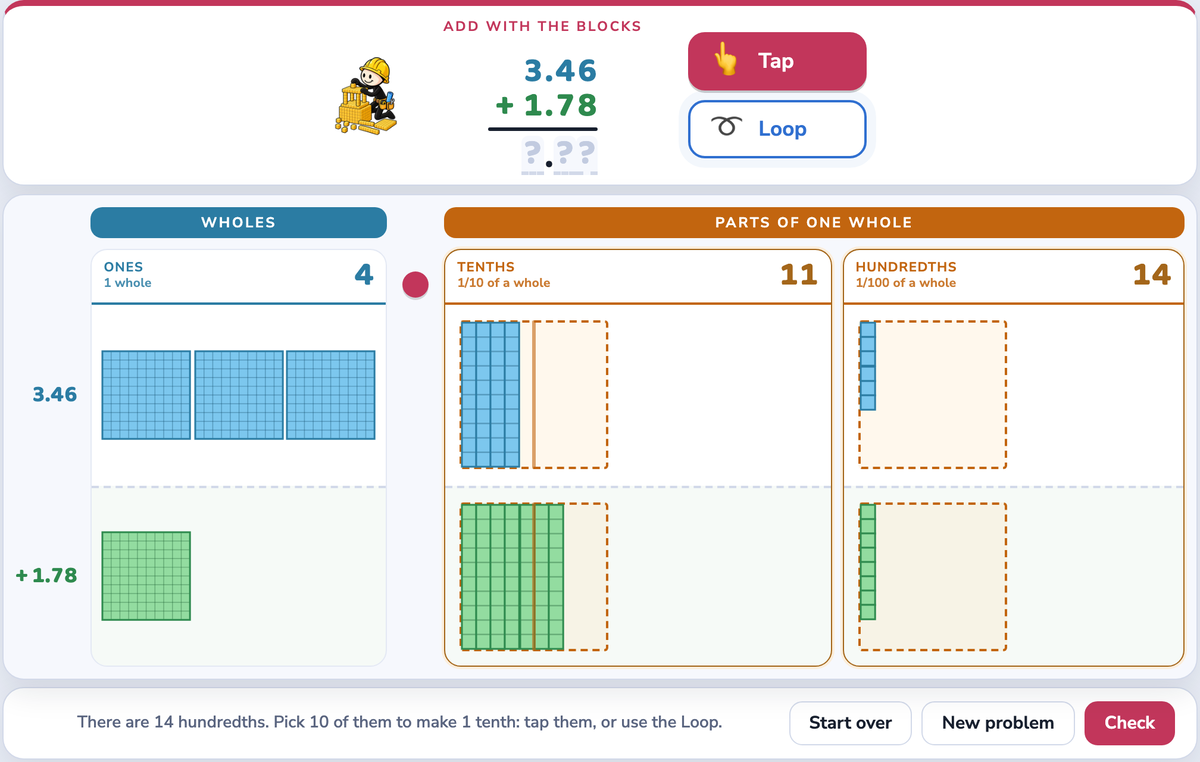
Both numbers are laid out in base-ten blocks, one row each, lined up in place-value columns:
- The first number is blue and the second is green, so students can always see where each piece came from.
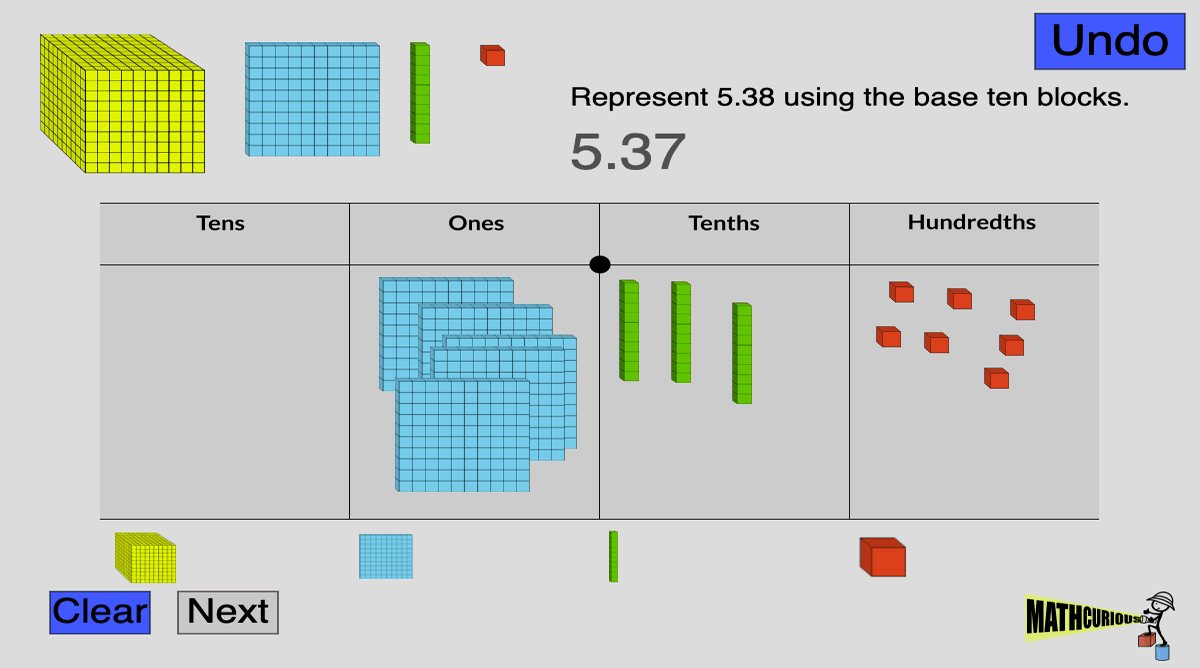
- Wholes sit on the left and parts of one whole on the right, past the decimal point.
- Each number's tenths and hundredths sit on a dashed outline of one whole. Students see straight away that 0.4 is 4 of the 10 strips of a whole, and that 10 hundredths fill exactly one strip.
- The written problem sits above the mat, with one answer box per place, so the decimal point is always lined up.
Adding: loop 10 and SNAP
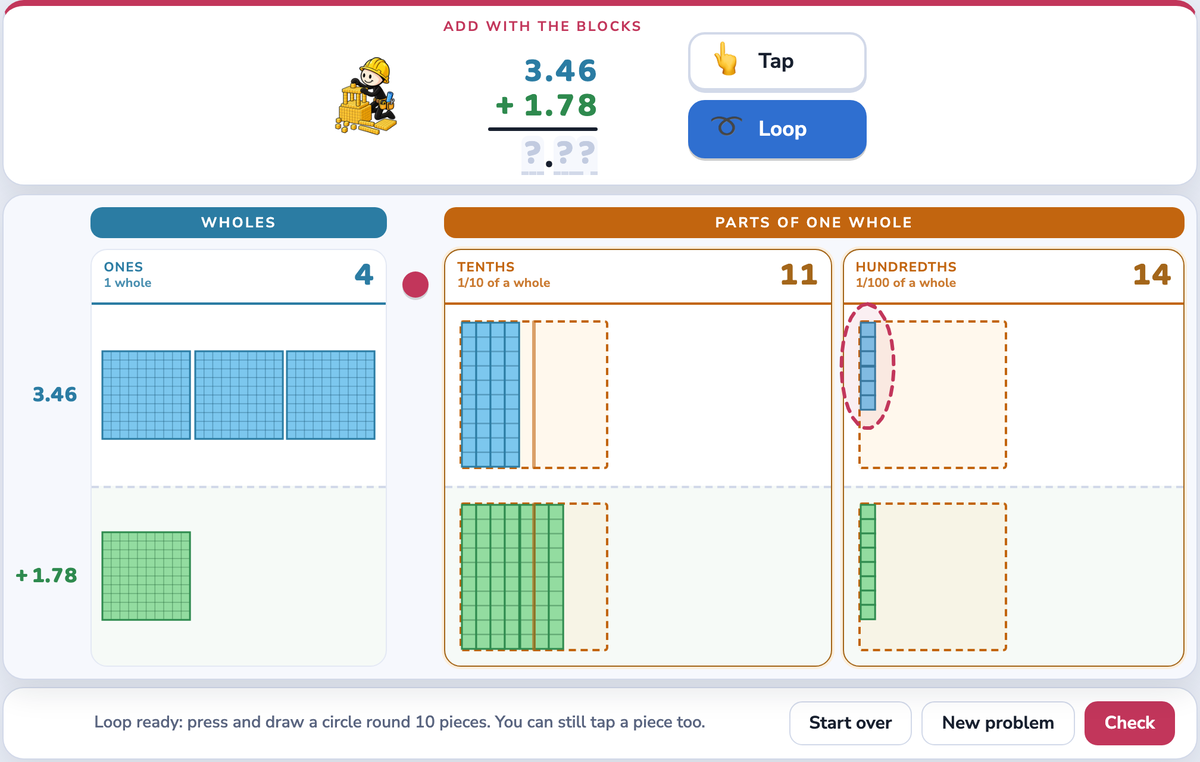
3.46 + 1.78 has 14 hundredths. That's more than a tenth's worth, so students make a tenth themselves:
- Tap pieces one at a time, or choose Loop and draw a circle round a group. They can pick from both numbers, like 6 blue and 4 green.
- As soon as exactly 10 are picked, they fly together and SNAP into one tenth. The new tenth lands in the first number's row.
- A small carried 1 appears above the tenths in the written problem, at the moment it happens.
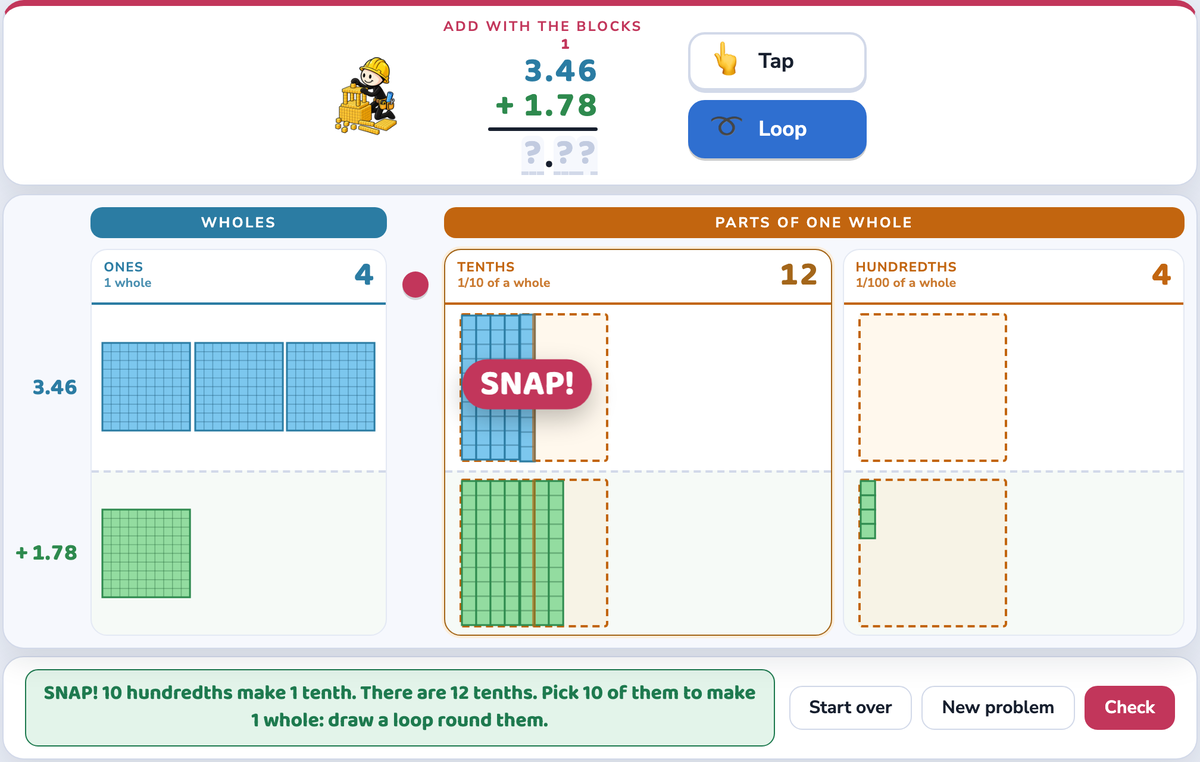
Then the same again for the tenths: 12 tenths, loop 10, SNAP, one more whole. The message bar tells students what to do next ("There are 12 tenths. Pick 10 of them to make 1 whole"), and the Loop button glows when there's grouping to do.
Subtracting: grab the hammer
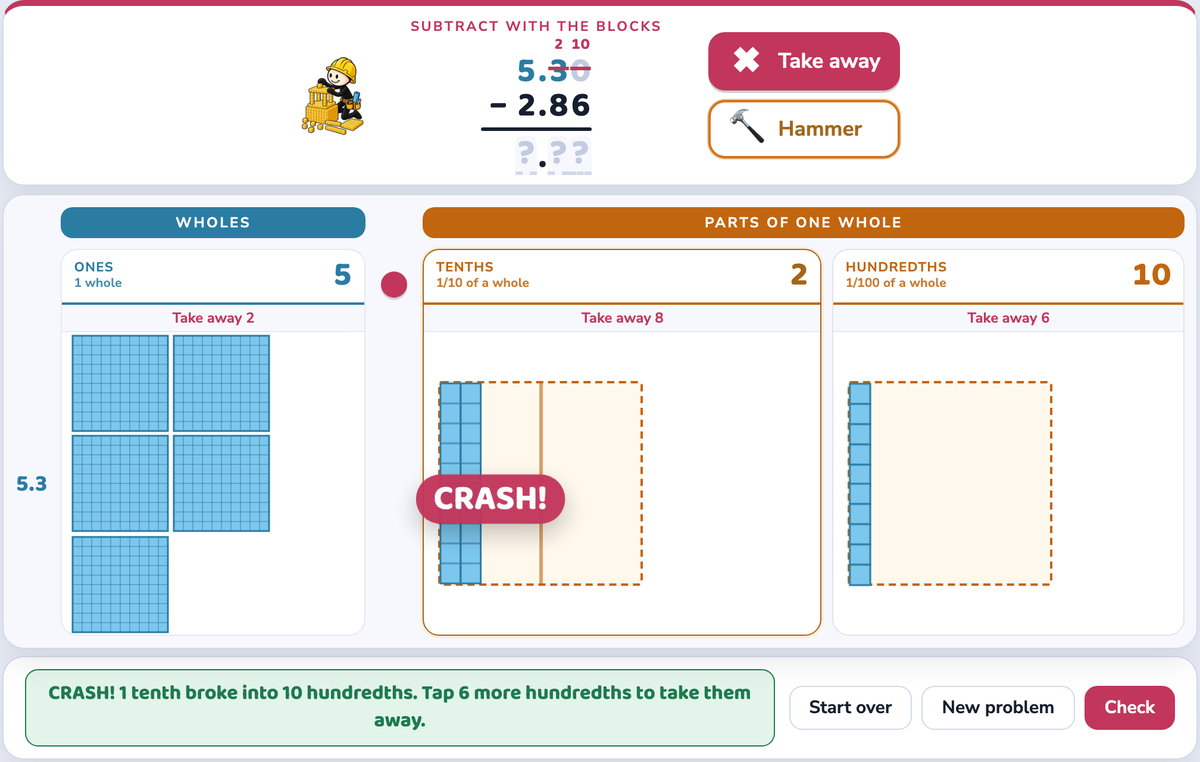
In subtraction only the first number is on the mat. Students tap pieces to cross them out. When there aren't enough, like 6 hundredths to take from 5.30, the Hammer glows:
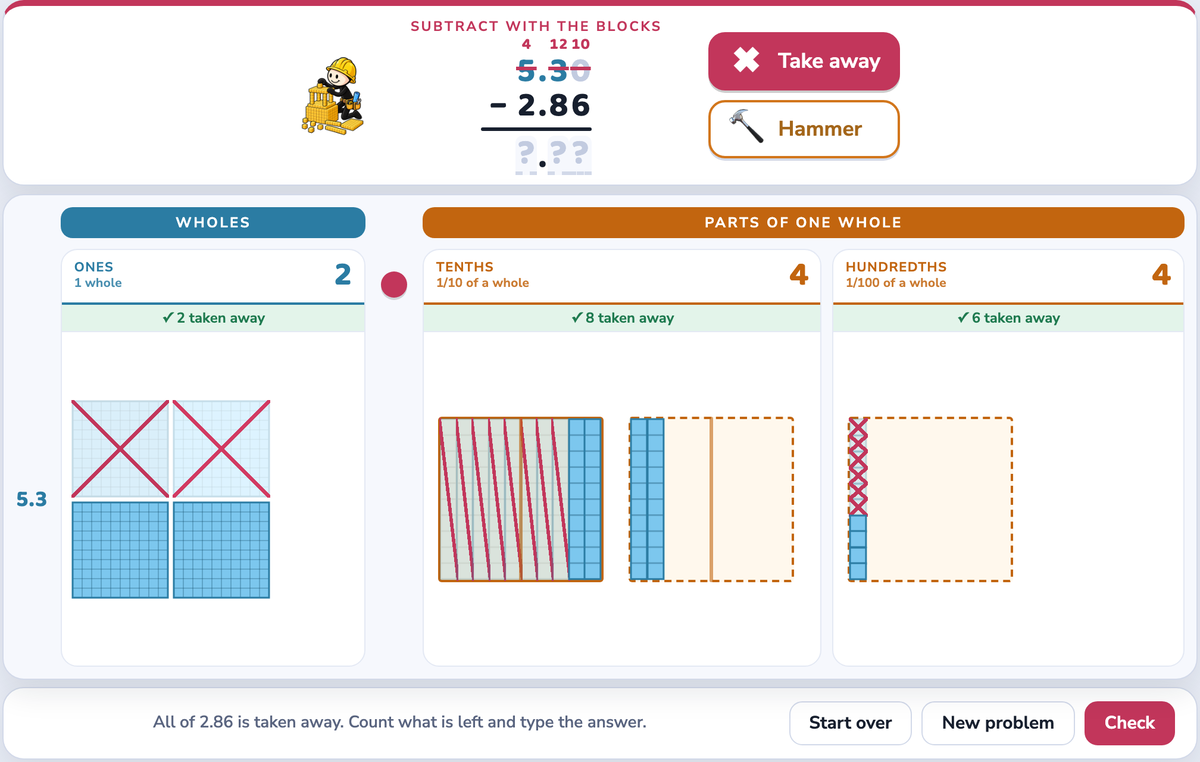
- Tap a whole or a tenth with the hammer: CRASH! It breaks into 10 of the next place.
- The regrouping is written above the problem: the 3 is crossed out with a 2 over it, and the 0 becomes 10.
- If there's nothing next door to break (4 − 1.35 has no tenths), the hint says to break a whole first.
Check, then see it four ways
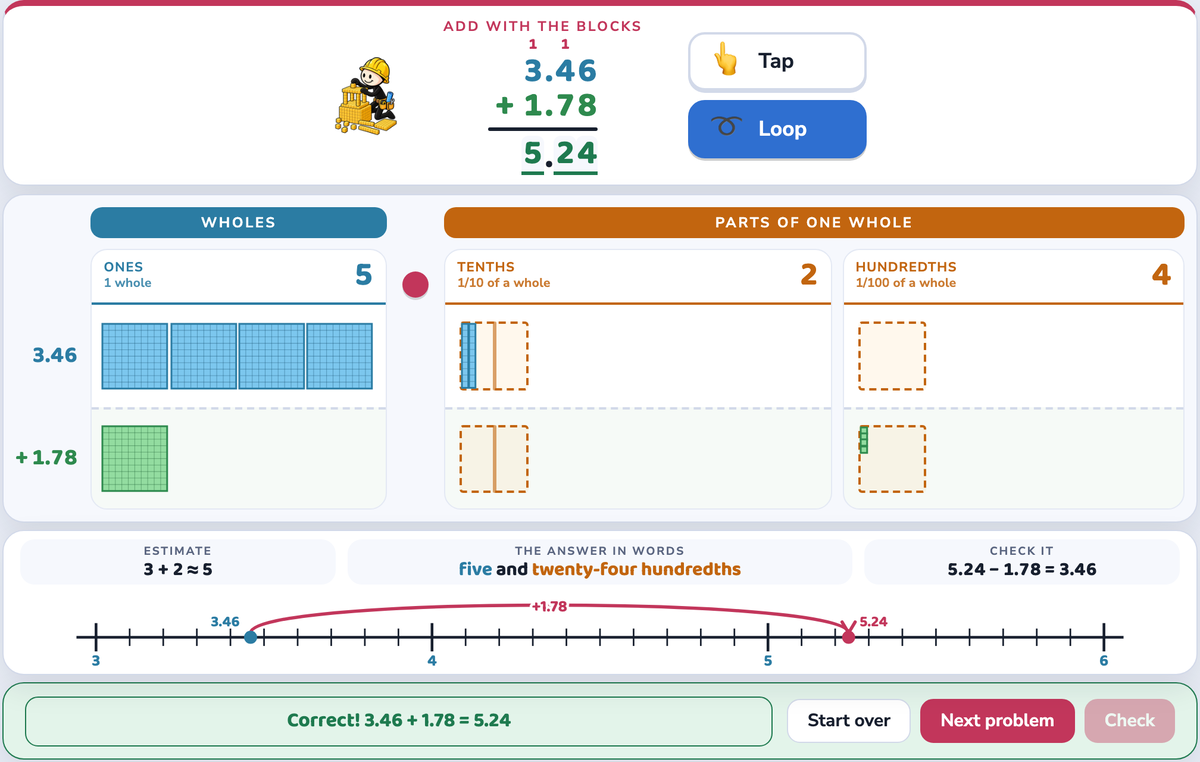
Students count what's on the mat, type the answer and press Check. A correct answer shows:
- An estimate: 3 + 2 is about 5, so 5.24 makes sense
- The answer in words: five and twenty-four hundredths
- A check with the opposite operation: 5.24 − 1.78 = 3.46
- The jump on a number line from the first number to the answer
Four versions
- Tenths: like 4.7 + 2.5
- Hundredths: like 3.46 + 1.78
- Thousandths: like 2.458 + 1.375. Here the big cube is one whole, so a flat is a tenth, a rod a hundredth and a small cube a thousandth.
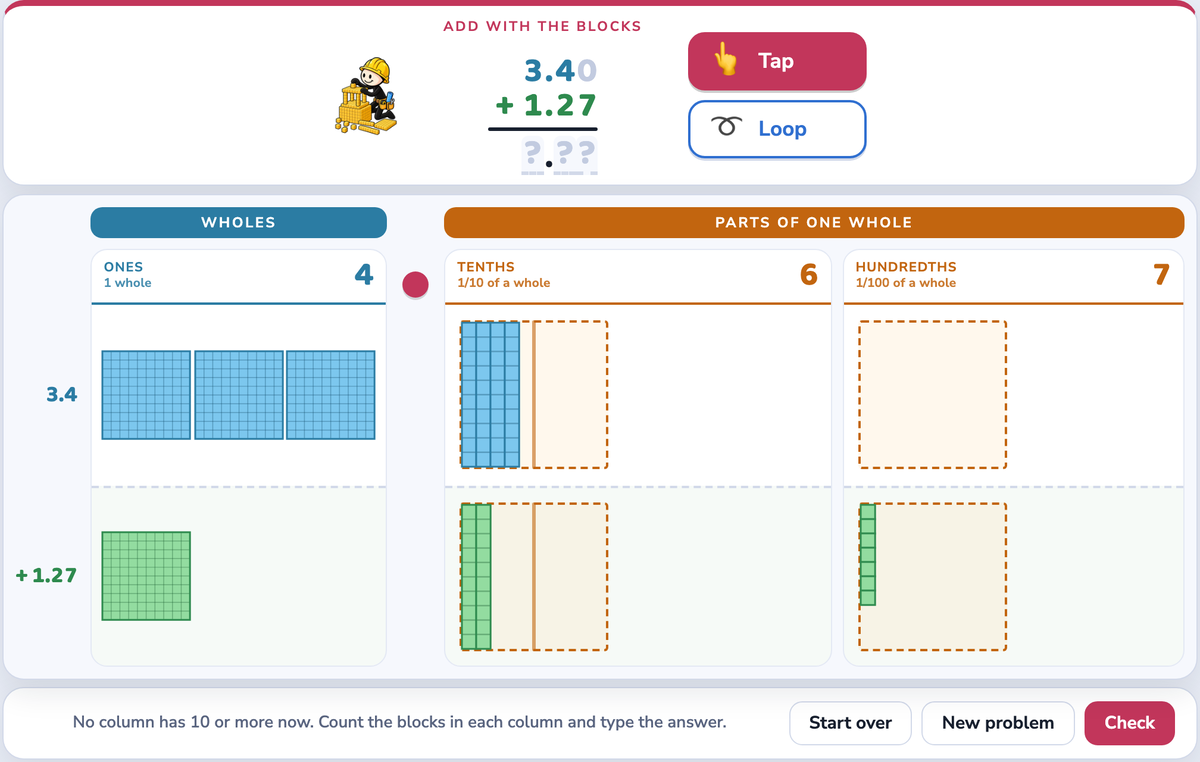
- Mixed: a tenths number with a hundredths number, like 3.4 + 1.27 or 5 − 2.86. The missing places show as pale zeros, so 3.4 lines up as 3.40.
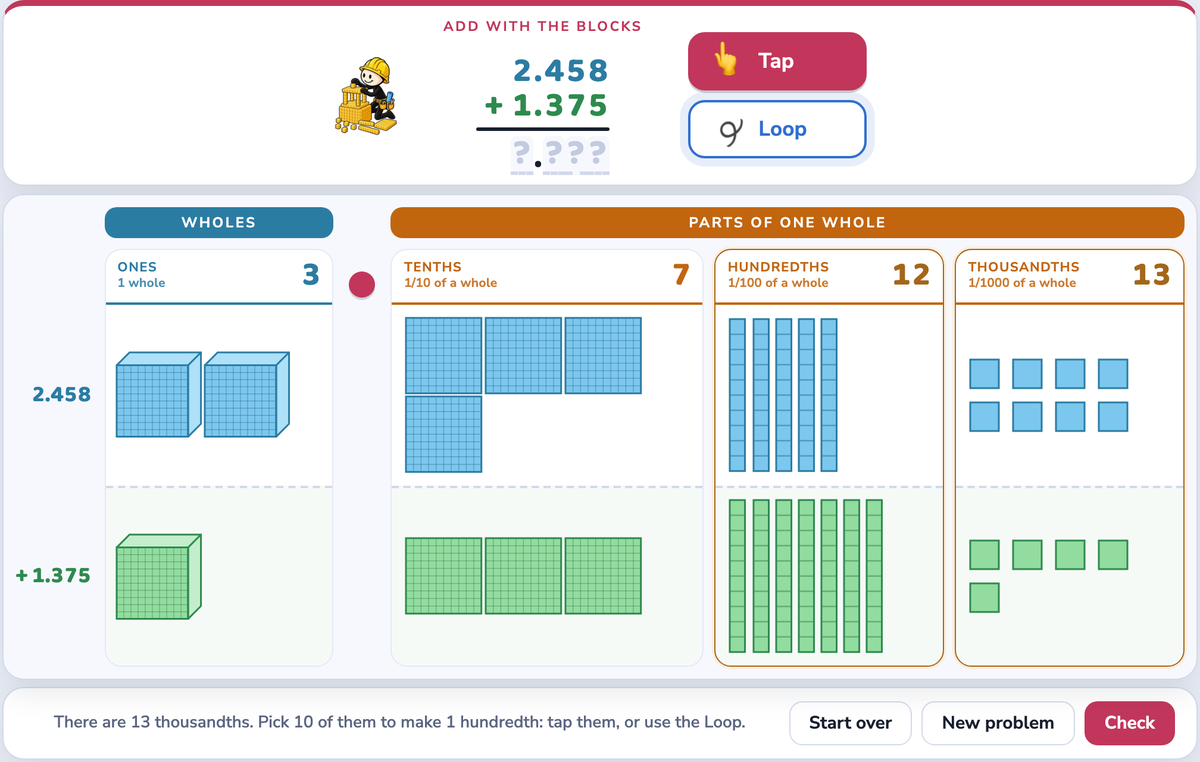
Every version has Add and Subtract, and most problems need regrouping. Teachers can also type their own problem, which is handy for modelling a question from the textbook on the board.
What students practise
- Adding and subtracting decimals to tenths, hundredths and thousandths
- Regrouping: 10 hundredths = 1 tenth, 10 tenths = 1 whole, and back again
- Lining up the decimal point and using zeros as placeholders
- Connecting models to the written method, step by step
- Estimating and checking with the opposite operation
Teaching tips
- Ask before regrouping. "How many tenths are there altogether? Is that more than a whole?"
- Go right to left. Hundredths first, then tenths, just like the written method.
- Point at the pale zero. In Mixed, why can we write 3.4 as 3.40, and why does it help us line up?
- Compare with the estimate. Is 5.24 close to 3 + 2? If the answer were 1.61, the estimate would catch it.
- Model, then hand over. Show the Loop on the board, then let students use Tap on their own devices.
Standards
- 5.NBT.B.7: add and subtract decimals to hundredths, using concrete models and place value strategies
- 5.NBT.A.1: each place is 10 times the place to its right
- 5.NBT.A.3: read, write and compare decimals to thousandths
- 4.NF.C.5: tenths and hundredths, and adding fractions with denominators 10 and 100
- 6.NS.B.3: fluently add and subtract multi-digit decimals
Quick answers
Do students need accounts? No. It's a link, so there's nothing to sign in to.
What devices does it work on? Any device with a web browser, including Chromebooks, tablets and the classroom board.
Does it make sounds? Yes: a snap, a crash and a cheer for a right answer. The speaker button mutes them.
Can I set my own problems? Yes. Press "Your own problem" and type any two numbers up to three decimal places.
Get Add & Subtract Decimals
Let students make every whole and break every tenth with their own hands, and lining up the decimal point stops being a rule to memorise.
Get Add & Subtract Decimals on Teachers Pay Teachers
More from Math Curious
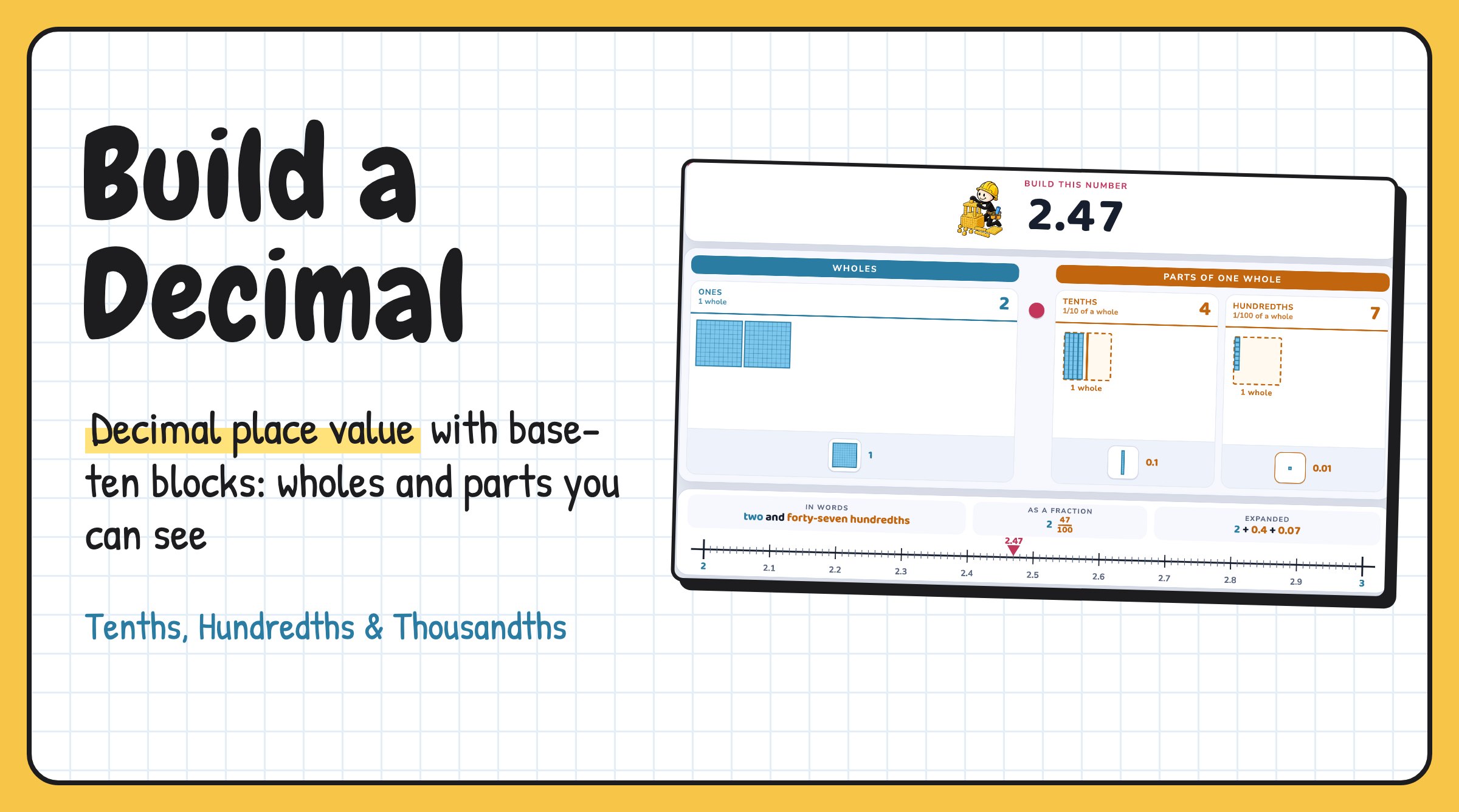
- Build a Decimal: decimal place value with base-ten blocks
- Addition Build: snap 10 ones into a ten
- Subtraction Smash: smash a ten into 10 ones